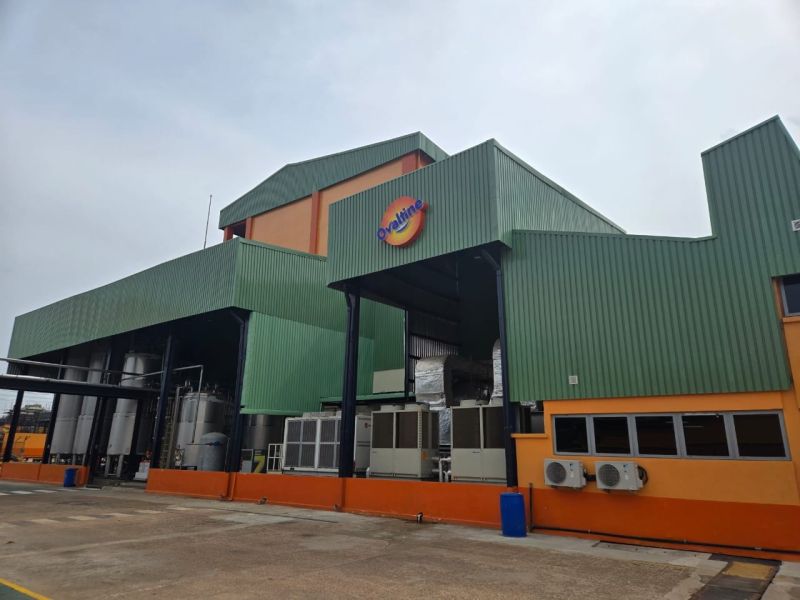

Twinings Ovaltine opened its £24 million Lagos manufacturing facility in March 2026, marking the first time the brand has produced anywhere on the African continent. The factory, located in Ogba and operated by Twinings Ovaltine Nigeria Limited, was timed to President Bola Tinubu’s state visit to the UK and announced as the flagship commercial commitment of the UK-Nigeria Enhanced Trade and Investment Partnership. Two months on, the diplomatic pageantry has faded. What remains is a competitive problem Twinings Ovaltine has to solve with a factory, not a press release.
The problem is structural. Milo and Bournvita have been manufactured in Nigeria for decades: Nestlé from its Ogun State plant since the early 1980s, Cadbury Nigeria from Lagos since 1965. Ovaltine has been the imported outlier in a category where local production is table stakes. According to Business Day’s December 2024 market data, Milo holds roughly 42% of Nigeria’s cocoa beverage category, Bournvita approximately 11%, leaving around 37% split between Ovaltine and smaller competitors. Ovaltine is number three in a three-horse race, carrying a price premium that market research has consistently found Nigerian consumers do not reward it for.
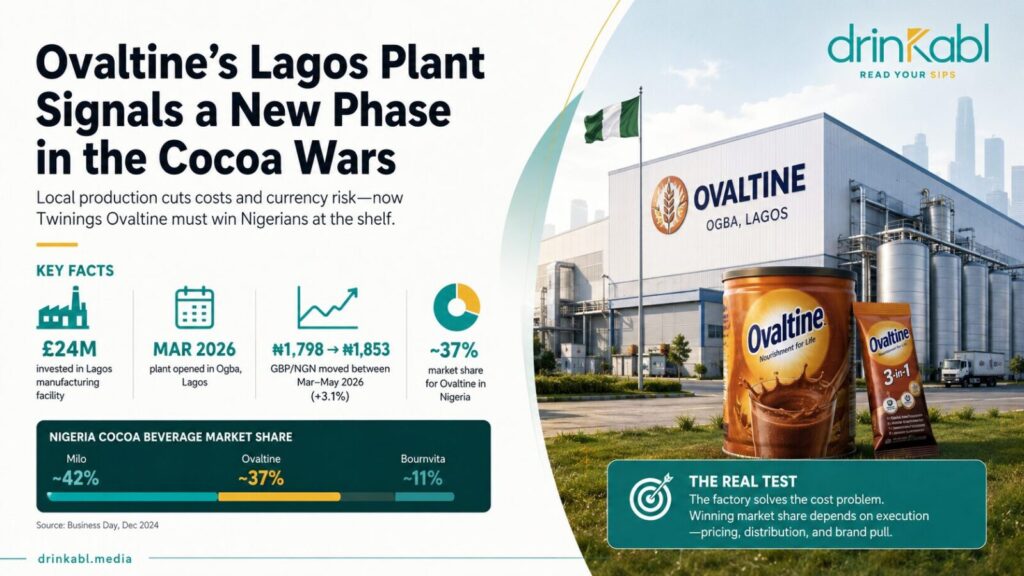
The Lagos plant changes one variable: landed cost. By producing locally, Twinings Ovaltine eliminates the import freight margin and removes its direct exposure to naira-sterling volatility on the cost of goods sold. That matters more now than it did in March. On the day the factory was announced, the pound traded at approximately ₦1,798, the 12-month low for sterling per NFEM data. By mid-May 2026, that rate had moved to approximately ₦1,853, according to Xe mid-market data. A company still importing finished products would have absorbed that shift in margins. A company manufacturing locally in naira insulates itself from exactly that exposure.
Trendtype, the emerging markets consultancy, noted at the time of the announcement that the Ogba facility positions Twinings Ovaltine to “compete more effectively” with Bournvita and Milo, both already manufactured in Nigeria. Local production does not hand Ovaltine market share. It gives the company the cost structure to price competitively and the supply chain speed to respond to demand shifts without waiting on import cycles. Whether it uses that structural advantage depends on decisions that have nothing to do with the factory- trade spend, distribution depth, sachet pack strategy, and how hard it pushes into northern Nigeria, where cocoa beverage consumption is significant and underpenetrated by premium brands.
The West Africa export rationale, prominently cited in the UK government’s announcement, deserves scrutiny. The facility is expected to serve as a regional hub boosting exports across West Africa, as cited the UK’s Department of Business and Trade. But Milo is manufactured in Ghana. Bournvita is distributed across Anglophone West Africa with deep retail penetration. Nigeria as a production base for the region is a credible long-term proposition given its scale and logistics infrastructure. Whether it generates meaningful export volume within any foreseeable commercial horizon is a different question.

What Twinings Ovaltine has done is make a commitment that is hard to walk back and expensive to have gotten wrong. As Drinkabl.media’s coverage of the sector noted in February, Nigeria’s beverage industry enters 2026 cautiously, recovering from ₦364.8 billion in combined industry losses across 2023 and 2024. Consumer wallets remain tight. The category leader spent decades building the brand recall that makes a child point at Milo in a shop. Ovaltine’s Lagos plant is, at best, the beginning of that work.
Read More: