
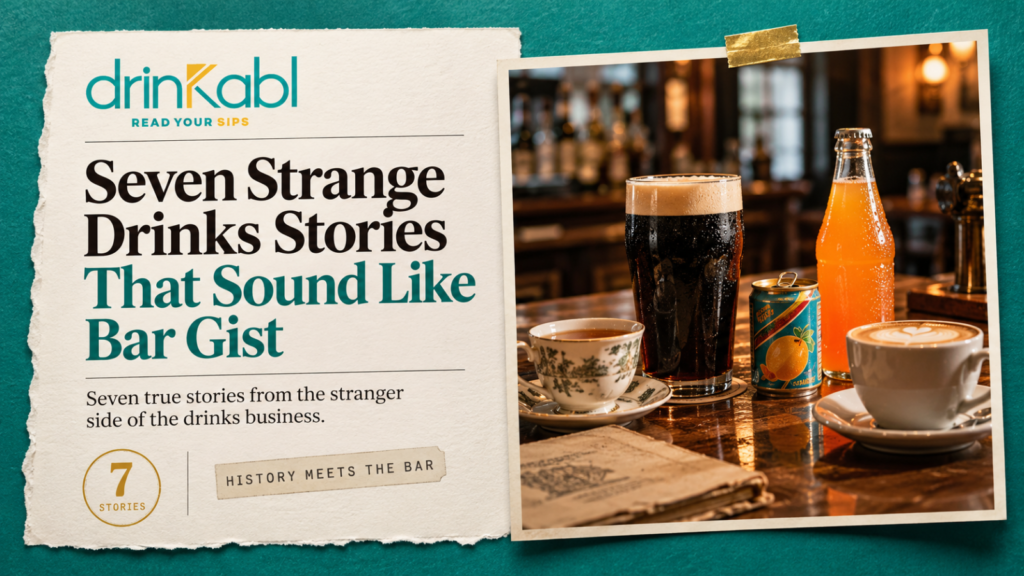
A billionaire loses an argument with a pint of Guinness, a tea smuggler worries about wrapping paper, and Mountain Dew sells nostalgia for five cents. Every word is true, which is the worrying part.
Some stories sound like something a man exaggerated at the joint after his third bottle. Nobody believes him until somebody checks, and then everybody goes quiet. The drinks business keeps producing them. A coffee shop gives birth to a global insurance market. A soft-drink company survives a world war by inventing a completely different drink. A burger chain gives vampires a straw.
Here are seven of them, all checked, all real, and each with a lesson for anyone who sells drinks for a living.
1. Mark Zuckerberg Meets Guinness and His Face Does the Talking
October 2026 | Ireland
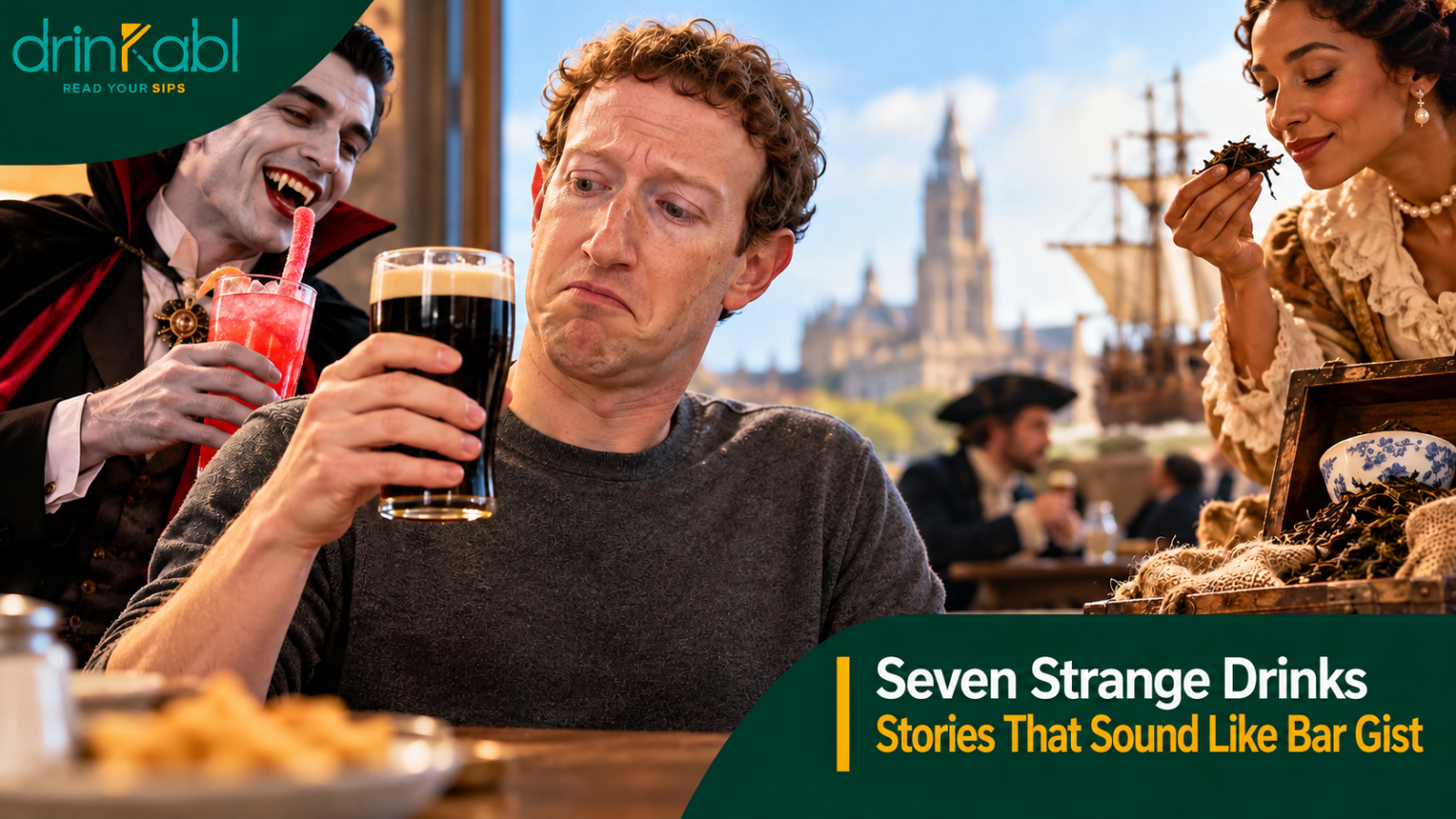
Being one of the richest technology executives alive does not guarantee that you will enjoy what is put in front of you. On the October 2026 episode of Irish entrepreneur John Collison’s Cheeky Pint podcast, Meta chief executive Mark Zuckerberg was filmed trying Guinness, and the internet immediately formed a committee to study his expressions. According to The Guardian, he appeared to struggle with the taste and took only part of the pint during the conversation.
Guinness is one of Ireland’s best-known exports, and Zuckerberg, who had recently bought a castle in Ireland, was meeting it for the first time on camera. Nigerians, who have a loyal relationship with the stout, will find this hard to watch. In many a Lagos bar, a pint that size is not a test. It is a Friday.
The industry takeaway: Consumers do not read the brand script. A celebrity can promise attention, but an unplanned grimace can travel further than any planned advert, and the brand has no say in which one wins.
2. Burger King Has a Drink for Vampires
October 2026 | United States
The beverage industry has made drinks for athletes, children, coffee lovers and people who want their soda to also do something useful for the body. Burger King has now thought about vampires. Its Halloween-themed Vampire’s Bite Strawberry & Sprite combines Sprite with an edible Sour Punch gummy straw and a specially decorated cup.
Nobody needs a vampire straw to drink Sprite, in the same way nobody needs matching asoebi to attend a wedding. Yet people want both, because the straw and the fabric are really tickets into the occasion. Halloween is no big deal in most Nigerian cities, but any marketer who has watched brands fight for attention in Detty December will see the lesson immediately.
The industry takeaway: Limited-edition drinks now compete on entertainment and shareability as much as taste. The hard part is turning a week of curiosity into profitable sales without making every launch feel like a stunt.
3. Eighteenth-Century Britain Had Tea Smugglers With Standards
The 1700s | Britain
Today a beverage company might complain about import duties, distribution costs and the price of raw materials. In eighteenth-century Britain, the tea trade had a more adventurous headache. Tea became hugely popular during the 1700s, but high import taxes made the legal version expensive, so smugglers stepped in to supply anyone who wanted a cup without the official price. Some ran organised networks. Others moved smaller loads through local communities.
A letter from 1758, kept by the Tain and District Museum in Scotland, shows how seriously the business was run. Lady Naomi Ross gave instructions for tea to be wrapped carefully, moved by particular routes and kept away from customs officers. Her worry about the wrapping was that the paper might spoil the flavour. This was a smuggler with quality control.
Anyone who follows the stories of goods crossing West African borders will recognise the plot: when the official price is painful, an unofficial market grows. Britain eventually cooled the trade down. In 1784, Prime Minister William Pitt the Younger cut the tea tax, which removed much of the reason for smuggling on a large scale, as the London Museum explains in its history of tea drinking.
The industry takeaway: Tax policy can reshape a whole supply chain. When the legal product costs far more than the alternative, a government may end up funding a black market instead of collecting revenue.
4. A Coffee Shop Became the Home of a Global Insurance Market
Late seventeenth century | London
In Lagos, serious deals happen in hotel lobbies, beer parlours and under canopies at owambe. In seventeenth-century London, a lot of serious deals happened in Edward Lloyd’s coffee house. His customers were shipowners, merchants and captains who needed news about ships, cargoes, foreign ports and the dangers of the sea. Lloyd understood that information had commercial value, and his shop became a place where people traded it.
Over time, that coffee house became linked to the market now known as Lloyd’s of London, today a major specialist insurance marketplace. The coffee was not the insurance product. But it gathered the right people in one room, and the business grew out of what they said to each other. Somebody sold a cup of coffee and ended up with a seat at the table of global finance.
The industry takeaway: Bars, cafes, pubs and restaurants can be more than shops. They can be networks and meeting points where entirely new businesses start.
5. London Had a Gin Craze So Bad That Parliament Kept Panicking
Early eighteenth century | London
There was a time when gin was so cheap and so easy to find in London that drinking it in excess became a social crisis. In the first half of the eighteenth century, government policy made domestic gin production attractive, while taxes affected the price of other drinks, including beer. Gin became easy to buy, especially for poorer Londoners, and the results included illness, poverty and public disorder.
Parliament answered with a series of laws, including the controversial Gin Act of 1736. The crisis also produced one of the most famous warnings about alcohol ever drawn, William Hogarth’s Gin Lane, published in 1751, which shows a community wrecked by drink, according to the London Museum. Nigerians will know the territory from their own history with ogogoro, the local spirit that colonial authorities also tried to control.
The odd part is that consumers did not simply wake up one day with a new taste. Government policy, price, supply and commercial incentives all pushed in the same direction, and the nation paid for it.
The industry takeaway: The link between price, tax, availability and public health is not new. Today’s arguments about alcohol rules have precedents that go back centuries.
6. Fanta Exists Because Coca-Cola Ran Out of Concentrate in Wartime Germany
1940 | Germany
Fanta is now linked to orange soda, bright packaging and happy advertising. In Nigeria it is practically a party colour, and many a jollof plate has been washed down with it. Its beginnings were much less cheerful. During the Second World War, Coca-Cola’s German operation could no longer get the concentrate needed to make Coca-Cola because of wartime trade limits. Its managers needed a new drink made from what could be found locally.
The answer, developed in 1940, used ingredients including whey and apple pulp, and was called Fanta. It was not the orange soda people know today, because the modern Fanta Orange formula was developed in the United States in 1955. Any Nigerian factory owner who has kept production going when the usual supply failed will understand the improvising spirit. The difference is that this story ended with a global brand rather than a diesel bill.
The story is often twisted online into a claim that the Nazi regime invented Fanta. The more accurate account, according to Coca-Cola’s own history and its explanation of the drink’s invention, is that Coca-Cola’s German operation developed it under wartime conditions after its usual supply chain broke down.
The industry takeaway: Supply problems can force companies to invent new products and new ways of production. But history needs care, especially when a brand’s origin story becomes part of its identity today.
7. Mountain Dew Sold a Limited-Edition Bundle for Five Cents
June 2026 | United States
Most brands celebrate an anniversary with special packaging, a promotion or a reminder of how long they have existed. Mountain Dew decided to make its offer painfully literal. In June 2026, PepsiCo announced a limited-edition commemorative bundle priced at five US cents, linked to the brand’s 1948 start in Tennessee. It planned 1,948 bundles, each with a commemorative can and a ten-pack of miniature cans, sold through TikTok Shop.
The number was chosen on purpose: 1,948 bundles for a drink born in 1948. In Nigeria, five cents is the sort of price a seller quotes right before the real price arrives, so a shopper here would have asked where the catch was. The catch is the usual one. A limited promotion is not a permanent price, and availability, eligibility and conditions all matter.
Still, the campaign shows how a brand can turn its own history into an event customers join, and a five-cent price makes a headline that a standard anniversary campaign would struggle to earn.
The industry takeaway: Brand heritage works best when people can take part in it. A good anniversary campaign mixes nostalgia, scarcity, social commerce and a price nobody forgets.
The Next Time Somebody Tells You a Story at the Bar
When a man at the joint swears that a billionaire once struggled with a pint of Guinness, ask him for the source. This time there is one, and it comes with six others.