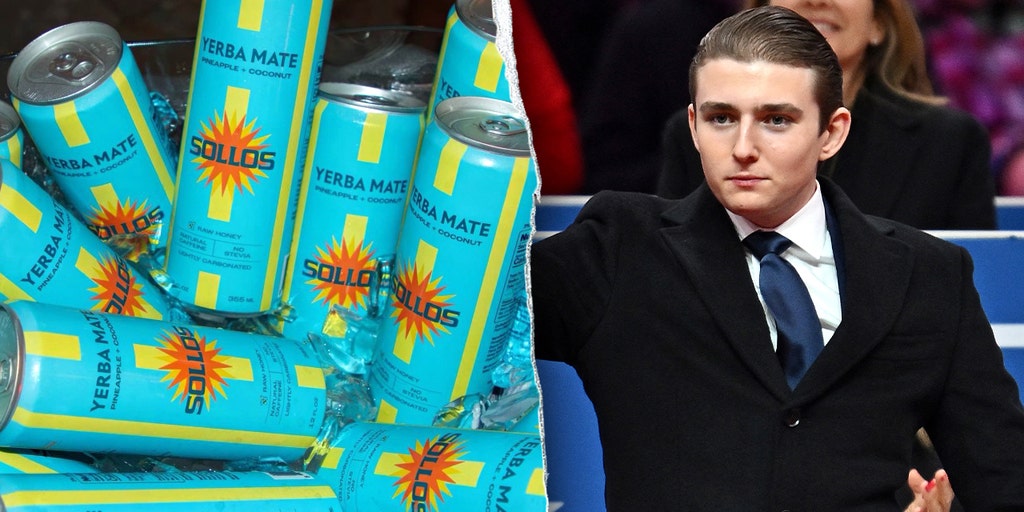

SOLLOS Yerba Mate, the Palm Beach-based beverage startup co-founded by Barron Trump and four partners, has secured early retail visibility with placement in convenience stores and on Amazon shortly after its May 22 product launch, achieving a milestone that many emerging beverage brands spend months trying to reach.
For most startup beverage companies, gaining shelf space is among the most expensive and time-consuming stages of market entry. Retail authorisations, distributor agreements, and inventory commitments can absorb a significant share of a young company’s operating capital long before meaningful sales begin. While SOLLOS has not disclosed specific retail partners, the company has confirmed that its products are available in select South Florida retail locations alongside its Amazon presence.
The speed of that rollout raises questions about the brand’s route-to-market strategy. Industry observers note that early retail availability could reflect either an undisclosed distribution relationship or a targeted placement strategy focused on independent convenience stores and regional outlets rather than a national chain launch. To date, the company has not announced any agreements with major convenience, grocery, or mass-market retail operators.
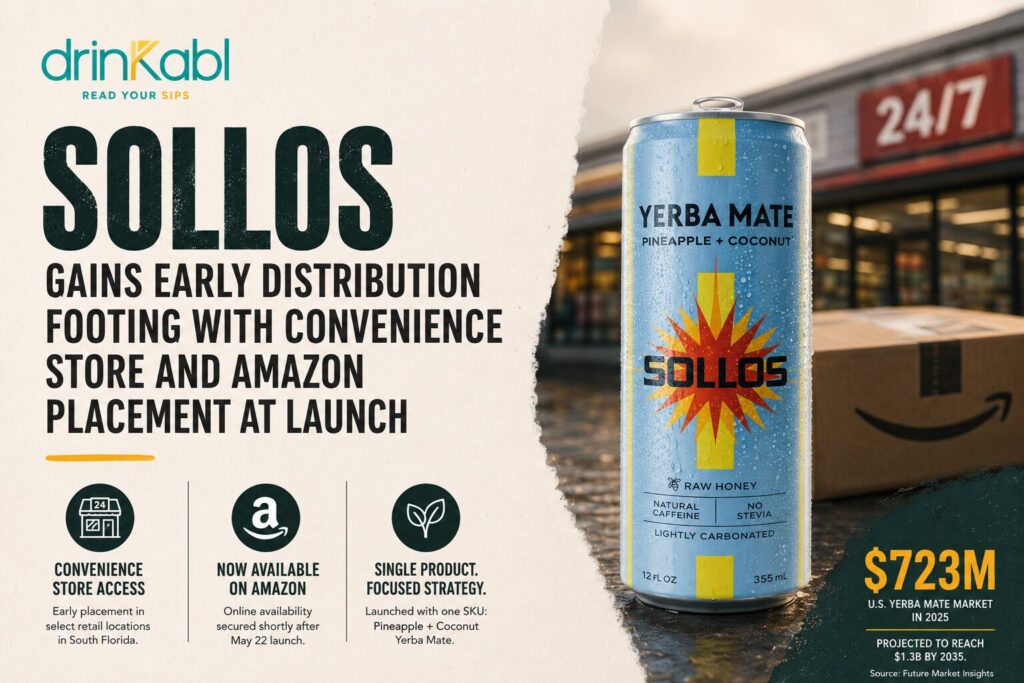
More revealing than the distribution approach may be the company’s product strategy. Rather than launching with multiple flavours, SOLLOS entered the market with a single SKU: Pineapple + Coconut Yerba Mate.
According to co-founder Spencer Bernstein, the company tested more than 100 formulations before selecting its final recipe. In comments reported by Fox Business and Newsweek, company representatives said the team deliberately concentrated resources on perfecting one product rather than introducing a broad flavour portfolio.
That approach offers several operational advantages. A single-SKU portfolio simplifies manufacturing, reduces inventory complexity, lowers spoilage risk, and creates a clearer proposition for distributors evaluating a new brand. For a company reportedly funded through a $1 million seed raise, the strategy also helps preserve capital during the critical early stages of market development.
SOLLOS enters a growing but increasingly competitive category. The US yerba mate market is estimated at approximately $723 million in 2025 and is projected to expand to roughly $1.3 billion by 2035, according to Future Market Insights. Growth is being driven by consumer demand for plant-based caffeine alternatives, cleaner ingredient decks, and beverages positioned around sustained energy rather than traditional energy drink formulations.
The category remains dominated by Yerba Madre, formerly known as Guayakí, which continues to hold significant shelf presence across North American retail channels. SOLLOS seeks to differentiate itself through organic certification, raw honey sweetening, and a simplified product offering, although such attributes have become increasingly common among premium ready-to-drink functional beverage brands.
The company’s launch also reflects a broader shift underway across the beverage industry. Drinkabl.media’s recent analysis of Sazerac’s expansion into ready-to-drink formats highlighted how established beverage groups are repositioning portfolios toward lighter, functional, and wellness-oriented products as consumer preferences evolve. SOLLOS is pursuing the same consumer trend from the opposite direction—entering the market as a startup without the distribution networks, manufacturing scale, or promotional budgets available to major beverage corporations.
Drinkabl.media first reported on SOLLOS in February following the company’s incorporation and disclosure of a $1 million private capital raise through an SEC filing.
The key question for the remainder of 2026 is whether SOLLOS can convert early visibility into scalable distribution. A future announcement involving a recognised distributor, convenience chain, or grocery retailer would provide stronger evidence that the brand is building long-term infrastructure. Until then, its retail presence appears to represent an encouraging early foothold rather than proof of nationwide market penetration.
For now, SOLLOS has achieved what many beverage startups struggle to accomplish in their first year: getting product into consumers’ hands through both physical retail and e-commerce channels. Whether that momentum translates into sustainable distribution growth will determine whether the brand becomes a niche entrant or a serious challenger within the expanding functional beverage category.
READ MORE