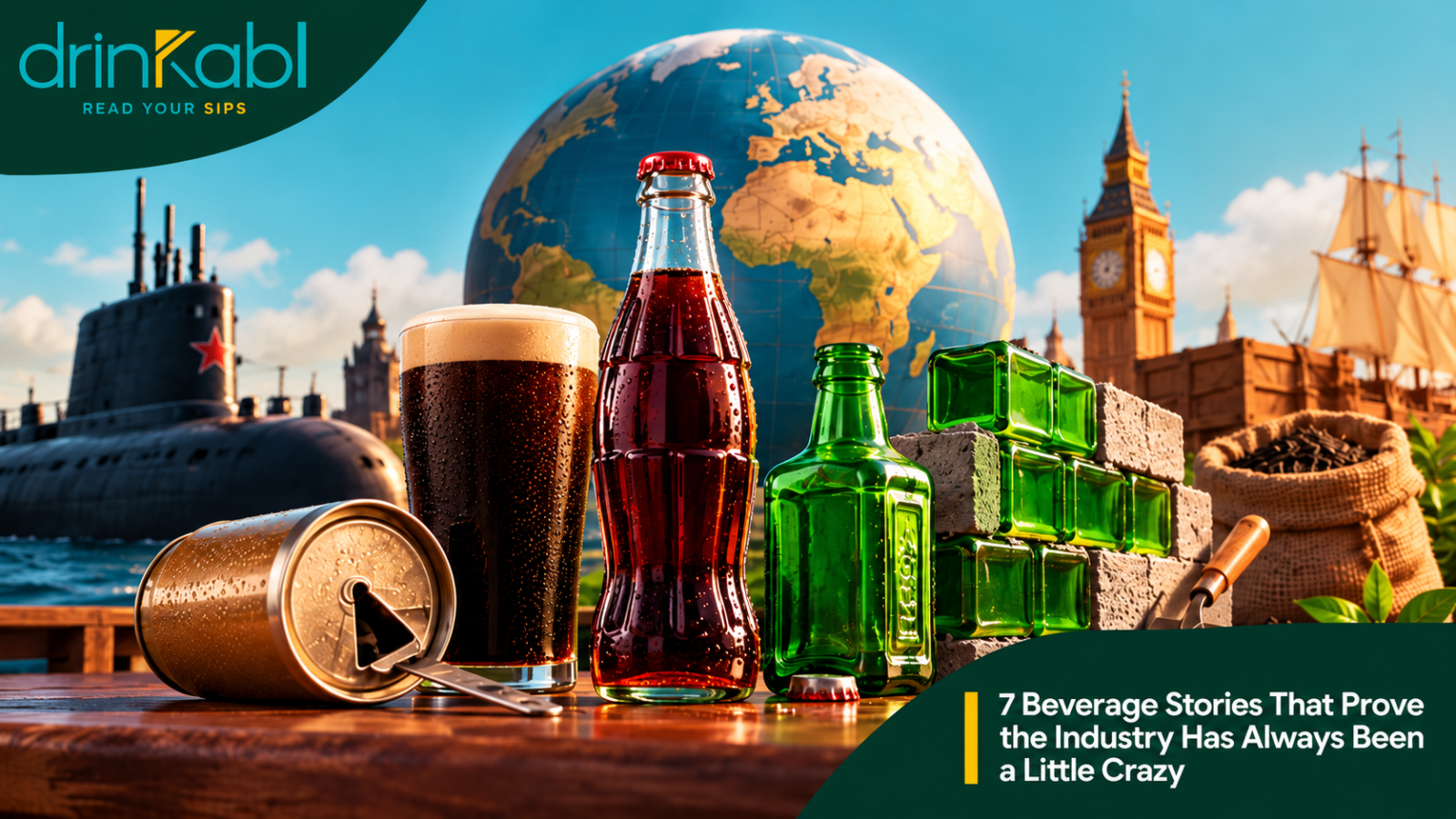

Pepsi briefly handled Soviet warships. Heineken tried to turn empty beer bottles into building materials. Coca-Cola’s most recognisable packaging was inspired by an ingredient its designers mistakenly researched.
The beverage industry likes to talk about innovation as though it always begins in a laboratory, requires millions in investment and ends with a revolutionary product. Sometimes, yes, other times, it starts with a businessman looking at an empty bottle and thinking it should become a brick, or a soft-drink company agreeing to a deal involving submarines, another is a packaging designer researching the wrong ingredient.
This week’s collection explores seven real beverage stories that are funny, strange and surprisingly educational. None requires a fictional twist. The historical record is already entertaining enough.
1. Pepsi Once Had a Deal Involving 17 Soviet Submarines
1989 | Soviet Union
Imagine pitching this to your company’s board: “We need to expand our soft-drink business in the Soviet Union. Unfortunately, cash and currency arrangements are complicated. I propose we accept some submarines.” That is not quite how the meeting would have sounded, but the underlying story is real.
In 1989, PepsiCo struck a deal involving decommissioned Soviet military vessels, including 17 submarines, alongside other warships and commercial shipping assets. The arrangement was part of the company’s effort to expand its Soviet business when conventional currency transactions were difficult.
Pepsi had already established a major presence in the Soviet market through a barter arrangement involving Pepsi concentrate and Stolichnaya vodka. The later agreement took this unusual approach to international trade even further.
The internet sometimes describes Pepsi as having owned the world’s sixth-largest navy. That is an exaggeration. The vessels were decommissioned, Pepsi was acting as an intermediary in the arrangement, and the ships were destined for disposal rather than combat. Still, the image of a cola company negotiating around a fleet of submarines is difficult to beat. Imagine the procurement department trying to classify the expenditure.
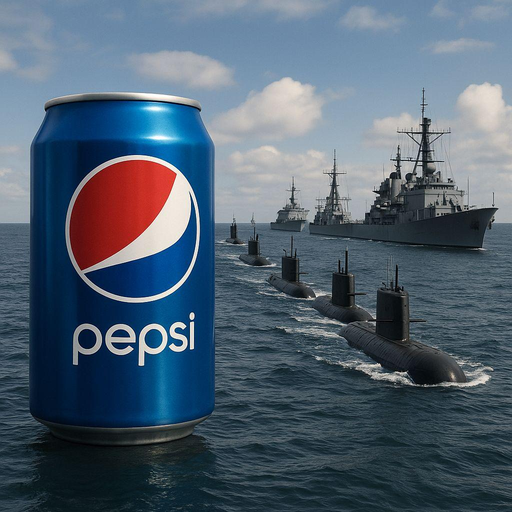
The business lesson: When conventional payment systems fail, companies may resort to barter, countertrade and complex partnerships to access markets. Pepsi’s Soviet experience is a reminder that international expansion is sometimes as much about finance and geopolitics as it is about flavour.
2. Heineken Designed a Beer Bottle That Could Become a Brick
1960s | Netherlands and the Caribbean
Most bottles have one job: hold a drink until somebody opens them. Alfred Heineken, the brewery’s influential former chairman, wanted to explore a second job. After seeing discarded beer bottles littering parts of the Caribbean, he became interested in whether packaging could serve a useful purpose after consumption. The result was the WOBO, short for World Bottle: a rectangular glass bottle designed to be reused as a building block.
The idea was developed with Dutch architect John Habraken. The bottles had flatter sides and a shape intended to make them more practical for construction than ordinary cylindrical beer bottles.
Heineken produced approximately 100,000 WOBO bottles in different sizes in 1964. The concept was innovative, but technical and commercial hurdles prevented it from becoming a mainstream packaging system.
Think about that. Somebody looked at the beverage industry’s waste problem and proposed a solution in which consumers could finish their beer and then use the packaging to build a wall. It was circular economy thinking decades before the phrase became a standard corporate presentation heading.

The business lesson: Packaging innovation should consider the entire life cycle of a container, including what happens after consumption. But an ingenious concept still needs to satisfy practical requirements, consumer behaviour, production economics and building standards.
3. Coca-Cola’s Famous Bottle Was Inspired by a Cocoa Pod — Because Designers Were Researching the Wrong Thing
1915–1916 | United States
Coca-Cola’s contour bottle is so recognisable that it has become a piece of design history.
But its origins contain a wonderfully human mistake.
In the early twentieth century, Coca-Cola faced a problem with competitors producing similar-looking bottles and confusing consumers. The company wanted packaging so distinctive that people could recognise it by touch, even in the dark.
Glassmakers were challenged to develop a new design.
At the Root Glass Company in Indiana, the team researched the ingredients associated with Coca-Cola while looking for inspiration. The design that emerged drew on the distinctive shape and ridges of the cacao pod — the fruit from which cocoa and chocolate are produced.
The amusing detail is that the designers were looking for inspiration from an ingredient they believed was associated with the product, but the resulting shape became far more famous than the research behind it.
The bottle was patented in 1915 and entered commercial use in 1916.
Today, consumers can recognise the bottle’s silhouette without seeing the label. What began as a response to imitation became one of the world’s best-known examples of distinctive packaging.
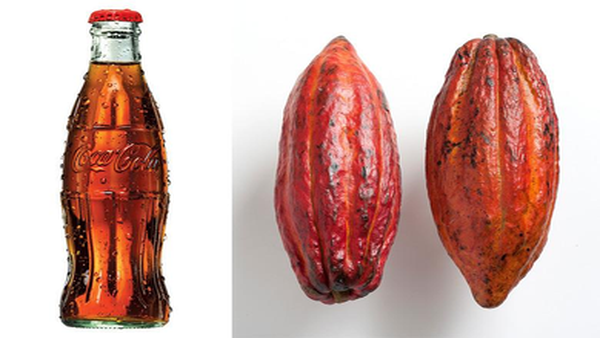
The business lesson: Packaging is not merely a container. A recognisable shape can become a powerful brand asset, helping consumers distinguish genuine products from competitors and imitators. The best design decisions can outlive the original problem they were created to solve.
Sources: Coca-Cola’s history of the contour bottle and The US National Archives Foundation’s account of the bottle design.
4. The First Successful Beer Cans Needed a Separate Tool to Open Them
1935 | United States
Today’s beer cans open with a small pull-tab. A consumer lifts the ring, hears a click and gets on with the evening. The first commercially successful beer cans were not nearly so convenient. When Krueger’s beer went on sale in cans in Richmond, Virginia, in January 1935, consumers were dealing with heavy metal containers that required a pointed tool to pierce the top. The familiar ring-pull opening had not yet arrived.
The packaging itself had required considerable engineering. Beer is carbonated, which means its container must withstand internal pressure without leaking or bursting. The can also needed an interior coating to prevent the beverage from reacting with the metal.
Krueger’s introduced its canned beer in partnership with the American Can Company. The initial consumer response was encouraging: 91% of the drinkers who tested the product approved of it.
The format spread rapidly. Within months, other breweries were adopting cans, attracted by their portability, stackability and advantages in distribution. So the next time you complain about a can that refuses to open cleanly, remember that earlier generations had to bring a tool to the drinking occasion.
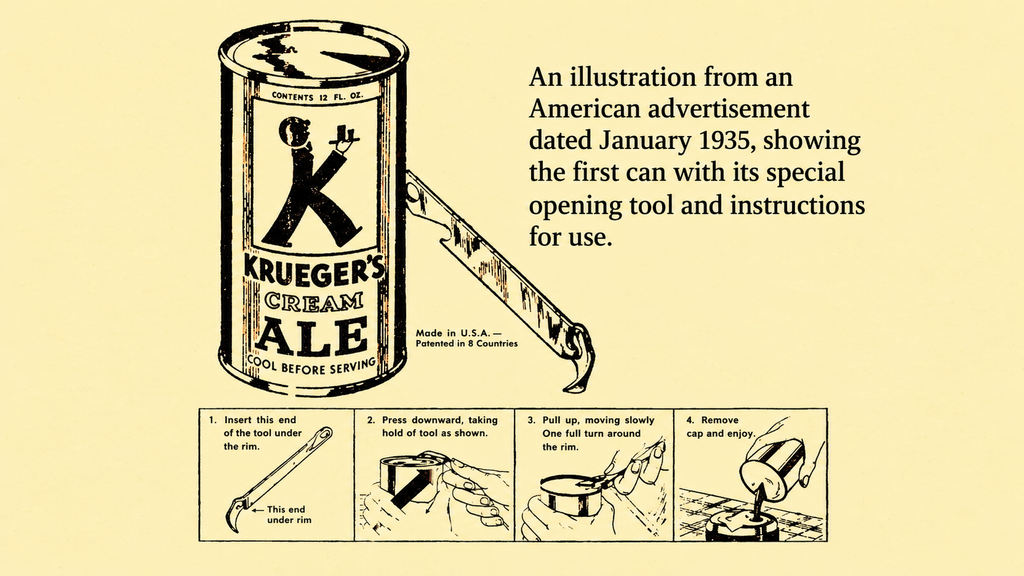
The business lesson: Packaging innovation depends on more than appearance. Materials science, product compatibility, distribution efficiency and ease of use all determine whether a new format succeeds. Sometimes the most important innovation is not the beverage itself but the container that makes it easier to sell.
Sources: HISTORY — First canned beer goes on sale and Smithsonian Magazine — The first canned beer went on sale.
5. Coca-Cola’s Six-Pack Carrier Was Designed to Get Bottles Into People’s Homes
1923 | United States
The six-pack looks like one of the most ordinary things in the beverage business. But getting consumers to take drinks home instead of consuming them at a soda fountain required some commercial imagination.
Coca-Cola’s bottling system introduced a cardboard six-pack carrier in 1923. The design made it easier for customers to carry several bottles at once, supporting the shift towards home consumption.
This was important because bottlers were not simply selling a drink. They were trying to change where and how people consumed it. A carrier that made six bottles easier to transport could help turn an occasional purchase into a household shopping habit.
The cleverness is in the simplicity. Nobody needed to invent a new flavour or a new production process. The company needed to make the existing product more convenient to buy, carry and consume. There is a lesson here for modern beverage brands trying to grow in supermarkets, convenience stores, delivery channels and emerging retail formats.
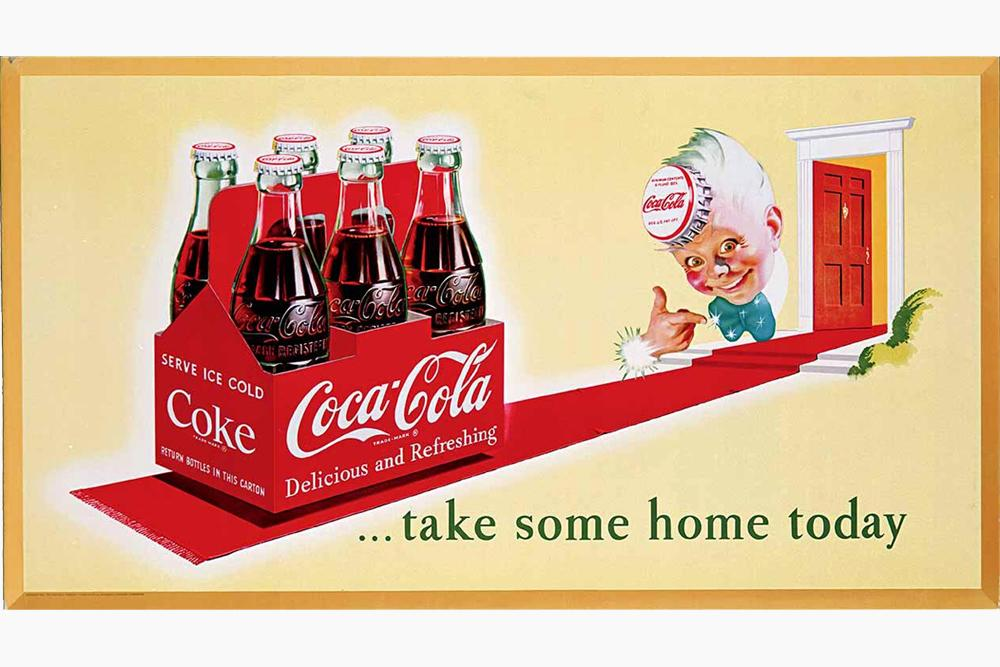
The business lesson: Sometimes the best route to growth is reducing friction between purchase and consumption. Packaging can influence purchase size, portability, consumption occasions and the economics of retail distribution.
6. Pepsi and Coca-Cola’s Rivalry Once Became a War Over the Soviet Consumer
1959–1990s | United States and Soviet Union
The cola wars are usually described in terms of advertising campaigns, celebrity endorsements and supermarket shelf space. During the Cold War, the rivalry took on a much larger political dimension.
At the 1959 American National Exhibition in Moscow, Pepsi executives arranged for Soviet leader Nikita Khrushchev to taste the drink. Photographs of the Soviet leader holding a Pepsi became an unexpected publicity coup.
Pepsi later became the first American soft-drink company to establish a substantial presence in the Soviet market, entering a barter arrangement in which it supplied concentrate in exchange for Stolichnaya vodka for distribution in the United States.
The commercial logic was straightforward: the Soviet Union had limited access to freely convertible currency, so barter helped facilitate trade. The rivalry with Coca-Cola was about more than which cola tasted better. It became a competition over market access, consumer aspiration and the symbolic power of American consumer brands.
Pepsi’s position in the Soviet market was eventually challenged as political and economic conditions changed. The absurdity is that a fizzy drink became part of a much larger conversation about capitalism, communism and international relations.
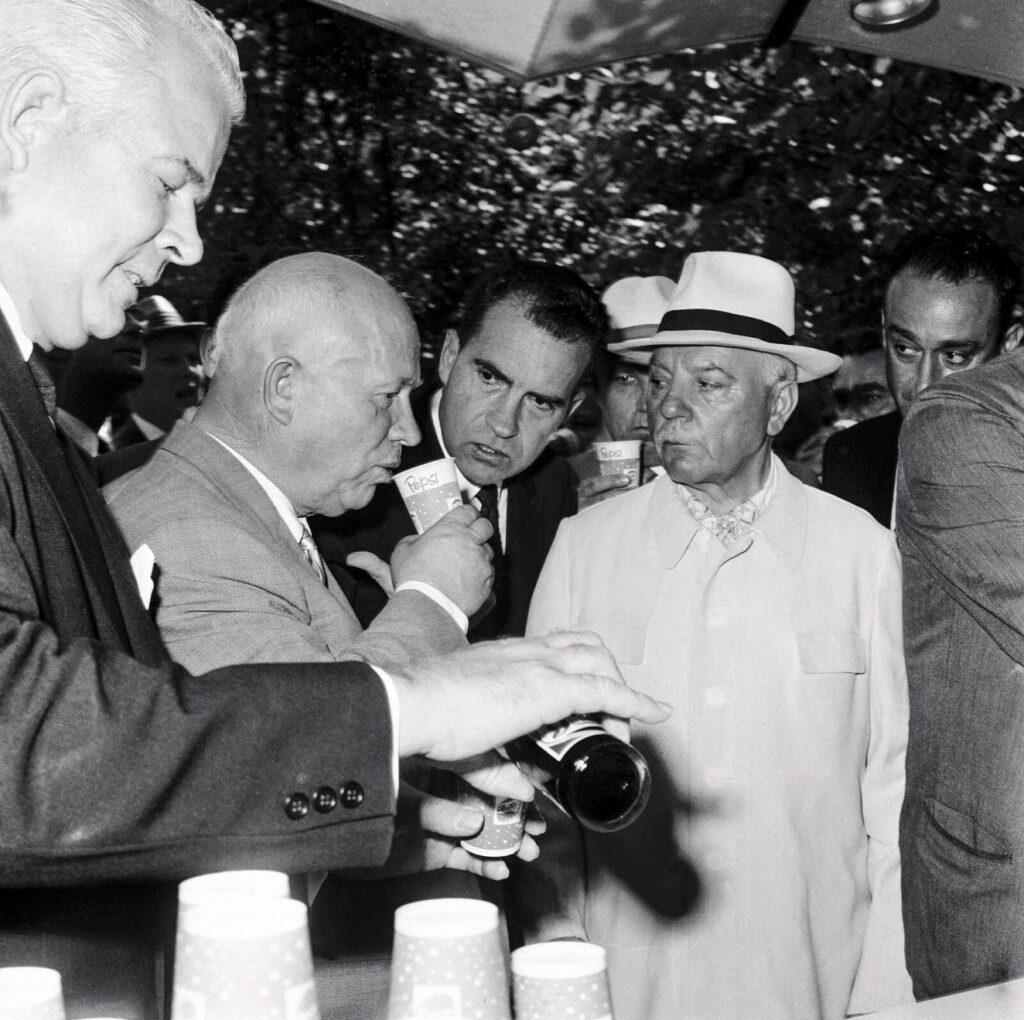
The business lesson: Global beverage brands are often shaped by political institutions, trade restrictions, currency arrangements and local partnerships. Market access can be as valuable as brand recognition, and international success rarely depends on marketing alone.
Source: HISTORY — Pepsi’s Cold War trade with the Soviet Union.
7. A Beer Can Was Once a Risky Bet for Brewers
1930s | United States
It is difficult to imagine beer packaging without cans, but brewers were initially cautious about adopting them.
Before 1935, putting beer in a metal can presented significant technical challenges. Carbonation created pressure, the beverage could react with the container, and the packaging needed to survive transportation and storage.
American Can Company spent years developing a suitable design. Its work eventually produced cans that could handle the pressure and protect the beer from undesirable reactions with the metal.
Krueger’s agreed to test the format with consumers. The initial results gave the brewery enough confidence to proceed commercially.
The can then helped transform beer distribution. Compared with glass bottles, cans were easier to stack, did not break in the same way and could eliminate the need to recover and wash returnable containers in some systems.
The irony is that a package now associated with convenience and mass-market beer was once an engineering gamble that required a brewery willing to take a chance.
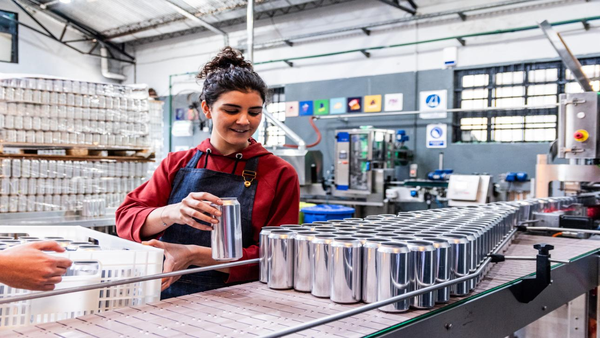
The business lesson: New packaging formats can reshape entire categories, but adoption requires both technical reliability and consumer acceptance. A successful innovation must work in the factory, survive the distribution network and make sense to the person buying the drink.
The Punchline: Sometimes the Bottle Is the Innovation
These stories reveal a recurring truth about beverages: the industry is built not only on what people drink but also on how products are packaged, transported, marketed and traded.
Pepsi’s Soviet dealings show how geopolitical realities can shape a soft-drink business. Heineken’s WOBO demonstrates the possibilities and limits of packaging reuse. Coca-Cola’s contour bottle shows how design can become a competitive advantage. The first beer cans reveal how engineering can transform distribution. And the humble six-pack carrier illustrates the commercial value of convenience.
The beverage industry often looks like a business of liquids. In practice, it is also a business of containers, systems, habits and ideas. And occasionally, it is a business in which a company selling cola ends up negotiating around submarines.