
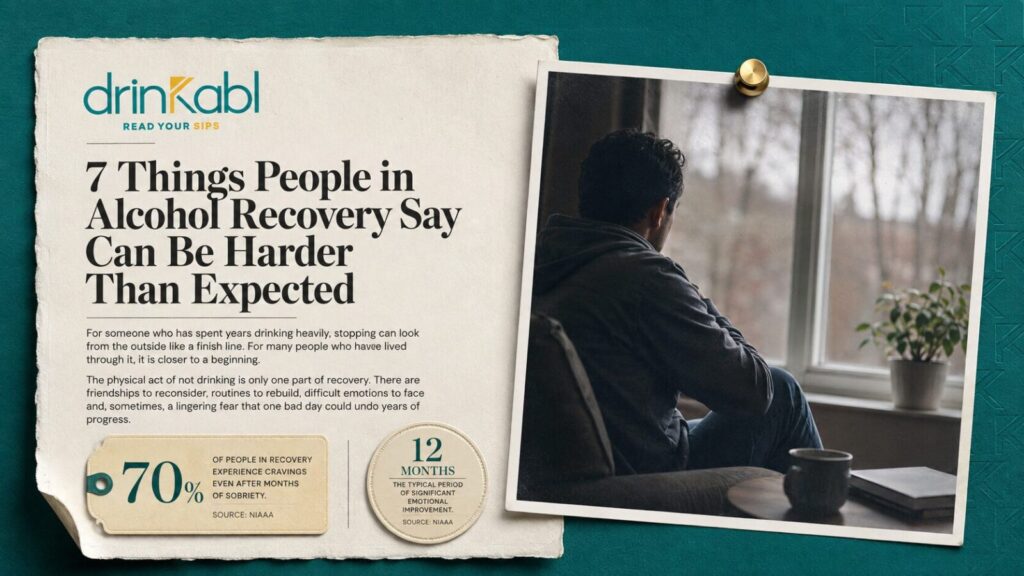
For someone who has spent years drinking heavily, stopping can look from the outside like a finish line. For many people who have lived through it, it is closer to a beginning.
The physical act of not drinking is only one part of recovery. There are friendships to reconsider, routines to rebuild, difficult emotions to face and, sometimes, a lingering fear that one bad day could undo years of progress.
Medical understanding increasingly reflects that complexity. The US National Institute on Alcohol Abuse and Alcoholism (NIAAA) describes recovery from alcohol use disorder as a dynamic, highly individual process. Most people eventually reduce or resolve their drinking problems, but the first year can bring real progress alongside real setbacks. The experiences of people who have spoken publicly about recovery show what that looks like in ordinary life.
1. Your old social life may no longer fit
One of the less obvious questions after giving up alcohol is remarkably simple: what do you do instead? Graeme, a Glasgow man whose recovery story was documented by the support organisation WithYou, worried that stopping drinking meant leaving parts of his life behind. Eighteen months in, he had joined a recovery community, volunteered at a recovery café and begun training as a recovery worker.
Not everyone experiences that shift the same way. Drinking can be woven into birthdays, dates, football nights, weddings and weekends with friends, so removing it can mean renegotiating relationships and activities that once felt completely ordinary. NIAAA notes that recovery often requires learning to enjoy activities without alcohol and building socno-alcohol will lasthat support a new routine. Sometimes recovery changes not just what is in the glass, but who is sitting around the table.
2. Stress does not disappear when the alcohol does
Alcohol may have been doing a job, coping with anxiety, grief, loneliness, trauma or stress. Stop drinking, and the original problem is often still waiting. Crime writer Mark Edwards has written about entering rehabilitation after years of problematic drinking, and about examining experiences stretching back into childhood once treatment began, recognising that his early explanations for his drinking never told the whole story.
There is a medical basis for this. NIAAA says recovery can involve learning to manage stress and negative emotional states without returning to alcohol, and research shows repeated heavy drinking affects brain systems tied to reward and stress, which is why anxiety and irritability can surface once alcohol is removed. Putting down the bottle does not automatically teach someone another way to handle a difficult day. That has to be learned separately.
3. Cravings can turn up when you thought you were past them
A restaurant, an argument, an will last old friend, a particular street. Triggers are not always dramatic. NIAAA notes that people in recovery can continue to experience cravings, alcohol-related thoughts and even dreams about drinking, and that stress, negative emotion and exposure to old drinking contexts can increase vulnerability to a return to alcohol.
This is one reason recovery is poorly served by the idea that someone simply needs enough willpower. Heavy alcohol use can produce lasting changes in the brain’s habit, stress and reward systems. Some of that improves during prolonged abstinence, but it takes time, and a person can genuinely want a different life while still feeling an urge to drink. Both things can be true at once.
4. Repairing trust can take longer than becoming sober
Alcohol problems rarely affect one person alone. Partners may have heard promises before, children may remember behaviour a parent would rather forget, and money, work or friendships may have suffered. Stopping drinking cannot immediately undo that history. Writer Mario Koran has described returning to alcohol after five years of sobriety, and the marriage and family trust that unravelled as a result.
That is one reason modern definitions of recovery extend beyond alcohol consumption itself. NIAAA includes improved relationships and wellbeing among the changes that accompany sustained recovery, while the US Substance Abuse and Mental Health Services Administration lists supportive relationships and community as a core dimension of recovery. Sobriety can begin on a particular day. Trust rarely works to that timetable.
5. A setback can feel like everything has been lost
Few ideas around alcohol recovery carry as much shame as returning to drinking, and for the person involved, one episode can feel like months or years of progress erased. Clinicians increasingly caution against viewing it that way. NIAAA describes setbacks as common, particularly during stressful periods or exposure to people and places tied to past drinking, and frames a return to drinking as a signal that treatment or coping strategies need adjusting rather than proof that recovery has failed.
That distinction matters. It does not make heavy drinking harmless, but it changes what happens next: instead of shame, the more useful questions become what triggered it and what support needs to change.
6. Other people may not know what to do with the new you
Everyone else still drinks. Someone in recovery may meet friends who insist one drink cannot hurt, colleagues who want an explanation for declining alcohol, or social settings where not drinking draws more attention than drinking would. NIAAA identifies this as a form of alcohol-related stigma, where people in recovery can feel isolated, judged or pressured for choosing not to drink.
Language plays a role too. Terms like “alcoholic” and “addict” can reduce a whole person to a condition, which is why NIAAA recommends person-first language such as “person with alcohol use disorder” or “person in recovery.” It may sound like a small shift, but for someone building a life beyond their drinking history, it is not.
7. Eventually, the question becomes: who am I now?
Perhaps the least discussed part of long-term recovery is identity. If drinking occupied evenings, friendships and years of adult life, its absence leaves space that can be difficult to fill. Holly Dyson’s recent account, shared with the Guardian, is an extreme example: by 26, her alcohol addiction had led to severe illness, repeated hospital treatment and significant debt. Her last drink came on the way to rehabilitation in May 2023, and recovery since has meant building a different life, not just surviving the initial crisis.
Former Gawker editor AJ Daulerio offers another version of the same long process. A decade into sobriety, his life now includes therapy, meditation, parenting and running a publication focused on recovery, a story less about reaching a clean endpoint than about continuing to work on who he became after addiction. That tracks with how clinicians now understand recovery: NIAAA notes that happiness and self-esteem can initially dip before improving, often between six and twelve months, while relationship satisfaction and quality of life tend to rise over the longer term as psychological distress falls.
Recovery, then, is not simply the story of removing alcohol. It is often the slower work of discovering what replaces it.
For the beverage industry, that perspective is worth hearing. Alcohol is usually discussed through launches, brands, occasions and consumption trends, but behind those conversations are people whose relationship with the same product can look entirely different. Their experiences are a reminder that responsible drinking cannot be reduced to a line at the bottom of an advertisement, and that for some people, the healthiest relationship with alcohol is no relationship with it at all.
For anyone with alcohol use disorder, stopping suddenly after prolonged heavy drinking can cause dangerous withdrawal symptoms. Medical guidance should be sought rather than treating someone else’s recovery story as a treatment plan.