
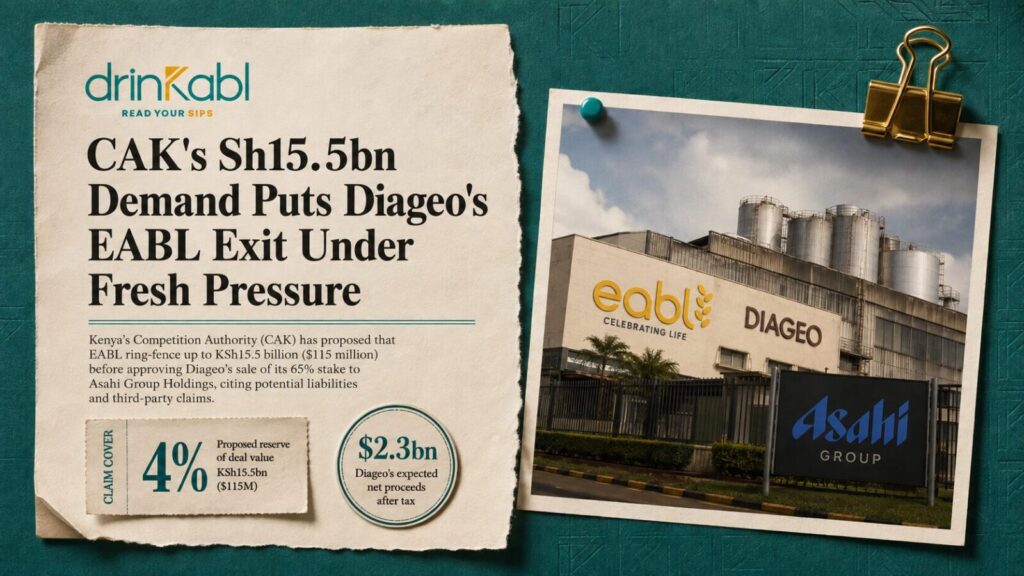
Diageo’s planned exit from East African Breweries Plc has hit another regulatory obstacle after Kenya’s Competition Authority (CAK) proposed that EABL ring-fence up to KSh15.5 billion ($115 million) before it approves the transfer of Diageo’s controlling stake to Japan’s Asahi Group Holdings.
The reserve, equivalent to about 4% of the transaction value, is intended to cover potential liabilities and third-party claims that could surface after the ownership change, according to reporting on the transaction. The reserve was initially proposed at as much as 10% of the deal value before being revised to the current 4% figure. It is intended to cover specific outstanding disputes, including an estimated $61.87 million (KSh8 billion) claim from Bia Tosha Distributors and an $18.92 million (KSh2.45 billion) claim from JILK Construction tied to the Kisumu brewery project.
A Diageo spokesperson said there was no basis for the proposed conditions and that the concerns behind them were unrelated to the transaction, adding that Diageo and Asahi were continuing discussions with CAK. The regulator has said it is still reviewing the merger and that any determination will be communicated in line with its guidelines.
The dispute matters because the EABL transaction is no longer simply a change in ownership. It has become a test of how Kenya balances foreign investment, competition oversight, minority shareholder protection and unresolved commercial claims when a major multinational exits a strategically important local business.
A deal bigger than the headline suggests
Diageo announced the transaction in December 2025, agreeing to sell its 65% controlling interest in EABL to Asahi. Diageo said the deal would generate roughly $2.3 billion in net proceeds after tax and transaction costs, implying an enterprise value of about $4.8 billion for 100% of EABL, with completion originally expected in the second half of 2026 subject to regulatory approval.
Asahi’s own announcement lays out the structure in more detail: it agreed to acquire 100% of Diageo Kenya Limited for $2.354 billion and Diageo’s 53.68% stake in UDV Kenya Limited for $646 million, inter-conditional agreements requiring merger-control approval in Kenya, Uganda and Tanzania. Through them, Asahi would indirectly acquire 65% of EABL. The widely cited $2.3 billion is Diageo’s net proceeds figure; Asahi’s disclosed equity consideration across the target businesses totals closer to $3 billion.
Why CAK is asking for the reserve
The proposed reserve is not a purchase-price adjustment or a payment to government. According to Kenyan reporting on the regulator’s discussions with Parliament, it is designed to protect parties that could still have claims against the business after ownership changes hands, including third parties affected by outstanding liabilities. The issue came up during an August 7 session between CAK and the National Assembly’s Departmental Committee on Finance and National Planning, where lawmakers sought assurances that the transaction would not prejudice local farmers, distributors, employees and consumers.
Business Daily also reports that CAK’s conditions extend beyond the financial reserve. The authority has proposed that at least 20% of retail refrigeration space carrying EABL or Asahi branding be reserved for competing manufacturers’ products, arguing that EABL’s existing distribution network, branding arrangements and company-owned coolers could otherwise foreclose rivals from key retail outlets and increase barriers to entry in an already concentrated market.
Kenya’s Competition Act gives CAK considerable latitude here: it can approve a merger, reject it or approve it with conditions, and its assessment can weigh employment, sector or regional impact, small-business market access and other public-interest considerations, not competition alone. What remains unclear is whether the KSh15.5 billion figure will become a formal condition of approval. CAK has not publicly confirmed final terms, and it is currently a proposed condition, not an approved requirement.
The regulator’s timing is significant
The reserve demand arrives after months of litigation. Kenyan beer distributor Bia Tosha Distributors sought to stop the sale over a long-running distribution-rights dispute; a Kenyan High Court dismissed the challenge in April and lifted interim orders that had restrained completion. That did not end the legal pressure. In June, minority shareholder Christine Irungu obtained conservatory orders from the High Court in Machakos temporarily blocking completion, questioning whether minority shareholders received adequate information when Diageo raised its EABL holding from about 50.03% to 65% through a 2022 to 2023 tender offer.
EABL subsequently wrote to Chief Justice Martha Koome, asking for administrative intervention over parallel proceedings and the risk of conflicting rulings, seeking faster hearings because the litigation threatened the deal’s timetable. Each additional dispute does not necessarily kill the transaction on its own, but it adds to the list of conditions that must be resolved before ownership can change hands, and the regulatory reserve proposal now lands on a deal already carrying that legal complexity.
EABL is entering the fight from a position of strength
The timing is notable because EABL’s underlying business has improved sharply. For the year ended June 2025, the brewer reported KSh128.8 billion in net revenue, up 4%, and KSh12.2 billion in profit after tax, up 12%, with net finance costs falling to KSh5.9 billion from KSh8.1 billion. Its latest results are stronger still: for the year ended June 2026, EABL reported revenue of about KSh146 billion, up 13%, and net income of KSh18.2 billion, up roughly 49%, with total dividends rising 59% to KSh12.70 per share.
That improvement matters because Asahi is not buying a distressed brewer. It is acquiring control of a profitable regional platform with established beer and spirits brands, production infrastructure and distribution across Kenya, Uganda and Tanzania, where EABL’s listed status on all three exchanges is expected to continue. For Asahi, that makes the deal strategically larger than a Kenyan market entry; it is a foothold across three major East African markets. For Diageo, the logic runs the other way: the sale fits its strategy of selective disposals and balance-sheet strengthening, expected to cut leverage by about 0.25 times.
What is really at stake for the beverage industry
The dispute exposes a growing question in African beverage M&A: who carries the risk after a multinational owner leaves? Large beverage companies operate through thousands of relationships with farmers, distributors, employees, retailers, contractors, regulators and minority investors, and those relationships do not disappear once a share purchase agreement is signed. That appears to be the concern behind Kenya’s regulatory approach, reinforced by Parliament’s questions about the impact on farmers, distributors, workers, consumers and competitors.
For multinational beverage groups, the precedent could matter well beyond this deal. A regulator requiring a financial safeguard before approving a change of control signals that completion may depend not just on conventional competition remedies, but on how convincingly buyer and seller demonstrate that outstanding obligations survive the ownership transition. That could raise transaction costs and extend closing timelines for buyers, and complicate a clean exit for sellers. For local stakeholders, the argument is simpler: a foreign owner should not be able to leave unresolved liabilities behind simply because ownership changed.
The next hurdle is not the cheque, it is approval
The central question now is whether Diageo and Asahi can reach an accommodation with CAK without fundamentally altering the deal’s economics. The regulator has legal authority to approve mergers with conditions, and Kenyan law bars implementation of a merger requiring approval until that approval is obtained and its conditions met. Diageo’s rejection of the proposed reserve means the issue remains unsettled.
The transaction was originally expected to close in the second half of 2026. That timetable now depends on several moving parts: CAK’s merger determination, regulatory approvals in Uganda and Tanzania, and the outstanding Kenyan court proceedings. The likelier near-term outcome is a negotiated remedy rather than a collapsed deal, but the KSh15.5 billion proposal has changed the character of the transaction. What began as Diageo’s strategic exit and Asahi’s African expansion has become a broader test of how ownership transfers are regulated when the asset at stake is not just a company, but a critical piece of a regional beverage supply chain.
For now, Asahi has not taken control, Diageo has not completed its exit, and CAK has not issued final approval. The $2.3 billion deal is still alive, but it is no longer moving on the timetable originally envisaged.