
Beer Prices Are Rising. So Is Fuel. Which One Is Nigeria Actually Angry About?
Two price shocks are compressing household budgets simultaneously, and the answer may reveal more about Nigerian consumer psychology than either industry expects
Walk into any bus stop conversation in Lagos, Kano, or Port Harcourt and the grievance is immediate. Fuel. It is always fuel. The price at the pump, the generator bill, the transport fare that doubled without notice. Nigerians have a language for fuel anger that is rehearsed, fluent, and politically charged, one inherited from decades of subsidy battles, street protests, and the kind of economic humiliation that settles into collective memory. When the government removed the petrol subsidy, the backlash was not just economic. It was existential.
But something quieter has been happening at the bar.
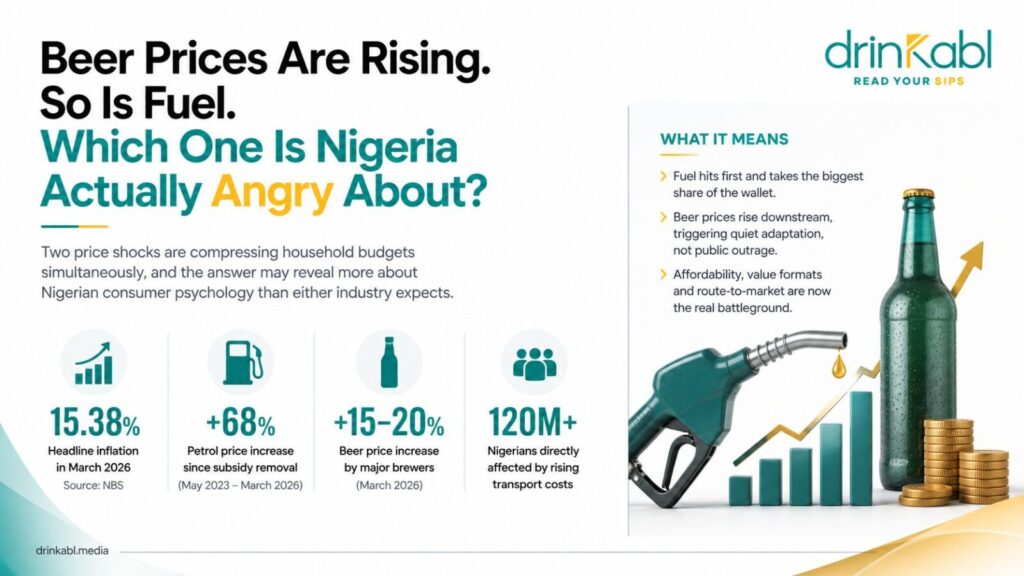
Beer prices have been climbing steadily through 2025 and into 2026. Nigerian Breweries and Guinness Nigeria both moved prices upward in March 2026, citing foreign exchange volatility pushing up the cost of imported inputs, rising energy costs tied to diesel dependency, and logistics inflation that tracks almost perfectly with the fuel price curve. The increases are real, they are structural, and they are landing on consumers whose purchasing power has already been significantly eroded. According to the National Bureau of Statistics, headline inflation reached 15.38 percent in March 2026, with food prices still elevated and transport costs accelerating sharply.
So why is the beer price increase generating quiet adaptation rather than public outrage, while fuel remains the defining economic grievance of this moment?
The political anatomy of fuel anger
Fuel grievance in Nigeria is not simply economic. It has architecture. Since the 1970s, the petrol subsidy was woven into the social contract between the Nigerian state and its citizens, an implicit acknowledgment that despite the country’s enormous oil wealth, ordinary people deserved to benefit in some tangible, daily way. When that subsidy was removed, it did not feel like a policy adjustment. It felt like a betrayal.
The infrastructure behind fuel anger is institutional. Labour unions have historically mobilised around pump prices. Civil society organisations have coordinated responses. There is precedent, organisational muscle, and a political vocabulary already in place. The 2012 Occupy Nigeria movement, which brought the country to a near-standstill after Goodluck Jonathan’s subsidy removal, forced a partial policy reversal. The August 2024 hunger protests drew explicitly on fuel costs as a central organising grievance.
Beer has none of that. There is no equivalent social contract around the price of a bottle of lager, no historical memory of mass action over brewery pricing. The grievance exists, but it has no vehicle, no coalition, and no political target. Outrage requires not just cause but infrastructure, and the beer price increase, for now, has neither.
The silence of behavioral adaptation
The absence of vocal protest does not mean consumers are unaffected. It means they are responding differently, and that distinction is critical for any brand trying to interpret the market correctly.
Drinking occasions are being quietly renegotiated. Bar and club visits, where overheads push prices furthest from the brewery gate, are declining in frequency. Weekend consumption is holding more firmly than midweek casual drinking. The shift to off-trade channels is accelerating, with kiosks and informal retail absorbing footfall that previously moved through licensed premises. Shared consumption, splitting a single bottle among a group, is becoming socially normalised across income levels that would not previously have recognised it.
Downtrading is the signal the industry needs to monitor most carefully. Consumers are not leaving beer. They are leaving premium beer, and in some cases moving toward unregulated informal alcohol that exists entirely outside the commercial brewing ecosystem. The brands most exposed are those that built their positioning around aspiration without building sufficient value perception to survive an affordability crisis.
Two shocks, one wallet
The relationship between fuel prices and beer prices is not simply that they are both rising. It is that fuel rises first, inside the wallet, before beer enters the equation. When a Lagos commuter pays significantly more for transport to and from work each week, that money is gone before any discretionary decision is made. The beer price increase is competing against what remains after fuel has already taken its share.
This also means that when Nigerians express anger about fuel, they are at least partially expressing anger about everything that follows from it. Beer prices are downstream of that conversation even when they are not explicitly named. The beer price increase is being absorbed into the fuel grievance rather than standing alone, which may be why it has not generated its own distinct outrage, but it is not being ignored.
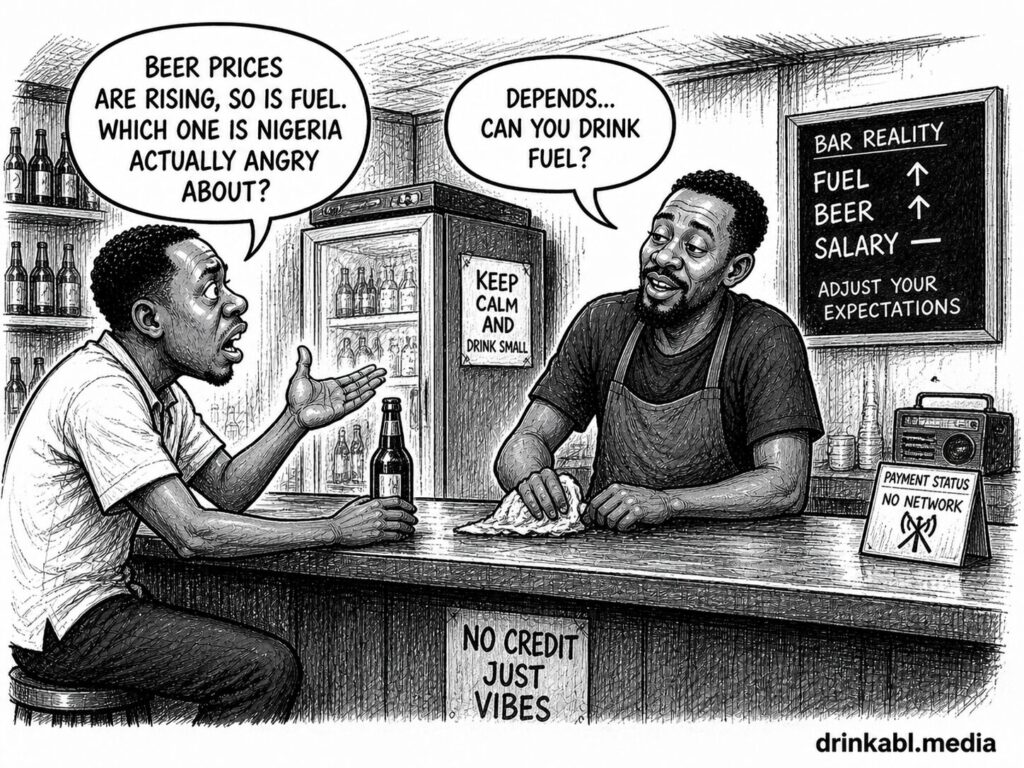
There is a risk the brewing industry reads the absence of organised consumer resistance as tolerance. It is not tolerance. It is adaptation, and adaptation has a ceiling. Both Nigerian Breweries and Guinness Nigeria returned to profitability in 2025, the former posting a net profit of N99.1 billion against a prior-year loss of N145 billion, the latter recording N41 billion in profit after tax for its extended period ending December 2025. But profitability achieved through price increases into a contracting consumer base is qualitatively different from profitability achieved through volume growth. The former is defensible in the short term, and becomes fragile if behavioral adaptation deepens or informal alternatives gain further ground.
Nigerian consumers are not done adapting. The question is whether the brands they drink are done underestimating them.