

A viral roadside incident in mid-April 2026 has exposed a fault line in how the beverage industry understands its last-mile reality in West Africa, and what consumer behavior in uncontrolled conditions actually looks like.
Signals emerging from across West Africa’s road distribution corridors have long told a complicated story. Across a region where informal retail dominates, infrastructure is inconsistent, and supply chains absorb daily shocks, the vulnerability of in-transit cargo has remained one of the beverage sector’s least-discussed operational realities. For companies moving millions of crates annually through unmarked routes and unregulated handling points, every kilometre carries compounded risk. It was in this context that a delivery truck loaded with soft drinks overturned on a Benin Republic roadside in mid-April 2026, and produced an outcome that nobody anticipated.
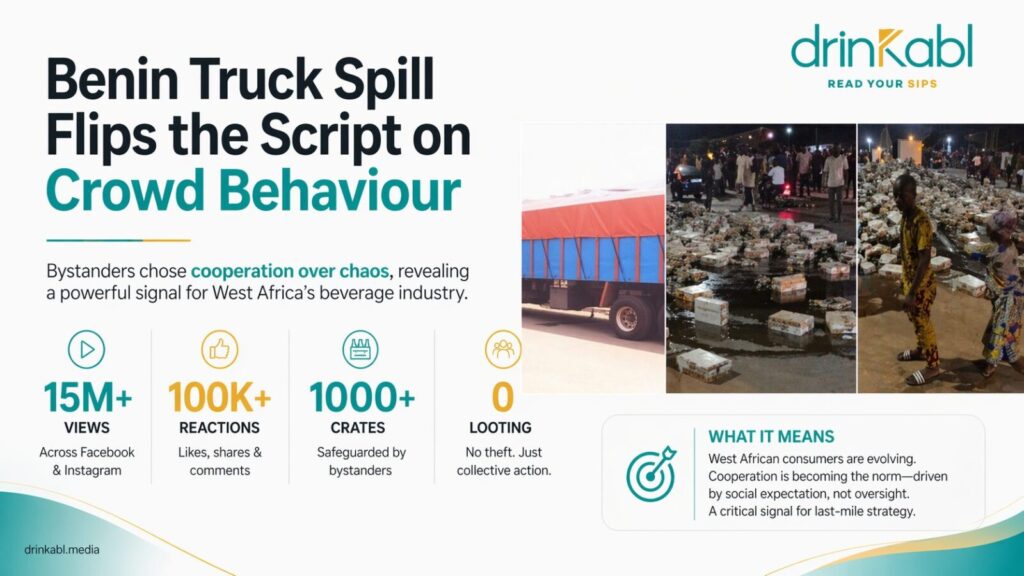
Instead of looting, bystanders helped.
Videos now circulating across Facebook and Instagram show groups of men and women carefully retrieving crates, restacking bottles, and securing what remained of the shipment. No scramble. No frenzy. Just coordinated, almost instinctive cooperation.
One widely shared clip posted around April 15, 2026, carried a caption that read: “This is Benin Republic… people helping to pack instead of stealing.” A second version surfaced days later on Instagram, drawing thousands of reactions and sparking a broader regional conversation about civic behavior and accountability.
For the beverage industry, the implications extend well beyond the optics of a feel-good moment.
As documented by Drinkabl.media’s reporting on West Africa’s beverage distribution landscape, road infrastructure limitations, unreliable logistics, and inconsistent oversight are among the most persistent structural challenges facing companies moving product across the region. A single roadside incident can mean the difference between recoverable loss and total inventory wipeout. For multinationals like The Coca-Cola Company and PepsiCo, whose West African volumes depend heavily on decentralised road networks and third-party distributors, cargo security in uncontrolled conditions is a live operational concern, rarely surfaced in investor briefings but deeply embedded in day-to-day supply chain decisions.
The Benin incident, however, reframes that concern in a different direction.
What the footage captures is not a governance success story. There were no police, no company representatives, no oversight mechanism at work. What emerged instead was raw civic response, people choosing order when disorder was easier, and collective good when personal gain was immediately available. As Drinkabl.media has reported in its broader analysis of Africa’s drinks market, the consumer across this region is evolving, becoming more intentional, more discerning, and more engaged with the brands and systems that serve them.
That evolution, it turns out, shows up not only in purchasing behavior but in moments of civic instinct.
The social resonance of this incident across Nigeria and the wider francophone West Africa belt is itself instructive. Viewers were not simply reacting to what they saw; they were reacting to what they had expected to see, and to the gap between those two things. In a market where, as Drinkabl.media has noted, brand trust and distribution reliability are becoming competitive differentiators, moments like this carry weight that no marketing brief can manufacture.
For beverage operators navigating West Africa’s terrain, the lesson is less philosophical than operational. Behavior in these situations is shaped not only by economic need but by social expectation. When cooperation becomes the default, it becomes self-reinforcing. When it doesn’t, that too compounds over time, at direct cost to cargo and brand integrity.
Meanwhile, the regulatory and fiscal pressures squeezing beverage producers across the region make last-mile resilience, and the social ecosystems that support it, even more consequential to bottom lines already under stress.
A truck fell. That part is ordinary. What followed is what made it matter to an industry still learning how to read its own markets.
Read More
Liberia’s Beverage Market Immersion: A Nigerian Traveller’s POV (Part 1)
How Nigeria’s Beer Wars Built the Beverage Industry’s Most Sophisticated Intelligence Machine
Who Is Silencing South Africa’s Sugar Warning? Inside the ARB’s Conflict of Interest Crisis