
Carlsberg will take over as PepsiCo‘s bottler in Azerbaijan from January 1, 2027, assuming production, sales and distribution of its soft drinks lineup under a new agreement between the two groups.
Carlsberg’s Xirdalan brewery, currently dedicated to its local beer portfolio, will go through a major rebuild to run PepsiCo’s soft drinks lines alongside it. Executives expect the combined business to nearly double Carlsberg’s volumes in the country.
The current PepsiCo franchise in Azerbaijan runs through Mars Overseas, which continues production until the handover date. For Carlsberg, absorbing that book of business means running two distinct manufacturing and distribution operations out of one plant, a heavier logistics load than a straight beer expansion would carry.
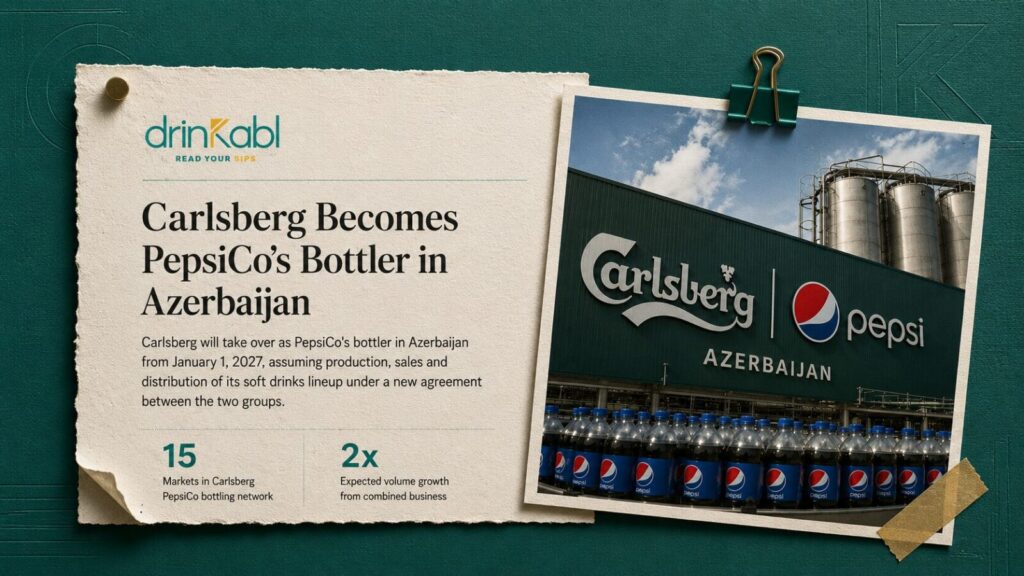
The agreement pushes Carlsberg’s PepsiCo bottling footprint to 15 markets. It already bottles Pepsi in the UK, Kazakhstan and Cambodia, and picks up Denmark, Finland and the Baltic states from 2029.
“We’re adding PepsiCo’s iconic brands to our strong local beer portfolio in the country and significantly growing our business in that market.” — Jacob Aarup-Andersen, CEO, Carlsberg Group
Nigerian Breweries chased the same multi-category logic when it moved to absorb Heineken’s wine and spirits business in 2023, betting a single distribution network could carry more brands more cheaply than one built around beer alone. Champion Breweries made a similar bet this year, folding EnjoyBev into its books to lift first-half revenue past ₦35 billion. Bottlers across the industry are converging on the same math: shared trucks, shared depots, more categories running through them.
Carlsberg Group CEO Jacob Aarup-Andersen said the deal adds “PepsiCo’s iconic brands” to Carlsberg’s local beer business and grows its footprint in the country.
The Azerbaijan deal lands weeks after Carlsberg struck a separate joint venture with Sapporo covering Southeast Asia and Hong Kong, its second bottling-style tie-up in a month. Whether Carlsberg keeps stacking these partnerships onto existing breweries, rather than building new plants, will shape how fast it can scale beyond beer next.
READ MORE