
It May Signal a Shift in Africa’s Beverage Power Balance
The indigenous bitters maker’s record-breaking stock market debut and Guinness Ghana Breweries’ sharp share decline have sparked fresh debate about whether investors are beginning to place bigger bets on Africa’s homegrown beverage champions than on multinational incumbents.
A thought-provoking LinkedIn analysis by brand strategist Karen Punch has reignited an important conversation across Africa’s beverage industry. In her post, Punch highlights the striking contrast between Kasapreko PLC’s historic public listing and the simultaneous decline in Guinness Ghana Breweries’ share price, asking what it takes for a locally founded bitters company to outshine a multinational brewer on its own stock exchange. It is a compelling question.
But perhaps an even bigger one is emerging. Is Kasapreko’s success less about branding alone and more about a structural shift in how African investors now value indigenous beverage businesses?
A Long-Standing Narrative, Challenged
For decades, multinational beverage companies dominated African capital markets. Their competitive advantages were obvious: global brands, international capital, extensive distribution networks and institutional governance that inspired investor confidence.
Local beverage companies, meanwhile, often remained privately owned, family-controlled and reliant on bank financing to fund expansion.
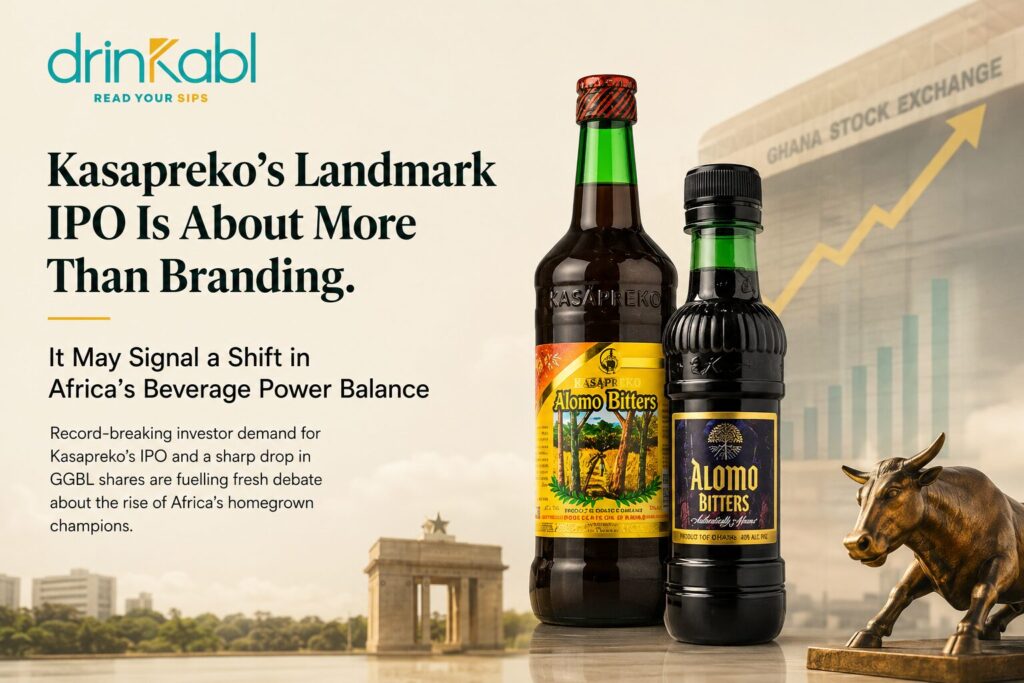
Kasapreko’s successful listing challenges that long-standing narrative. Founded in 1989 by Dr. Kwabena Adjei as a herbal bitters producer, the company has grown into one of Ghana’s largest indigenous beverage manufacturers, expanding beyond alcoholic beverages into bottled water, carbonated soft drinks and energy drinks while exporting to dozens of international markets.
Its Initial Public Offering sought to raise GH¢700 million through the sale of 583.3 million shares. Instead, investors submitted approximately GH¢1.73 billion in subscriptions, resulting in an oversubscription of about 146 percent above the target amount. More than 18,700 investors participated, making it the largest IPO oversubscription ever recorded by a locally owned manufacturing company on the Ghana Stock Exchange.
That level of demand is difficult to dismiss as simple market enthusiasm. It reflects confidence.
Investors May Be Rewarding Different Qualities
The timing is particularly notable. As Kasapreko attracted unprecedented investor demand, Guinness Ghana Breweries experienced a significant decline in its share price during the same period, prompting comparisons across Ghana’s beverage sector.
The two developments are not necessarily connected, nor should one be interpreted as causing the other. Share prices respond to multiple variables, including earnings expectations, liquidity, broader market conditions and investor sentiment. However, together they invite a broader question. What qualities are investors now rewarding?
Increasingly, local beverage companies are no longer viewed merely as regional challengers. They are becoming businesses with scalable manufacturing operations, diversified product portfolios and expanding export ambitions.
Kasapreko’s prospectus outlines plans to use most of the IPO proceeds to construct a new manufacturing facility, significantly expanding production capacity rather than simply refinancing existing operations. That growth story appears to have resonated strongly with investors.
Beyond Herbal Bitters
Reducing Kasapreko’s success to Alomo Bitters alone misses the evolution of the business. Today the company competes across multiple beverage categories, including bottled water, soft drinks, spirits and energy beverages.
That diversification matters because investors are increasingly evaluating beverage companies as manufacturing businesses with multiple revenue streams rather than as owners of a single successful brand.
This reflects a broader shift taking place across Africa’s beverage landscape. Companies that successfully integrate manufacturing, distribution, export capability and brand development are becoming attractive long-term investment opportunities.
A Different Kind of African Beverage Champion
Perhaps the most significant lesson from Kasapreko’s listing is not that local companies can compete with multinationals. That argument has existed for years.
Instead, the IPO suggests investors are increasingly willing to finance indigenous companies at scale. For decades, African beverage entrepreneurs often sold equity to multinational partners once they reached a certain size. Kasapreko has chosen a different route. Rather than selling the business, it invited the investing public to participate in its next phase of growth.
That distinction could prove important. If successful, the model may encourage more privately owned beverage manufacturers across Africa to consider public markets as an alternative source of expansion capital.
What Happens Next?
The real story may only be beginning.
Will Kasapreko sustain the growth expectations embedded in its market debut? Will other indigenous beverage companies in Nigeria, Kenya, Uganda or Côte d’Ivoire now begin exploring stock market listings? And could multinational beverage companies increasingly find themselves competing not only for consumers, but also for investor confidence against ambitious African-owned manufacturers?
Those questions extend well beyond one IPO. They may define the next chapter of Africa’s beverage industry.