
Standfirst: The United States’ decision to impose a 12.5% tariff on Nigerian imports over concerns about forced-labour import enforcement may not immediately disrupt Nigeria’s beverage industry. But for exporters seeking growth in the world’s largest consumer market, it signals a shift towards a new era where regulatory compliance could become as important as product quality and price.
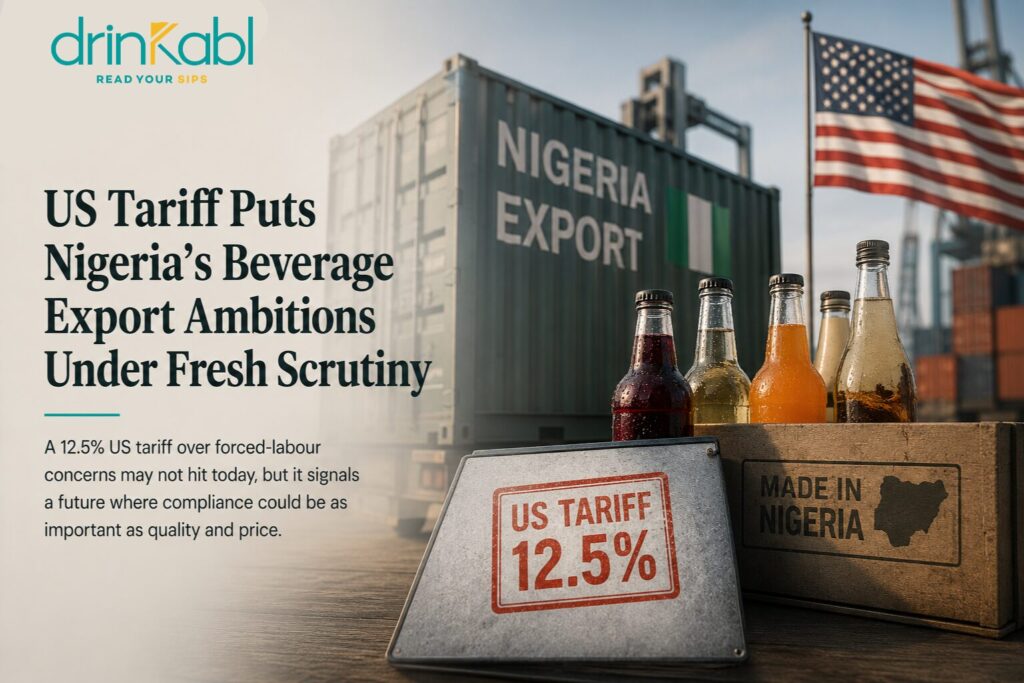
The Office of the United States Trade Representative (USTR) has announced a 12.5% tariff on Nigerian imports as part of a wider trade action against 60 economies found to have failed to impose and effectively enforce prohibitions on imports produced with forced labour. The measure is unlikely to trigger an immediate crisis for the country’s beverage producers, since Nigeria exports relatively modest volumes of alcoholic and non-alcoholic beverages to the United States compared with its trade within West Africa, Europe and the United Kingdom.
Yet the decision introduces another hurdle for exporters at a time when many Nigerian beverage companies are actively pursuing international growth. More importantly, it reflects a broader transformation in global trade: access to premium markets is increasingly being shaped not only by tariffs and quality standards but also by labour governance, supply-chain transparency and environmental, social and governance (ESG) expectations.
A Trade Policy Shift, Not Just a Nigeria Story
Contrary to some initial reports, Nigeria is not being singled out. The USTR’s decision forms part of a wider Section 301 investigation into whether major trading partners have implemented and enforced measures preventing goods made with forced labour from entering their domestic markets. Countries judged to have stronger legal frameworks or firm commitments to introduce them were assigned a lower 10% tariff, while Nigeria and dozens of others were placed in the higher 12.5% category.
The distinction is significant. The action is not an allegation that Nigerian beverage companies use forced labour. Rather, it reflects Washington’s assessment of Nigeria’s regulatory framework governing imports linked to forced labour. For beverage exporters, the commercial consequence is the same: products entering the United States become more expensive, reducing competitiveness against suppliers from countries facing lower tariffs.
Why Beverage Companies Should Pay Attention
Today, the United States is not the primary export destination for most Nigerian beverage manufacturers. Major producers derive the bulk of their revenues from domestic sales, regional ECOWAS markets and selected European destinations. However, several categories have increasingly targeted North America as a growth opportunity, including:
- Premium spirits and bitters
- Craft alcoholic beverages
- Palm wine-based products
- Ready-to-drink beverages
- Ginger drinks
- Hibiscus (zobo) beverages
- Fruit juices and concentrates
For these exporters, an additional 12.5% tariff increases landed costs before shipping, distribution and retailer margins are even considered. In a highly competitive retail environment, even modest price increases can influence purchasing decisions, particularly where buyers have access to substitute products from countries enjoying lower tariff rates.
Small Exporters Could Feel the Greatest Pressure
Large multinational beverage companies typically possess greater flexibility. They can redistribute production, optimise supply chains, negotiate freight contracts or shift export priorities between markets.
Small and medium-sized Nigerian beverage producers operate under different realities. Many already contend with:
- High logistics costs
- Foreign exchange volatility
- International certification requirements
- US Food and Drug Administration (FDA) registration processes
- Limited export financing
An additional tariff may narrow already thin margins, making expansion into the US market less commercially attractive. For emerging Nigerian beverage brands seeking diaspora consumers, specialty retailers and African grocery chains across North America, pricing has always been a competitive challenge. The latest tariff only raises that hurdle further.
Compliance Is Becoming a Competitive Advantage
Perhaps the most important implication extends beyond the tariff itself. Global beverage supply chains are evolving. International retailers, distributors and investors increasingly assess suppliers on more than product quality and production capacity, with labour standards, ethical sourcing, traceability and corporate governance now central to procurement decisions.
Major beverage companies have spent years strengthening due diligence across agricultural supply chains covering commodities such as cocoa, sugar, coffee and fruit concentrates. The USTR’s decision reinforces a broader trend: governments and multinational buyers increasingly expect stronger evidence that products move through transparent and responsibly managed supply chains. For Nigerian exporters, demonstrating compliance may soon become as valuable as securing product certifications.
Limited Immediate Impact, But a Long-Term Warning
Despite the attention surrounding the announcement, industry analysts are unlikely to expect an immediate decline in Nigerian beverage exports. The country’s exposure to the US beverage market remains relatively limited, and several products may still qualify for exemptions depending on tariff classifications and future regulatory guidance.
However, the development serves as an early warning. As global markets place greater emphasis on responsible trade practices, regulatory compliance may become another essential requirement for export competitiveness alongside food safety, packaging standards and product quality.
Could This Accelerate Export Reforms?
The more interesting question is what happens next. If Nigeria strengthens legislation and enforcement relating to imports linked to forced labour, there remains the possibility of improving its standing in future US trade assessments.
Such reforms would extend beyond satisfying Washington. They could enhance Nigeria’s reputation among global buyers, strengthen investor confidence and improve access to premium export markets that increasingly demand higher governance standards. For beverage manufacturers with international ambitions, these changes would represent more than regulatory adjustments, they could become commercial advantages.
International trade is entering an era where governments are using market access to encourage higher labour, environmental and governance standards. For Nigerian beverage exporters, success in overseas markets will increasingly depend not only on producing world-class beverages but also on demonstrating world-class compliance. Companies that prepare for that shift today are likely to be better positioned for tomorrow’s export opportunities.
Read More on Drinkabl.Media: