
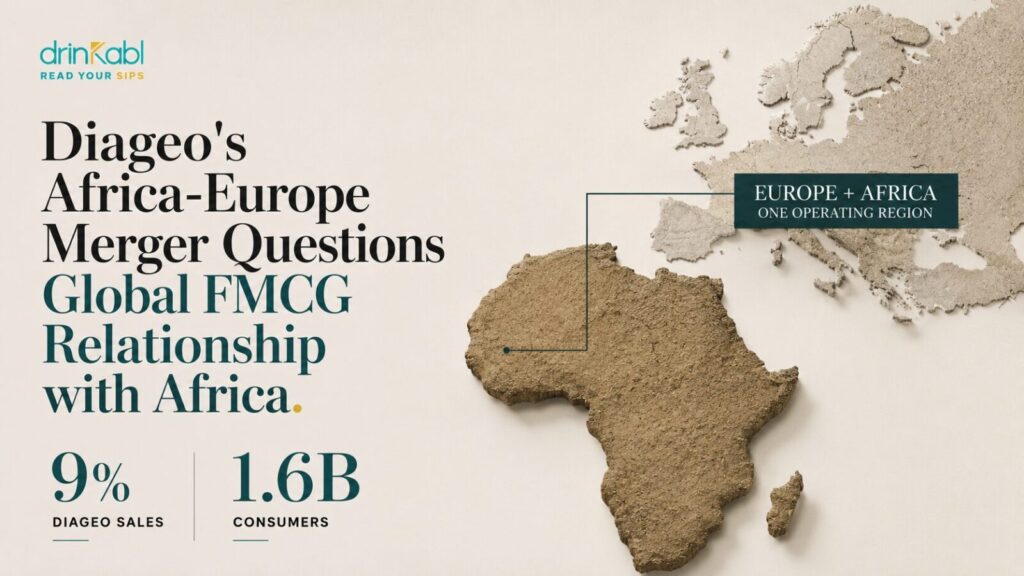
Diageo folded its Africa division into a combined Europe and Africa unit in mid-May, and Africa president Hina Nagarajan is leaving the business as part of the restructuring. The move, confirmed by Diageo as part of CEO Dave Lewis’s broader cost-cutting overhaul, ends Africa’s run as a standalone reporting region inside one of the few major drinks groups that gave the continent its own executive seat.
It also revived a debate that Lagos-based FMCG strategist Ben Longman framed in a LinkedIn post this week: for most global consumer goods companies, Africa’s 1.6 billion people barely register on the balance sheet. Longman estimates Nestlé, Unilever, PepsiCo, Procter & Gamble, and Mondelez each draw under 5% of revenue from the continent, with P&G closer to 1-2%. Diageo, he notes, sits at the higher end among its peers, with Africa accounting for roughly 9% of group sales; Heineken sits higher still at 13-14%, AB InBev around 7%, and Coca-Cola near 5-6%.
Diageo’s own disclosures bear out the broader retreat. The company has been shedding African assets for two years, divesting Guinness Nigeria, Guinness Ghana Breweries, and Seychelles Breweries, and agreeing in December to sell its 65% stake in East African Breweries to Japan’s Asahi for $2.3 billion. Drinkabl.media’s coverage of that deal traced how the divestment was structured to cut Diageo’s net debt-to-EBITDA ratio, not to deepen its African footprint.
Longman’s argument is that the math looks different by 2030. Nigeria’s population growth alone will reshape the continent’s weight in global consumer forecasts, and slowing volume growth in saturated markets will push CEOs to look for new ones. His comparison point is P&G in China: the company entered in 1985 and opened its first Chinese R&D centre in 1998, a 13-year runway most boardrooms wouldn’t tolerate today, but one that built a market P&G now can’t afford to lose. P&G has no comparable R&D presence in Africa.
What makes the timing pointed is who is filling the gap. Longman points to FMCG companies from India, Turkey, Egypt, Indonesia, and Pakistan, middle-income markets with their own emerging-market playbooks, showing up at trade shows and committing local investment in ways Western multinationals have not matched. Diageo’s own pivot validates the pattern at the top: it isn’t deepening African investment, it’s merging the region into Europe to cut overhead. Drinkabl.media’s reporting on Diageo’s Nigerian marketing push earlier this month showed the company can still commit serious budget to the region when a single market like Nigeria justifies it; the question is whether that logic survives a leaner regional structure with no dedicated Africa president to defend it.
The next test is whether Diageo names a standalone Africa lead under the merged structure when Lewis lays out his full strategy in August, or whether the region settles into a permanent subordinate role inside Europe.
READ MORE