
as Nigeria Import Volumes Climb
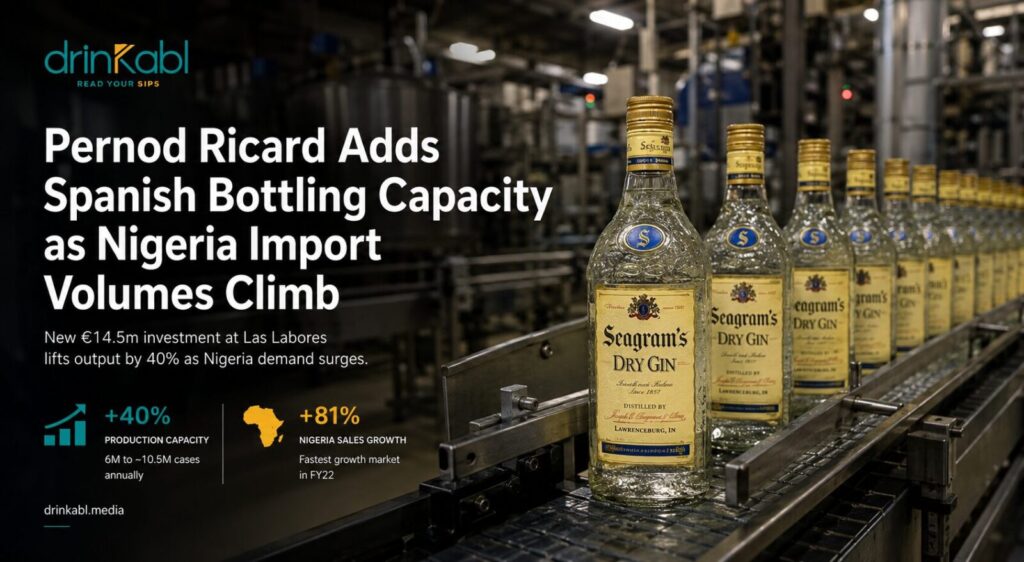
Pernod Ricard has opened a new bottling line at its Las Labores production centre in Castilla-La Mancha, Spain, lifting annual output capacity by more than 4.5 million cases. The €14.5m ($16.8m) investment raises production volumes at the site by 40%, from 6 million cases to roughly 10.5 million.
The new line, called Line 8, runs at 18,000 bottles an hour and adds automated palletising to a plant that already ships to more than 65 countries. Las Labores bottles a portfolio including Beefeater and Havana Club, brands that move through Pernod Ricard’s wholly owned import operations across Africa.
Capacity decisions at Las Labores carry weight beyond Spain. Pernod Ricard’s Nigerian affiliate, established in 2010, imports the group’s full portfolio rather than manufacturing locally, meaning every SKU sold in Lagos or Abuja traces back to a European bottling line. Nigeria sales grew 81% in fiscal 2022, the fastest pace of any Pernod Ricard market that year, a level of demand that strains supply lines anchored entirely overseas.
Extra capacity at the source plant reduces the risk of allocation shortfalls reaching import-dependent markets during peak demand periods, though Pernod Ricard has not specified how output from Line 8 will be distributed across export regions.
The expansion also lands as Nigerian regulators tighten enforcement against counterfeit spirits. Pernod Ricard Nigeria has said it works directly with security agencies on anti-counterfeiting raids, an enforcement push that depends on consistent, traceable supply from authorised import channels rather than grey-market stock.
Pernod Ricard Iberia managing director Sébastien Mouquet called the line “a clear commitment to the future of our Las Labores Production Centre and to Castilla-La Mancha,” tying the investment to the company’s broader industrial network rather than the Spanish market alone.
The Las Labores expansion follows a pattern playing out across Pernod Ricard’s African-facing supply chain: as Drinkabl.media’s coverage of Coca-Cola HBC’s Egypt investment showed, multinational beverage groups are increasingly treating African demand growth as the justification for capital spending decisions made far from the continent. Drinkabl.media’s reporting on the EABL ownership transition traced a similar dynamic, where production decisions made by a foreign parent reshape what reaches African shelves and at what reliability.
Pernod Ricard has not disclosed a timeline for the next capacity review at Las Labores. With Nigerian demand historically among the group’s fastest-growing, the next test will be whether European output keeps pace with African order volumes, or whether shortages resurface before the next investment cycle begins.
READ MORE