

BY Ziyadat Oluwafunmilola Edu
On January 1, 2026, NAFDAC began enforcing a ban that had been seven years in the making. The target: alcoholic beverages sold in sachets and bottles below 200ml, the kind of packaging that made alcohol cheap enough for a child’s pocket money and small enough to hide in a school bag. The policy came with Senate backing, a Director-General’s press conference, and the full weight of Nigeria’s food and drug regulatory machinery. It was, by every institutional measure, a serious intervention.
Six months later, sachet alcohol is still being sold across kiosks, motor parks, roadside shops, and open markets in cities and rural communities alike.
That gap, between what the ban announced and what it achieved, is precisely what interests me.
Discussions around alcohol restrictions often focus on what policymakers hope to remove from the market: consumption, access, visibility, or participation. Whether through outright bans, regulatory crackdowns, or severe distribution restrictions, the objective is usually straightforward; to reduce the presence of a product by limiting its availability.
Yet what fascinates me is not merely what disappears, but the response to the disappearance.
Every ban is an attempt to dictate what disappears.
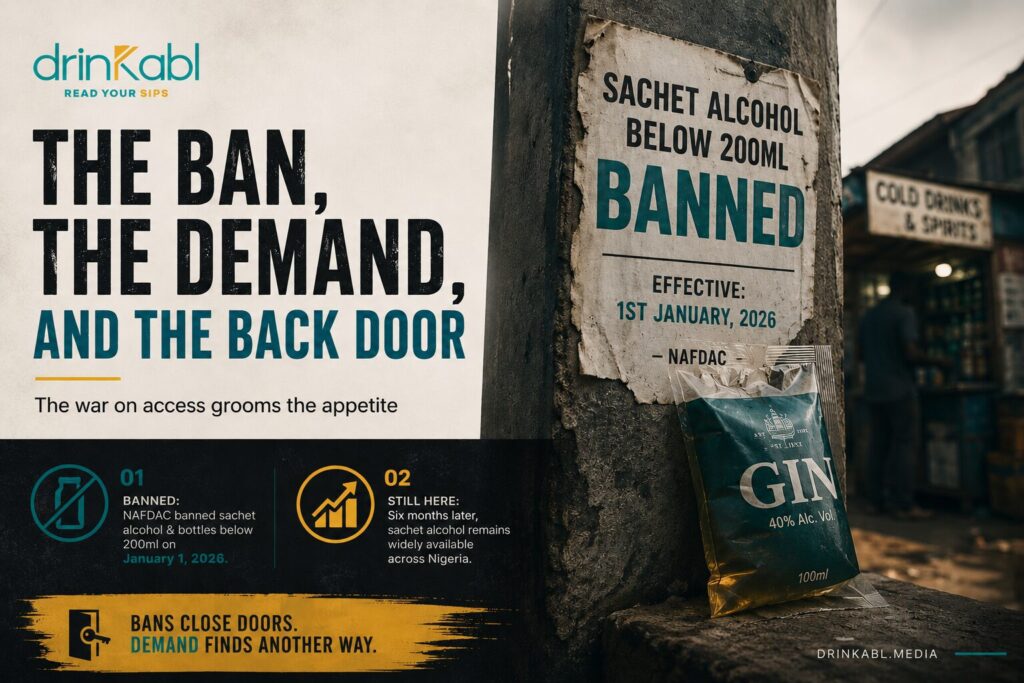
The market’s response is often: “Noted. Now, about that back door…”
Regulators often look at prohibition as though its story begins and ends with the restricted product, but that misses the more fascinating part of the equation: human ingenuity. It is a phenomenon that shows the real competitor to a banned product is not necessarily another legal product. More often than not, it is the creativity of people determined to satisfy an existing demand.
That is why enforcement can sometimes become an advertisement for the resilience of demand. Suppliers, reportedly tipped off about impending enforcement, did not shut down, they raised prices. The product did not vanish; it simply got more expensive, which, in a perverse way, reinforced its value. The harder a behaviour is pushed out of sight, the more inventive people become in finding alternative routes to it.
There is rarely a grand meeting where everyone gathers to design alternatives, yet people somehow improvise collectively. Markets reorganise themselves, new middlemen emerge, substitutes appear, and entirely new habits are formed. It is almost as though demand possesses a survival instinct of its own.
What makes this particularly interesting is that bans are often judged by what can be counted rather than what can be understood. Reduced sales figures, fewer visible outlets, or lower reported participation may suggest success, yet those metrics tell us very little about what has migrated elsewhere. A behaviour can become harder to observe without becoming less common. In that sense, prohibition births a peculiar situation: the very act of pushing something underground can make it more difficult to determine whether the policy achieved its intended outcome.
History repeatedly suggests that scarcity increases perceived value faster than it eliminates desire, because the forbidden possesses an incessant ability to become more attractive simply by being forbidden. Availability often breeds familiarity, but restriction can breed fascination. The moment something becomes difficult to obtain, it acquires a certain mystique.
One retailer, when asked about the ban’s impact, noted that even if young people were discouraged from sachet alcohol, many might simply move to larger bottles and consume more. That observation, almost casual in its delivery, captures something regulators rarely account for: the substitution effect, where removing one access point does not eliminate the behaviour, it redirects it.
This is why the most important question surrounding any ban is not what it removes, but what it creates. A prohibition that eliminates one format but gives rise to four alternative access points has still changed the market, just not necessarily in the way its architects intended.
There is a significant difference between a successful ban and a behaviour that has merely become less visible. Simply put, a phenomenon may retreat from public view while remaining very much alive beneath the surface. If policymakers confuse one for the other, they may mistake adaptation for compliance.
And just maybe that is the true measure of prohibition: not whether something disappeared, but whether the demand for it did.
Ziyadat Oluwafunmilola Edu is a writer who enjoys interrogating narratives and examining the interests beneath public debates.
READ MORE