

Authorities in China’s Hunan Province say a man, identified only by his surname Si, convinced members of his family to fake his death after being arrested for driving under the influence of alcohol for the third time. Facing the prospect of a prison sentence, he allegedly orchestrated an elaborate deception that included purchasing a coffin, scattering empty medicine bottles around his home to suggest a fatal overdose, and staging a funeral before secretly fleeing to Yunnan Province.
He was arrested earlier this month and sentenced to five months’ criminal detention and a fine of 20,000 yuan (approximately $2,800). Chinese authorities are also investigating his mother and grandmother for allegedly assisting him in evading justice.
Investigators eventually uncovered inconsistencies in the family’s account. There was no death certificate, no hospital or mortuary record, and neighbours had never seen the deceased’s face before burial. Surveillance footage and financial records later confirmed that Si was alive.
Few people respond to a drunk-driving charge by staging their own funeral. Yet an extraordinary case in China has become a striking illustration of how high the stakes have become for repeat offenders. As unusual as the incident is, the bigger story extends far beyond one man’s failed escape. It reflects a broader global trend in which governments are imposing tougher penalties on alcohol-impaired driving and investing more heavily in enforcement.
Drink Driving Is No Longer Treated as a Minor Offence
Around the world, drink driving has increasingly shifted from being viewed as a traffic violation to a criminal offence, particularly for repeat offenders.
China has strengthened its road safety laws over the past decade, introducing stricter criminal penalties, expanding roadside breath-testing programmes, and deploying digital surveillance to improve compliance. Repeat offenders can face detention, substantial fines, licence suspensions, and long-term criminal records.
The same pattern is evident elsewhere. Countries across Europe, North America, Australia, and parts of Asia have lowered legal blood alcohol limits, increased fines, introduced mandatory licence suspensions, and required ignition interlock devices for convicted offenders. In several jurisdictions, repeat offences now routinely result in imprisonment.
The rationale is straightforward. According to the World Health Organization, alcohol significantly impairs reaction time, judgement, coordination, and decision-making, making drink driving one of the leading preventable causes of road traffic deaths worldwide.
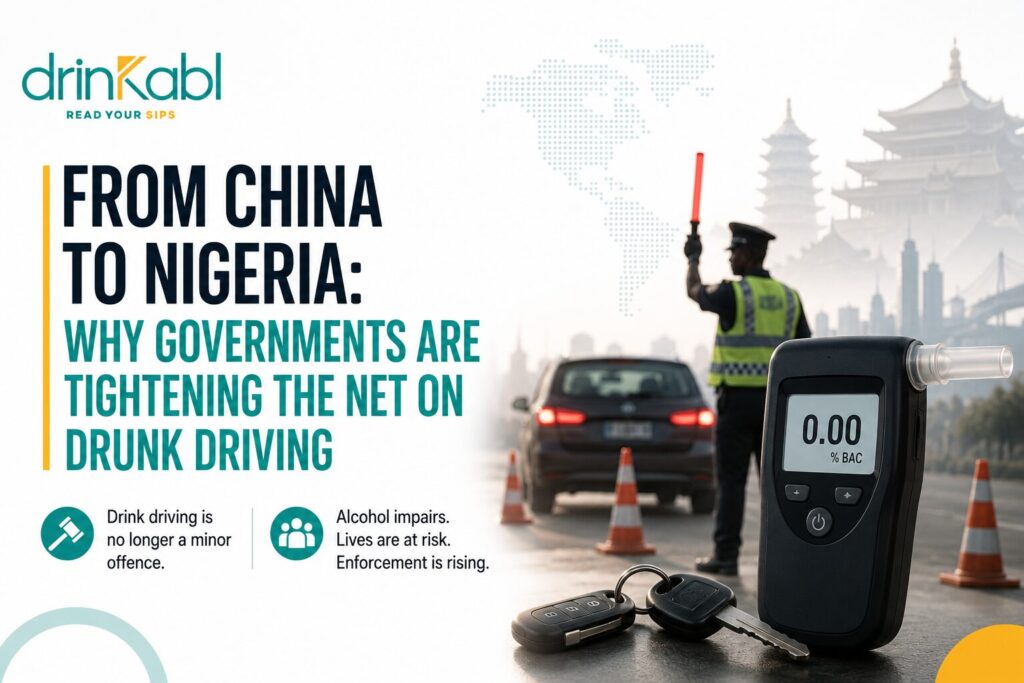
Nigeria’s Enforcement Challenge
Nigeria also prohibits driving under the influence of alcohol, with the Federal Road Safety Corps (FRSC) empowered to enforce traffic safety regulations. However, enforcement remains uneven.
Unlike many developed markets where random roadside breath testing has become routine, Nigerian enforcement is often concentrated around special patrols, festive periods, or after serious road crashes. Breathalyzer deployment remains limited, while prosecution and conviction data are not consistently published.
This has created a perception among many motorists that the likelihood of being caught remains relatively low, despite the serious risks posed by impaired driving.
Road safety experts have repeatedly argued that stronger enforcement, wider deployment of alcohol-testing equipment, and sustained public awareness campaigns are necessary to reduce alcohol-related crashes.
Why This Matters to the Beverage Industry
For alcohol producers, the issue goes beyond compliance with traffic laws. Responsible drinking has become an increasingly important part of corporate sustainability and regulatory engagement. Global brewers and spirits companies now invest heavily in campaigns encouraging designated drivers, moderation, and alternative transport after drinking.
Many multinational beverage companies operating in Africa have adopted responsible-consumption programmes, recognising that long-term industry growth depends not only on expanding sales but also on maintaining public trust.
As governments across Africa continue to review alcohol policies, including taxation, advertising restrictions, health warnings, and retail regulations, companies that actively promote responsible consumption are likely to be viewed more favourably by regulators and consumers alike.
Technology Is Making Evasion More Difficult
The Chinese case also demonstrates how technology is changing law enforcement. Authorities reportedly pieced together the deception through surveillance footage, financial transactions, and administrative records rather than relying solely on witness testimony.
Increasingly, digital identity systems, CCTV networks, vehicle databases, and electronic financial records are making it far more difficult for offenders to evade detection, even through elaborate schemes. The sophistication of these tools means that enforcement is becoming not only stricter but smarter.
Beyond the Headlines
The image of a man staging his own funeral to escape a drink-driving conviction is undoubtedly remarkable. Yet the lasting significance of the story lies elsewhere. Across the world, governments are signalling that alcohol-impaired driving is no longer viewed as a routine traffic offence. It is increasingly treated as a serious public safety issue carrying meaningful legal consequences.
For African policymakers, the trend offers a timely reminder that stronger enforcement, better technology, and sustained public education can play a critical role in reducing preventable road deaths.
For the beverage industry, it reinforces another reality: promoting responsible alcohol consumption is no longer simply a corporate social responsibility exercise. It is becoming an essential component of operating in an increasingly regulated marketplace where public health, business reputation, and long-term sustainability are closely intertwined.
Read More