
Africa’s beverage industry faces no shortage of opportunity, but turning that potential into sustained growth will require stronger brands, better market intelligence and closer collaboration across the value chain.
That was the central message from the virtual press briefing for The New Pour Summit ’26, where organisers, industry leaders, investors and strategic partners outlined the conversations expected to shape the inaugural beverage intelligence gathering scheduled for 25 July in Nairobi and online.
Hosted by Drinkabl Africa, the briefing brought together participants from Nigeria, Kenya, Ethiopia, Ghana, Morocco and other African markets to preview the summit’s agenda, introduce strategic partners and unveil plans for the New Pour Report, a research publication designed to provide African-focused beverage market intelligence.
Opening the session, moderator Andrew Balongo Opere described the summit as a response to the rapidly changing realities confronting beverage businesses across the continent, including rising production costs, shifting consumer behaviour, supply chain disruptions, technological change, currency volatility, and intensifying competition.
“Every major industry has defining moments,” he said. “Africa’s beverage industry is experiencing one of those moments today.”
Beyond growth, towards resilience
Speaking during the briefing, Tosin Balogun, Co-Founder of Drinkabl Africa, said the continent’s beverage industry is entering an important growth phase, citing increased investment activity, stronger export performance and improving profitability across several markets.
He referenced Ethiopia’s coffee exports surpassing US$3 billion, continued expansion in Kenya’s tea sector and improving financial performance among West African brewers as evidence that Africa’s beverage economy continues to attract investor attention.
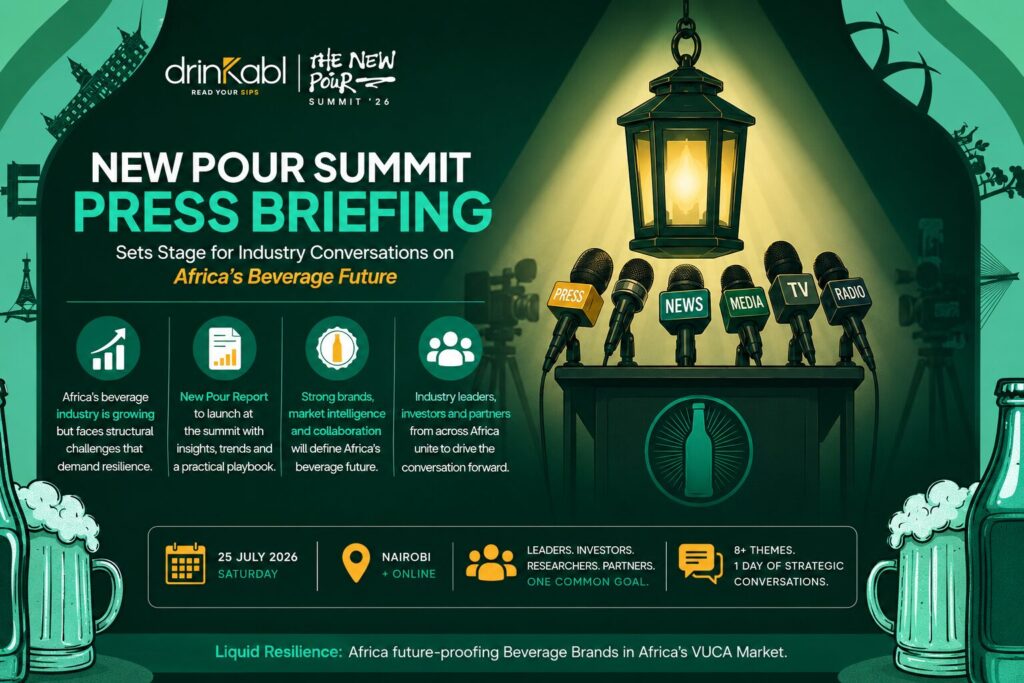
But beneath those encouraging indicators, he said, are structural challenges that businesses must learn to navigate.
Counterfeiting, currency depreciation, regulatory uncertainty and supply chain disruptions continue to threaten long-term growth, making resilience an increasingly important competitive advantage.
“As much as the growth is there, let us discuss how we are going to tackle the challenges that can serve as barriers to achieving the full potential of Africa’s beverage industry,” Balogun said.
Those challenges inspired this year’s summit theme, “Liquid Resilience,” which Balogun said reflects the need for beverage companies to prepare for disruption rather than merely respond to it.
“The brands that will survive and thrive won’t necessarily be the biggest brands,” he said. “They will be the most informed.”
New Pour Report to debut at the summit
One of the briefing’s biggest announcements was confirmation that Drinkabl Africa will officially unveil the inaugural New Pour Report during the summit.
Balogun said the publication was developed to address what he described as a long-standing dependence on international research platforms for African beverage market intelligence.
Drawing on insights from more than ten independent publications and proprietary analysis, the report will examine capital flows into Africa’s beverage industry, identify ten major trends shaping the sector and present a practical playbook for founders, executives and investors seeking commercial opportunities across the continent.
Rather than simply presenting market data, Balogun said the report is intended to help industry stakeholders understand where opportunities are emerging and how businesses can position themselves to benefit from them.
Brand building remains Africa’s competitive advantage
Among the keynote speakers was Walter Serem, Regional Director for East Africa at Brand Finance, who argued that African beverage companies must invest as deliberately in brand building as they do in manufacturing.
Speaking from his experience in branding and marketing, Serem said Africa possesses the products, heritage and consumer stories needed to build globally competitive beverage brands.
He highlighted Tusker as an example of how strategic positioning and long-term brand investment can transform a local beer into one of Africa’s strongest consumer brands.
For Serem, innovation alone is not enough.
“A product is a product, but a brand is a brand,” he said, encouraging African companies to invest in positioning, storytelling and long-term brand equity.
Consumer behaviour reshaping the market
Consumer intelligence also featured prominently during the discussion.
Dharmendra Jain, Founder and CEO of Actionable AI, the summit’s Intelligence Partner, said demographic change is rapidly transforming Africa’s beverage landscape.
With one of the world’s youngest populations, he noted, beverage companies are increasingly responding to growing demand for healthier products, locally sourced ingredients and purpose-driven brands.
Understanding those behavioural shifts, he said, will become essential for companies hoping to remain relevant in increasingly competitive markets.
Investors call for stronger African storytelling
Several contributors argued that Africa’s beverage industry has not suffered from a shortage of innovation, but from a shortage of storytelling.
Kanessa Muluneh, founder of Nyle-Africa-based diaspora investment firm, said many African products possess significant commercial potential but struggle to build the narratives that attract consumers and investors.
She also highlighted the limited availability of reliable market intelligence as one of the biggest challenges facing investors looking at Africa.
Nairobi-based wines and spirits professional Geofrey Kuria echoed that sentiment, saying the continent is producing innovative beverage businesses across multiple categories, yet many receive little visibility beyond their domestic markets.
Industry veteran Ojo Adebere, whose career spans leadership roles across several FMCG companies, welcomed the summit’s broader approach to beverages, noting that conversations have historically focused on alcohol while overlooking categories such as coffee, tea, bottled water and soft drinks.
Strategic partners back the initiative
The press briefing also recognised strategic partners supporting the inaugural summit, including Actionable AI, Open Squares Consulting, Pierine Consulting, Muka Limited, MX5 PR, East African Breweries Limited (EABL), Building for Africa and Nyle.
Representatives from Actionable AI and MX5 PR described the summit as an important platform for advancing industry dialogue across Africa’s beverage sector.
Later in the session, Juwon Olugboye, who has contributed to the development of the New Pour Report, said the initiative has the potential to unite stakeholders from across the industry’s different verticals around shared opportunities rather than competition alone.
Looking ahead to July 25
The briefing concluded with an extended question-and-answer session covering brand positioning, African ownership of beverage brands, storytelling, investment, regulation and the long-term vision for the summit.
Organisers said delegates attending the hybrid event can expect the launch of the New Pour Report, research presentations, masterclasses, networking sessions and discussions covering branding, innovation, consumer intelligence, investment, route-to-market strategy and emerging beverage trends.
As preparations continue for the inaugural edition, the message from the briefing was clear: Africa’s beverage industry is entering a new phase of growth, but sustained success will depend on how effectively businesses translate market opportunities into resilient brands, informed decisions and collaborative industry action.
Notable participants at the briefing
The virtual briefing featured contributions from beverage executives, investors, researchers, branding specialists and media representatives across Africa, including:
- Tosin Balogun, Co-Founder, Drinkabl Africa
- Walter Serem, Regional Director, East Africa, Brand Finance
- Dharmendra Jain, Founder and CEO, Actionable AI
- Kanessa Muluneh, Founder, Nyle
- Geofrey Kuria, Wines and Spirits professional based in Nairobi
- Ojo Adebere, FMCG and beverage supply chain leader
- Juwon Olugboye, Strategist, FRUKT
- Emmanuel Kichumba, MX5 PR
The briefing also attracted journalists and media partners from Nigeria, Kenya, Ghana, Ethiopia and Morocco ahead of the New Pour Summit, which takes place on 25 July 2026 in Nairobi and virtually.
READ MORE
EABL Asks Chief Justice to Rein In Fourth Legal Challenge to Diageo’s $2.3bn Asahi Deal
Kenyan court rejects third bid to halt Diageo’s $2.3bn EABL exit