

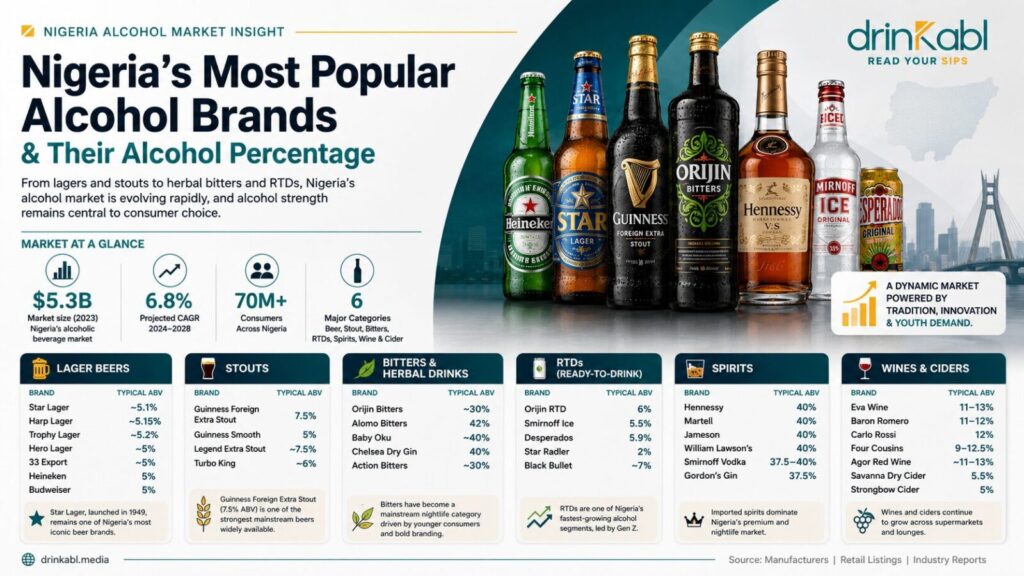
From lagers and stouts to herbal bitters and RTDs, Nigeria’s alcohol market is evolving rapidly, and alcohol strength remains central to consumer choice.
Nigeria’s alcoholic beverage market is one of Africa’s most dynamic and culturally influential industries, blending decades-old beer traditions with a fast-growing appetite for herbal alcoholic drinks, flavored ready-to-drink (RTD) beverages, premium spirits, and ciders.
While price and regional loyalty continue to shape purchasing decisions, alcohol-by-volume (ABV) percentages remain an important factor for many consumers navigating Nigeria’s increasingly crowded beverage landscape.
The market’s evolution also reflects broader lifestyle changes. Younger consumers are driving demand for sweeter, flavored, and experience-led products, while premium imported spirits continue to gain traction in nightlife and hospitality channels across Lagos, Abuja, and Port Harcourt.
Below, Drinkabl Africa breaks down some of Nigeria’s most recognizable alcohol brands, grouped by category and based on publicly available manufacturer specifications, verified retail listings, and product disclosures.
For more beverage industry analysis, market intelligence, and African drinks business coverage, visit Drinkabl Africa.
Lager Beers
Nigeria’s lager category remains the industry’s largest by volume, anchored by legacy domestic brands and globally recognized labels brewed locally.
| Brand | Category | Typical ABV | Manufacturer |
|---|---|---|---|
| Star Lager | Lager Beer | ~5.1% | Nigerian Breweries |
| Harp Lager | Premium Lager | ~5.15% | Nigerian Breweries |
| Trophy Lager | Lager Beer | ~5.2% | International Breweries |
| Hero Lager | Lager Beer | ~5% | International Breweries |
| 33 Export | Lager Beer | ~5% | Nigerian Breweries |
| Heineken | Premium Lager | 5% | Nigerian Breweries |
| Budweiser | Lager Beer | 5% | International Breweries |
Star Lager, launched in 1949, remains one of Nigeria’s most culturally recognizable beer brands, while Trophy and Hero maintain strong regional influence across southwestern and southeastern markets respectively.
Stouts
Nigeria is widely regarded as one of the world’s strongest stout-consuming markets, with consumers historically favoring fuller-bodied and higher-strength dark beers.
| Brand | Category | Typical ABV | Manufacturer |
|---|---|---|---|
| Guinness Foreign Extra Stout | Foreign Extra Stout | 7.5% | Guinness Nigeria |
| Guinness Smooth | Smooth Stout | 5% | Guinness Nigeria |
| Legend Extra Stout | Extra Stout | ~7.5% | Nigerian Breweries |
| Turbo King | Stout | ~6% | International Breweries |
Guinness Foreign Extra Stout remains among the strongest mainstream beers widely available in Nigeria, with its locally brewed formulation carrying a 7.5% ABV — significantly higher than some international variants.
Industry analysts have long linked Nigeria’s strong stout culture to consumer preference for richer taste profiles and perceived value tied to higher alcohol strength.
Bitters & Herbal Alcoholic Drinks
Herbal alcoholic drinks have become one of Nigeria’s fastest-growing alcohol segments over the past decade, blending traditional herbal associations with contemporary branding.
| Brand | Category | Typical ABV | Manufacturer |
|---|---|---|---|
| Orijin Bitters | Herbal Bitters | ~30% | Guinness Nigeria |
| Alomo Bitters | Herbal Bitters | 42% | Kasapreko |
| Baby Oku | Herbal Spirit | ~40% | Imported |
| Chelsea Dry Gin | Dry Gin | 40% | Chelsea Distillery |
| Action Bitters | Herbal Bitters | ~30% | Intercontinental Distillers |
Orijin played a major role in reshaping Nigeria’s flavored alcohol segment following its launch by Guinness Nigeria in 2013, helping establish bitters as a mainstream nightlife category rather than a niche traditional product.
The category’s rise has been fueled by younger urban consumers seeking sweeter flavor profiles and culturally resonant branding.
RTDs (Ready-to-Drink Alcoholic Beverages)
RTDs have emerged as one of the country’s fastest-growing alcohol categories, benefiting from convenience, affordability, and youth-focused marketing.
| Brand | Category | Typical ABV | Manufacturer |
|---|---|---|---|
| Orijin RTD | Herbal RTD | 6% | Guinness Nigeria |
| Smirnoff Ice | Vodka RTD | 5.5% | Guinness Nigeria |
| Desperados | Flavored Beer | 5.9% | Nigerian Breweries |
| Star Radler | Beer Mix | 2% | Nigerian Breweries |
| Black Bullet | Alcoholic Energy Drink | ~7% | International Breweries |
RTDs have become especially visible within Nigeria’s entertainment economy, where concerts, nightlife activations, and influencer marketing continue to shape consumption trends among Gen Z drinkers.
Spirits
Imported spirits dominate Nigeria’s premium alcohol segment, particularly within urban nightlife and hospitality channels.
| Brand | Category | Typical ABV |
|---|---|---|
| Hennessy | Cognac | 40% |
| Martell | Cognac | 40% |
| Jameson | Irish Whiskey | 40% |
| William Lawson’s | Scotch Whisky | 40% |
| Smirnoff Vodka | Vodka | 37.5–40% |
| Gordon’s Gin | Gin | 37.5% |
Wines & Ciders
Although smaller than beer and spirits categories, wines and ciders continue to expand steadily within supermarkets, lounges, and middle-income urban households.
| Brand | Category | Typical ABV |
|---|---|---|
| Eva Wine | Red Wine | 11–13% |
| Baron Romero | Red Wine | 11–12% |
| Carlo Rossi | Wine | 12% |
| Four Cousins | Wine | 9–12.5% |
| Agor Red Wine | Red Wine | ~11–13% |
| Savanna | Dry Cider | 5.5% |
| Strongbow | Apple Cider | 5% |
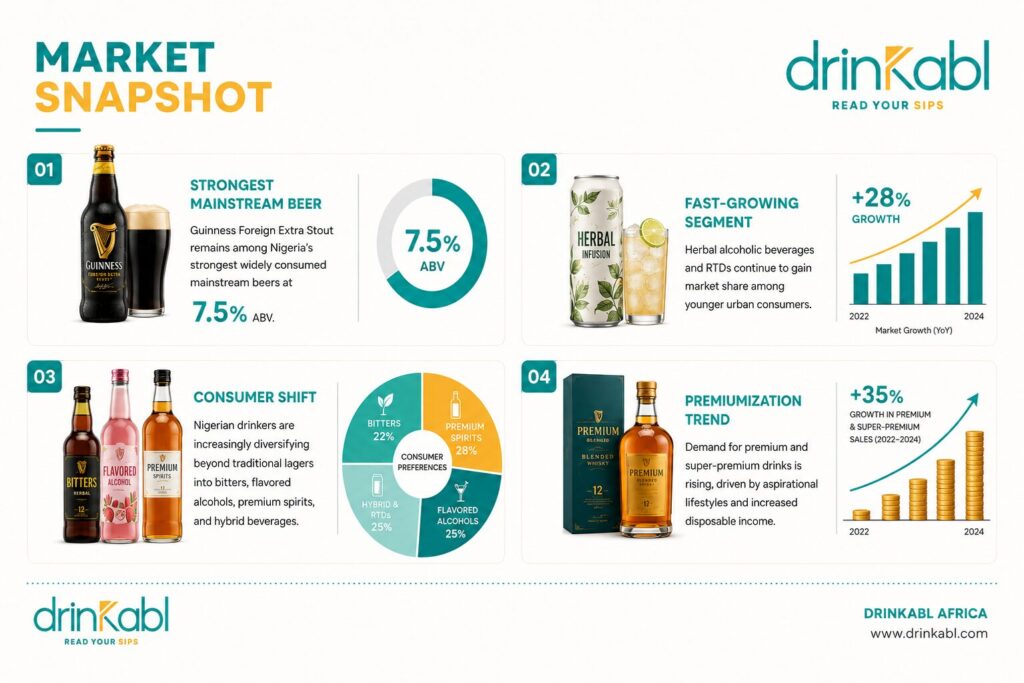
As Nigeria’s beverage industry evolves, competition is increasingly centered on flavor innovation, cultural positioning, premium identity, and alcohol strength — factors reshaping one of Africa’s most commercially important alcohol markets.
For more African beverage industry news, exclusive analysis, and market intelligence, visit Drinkabl Africa.