

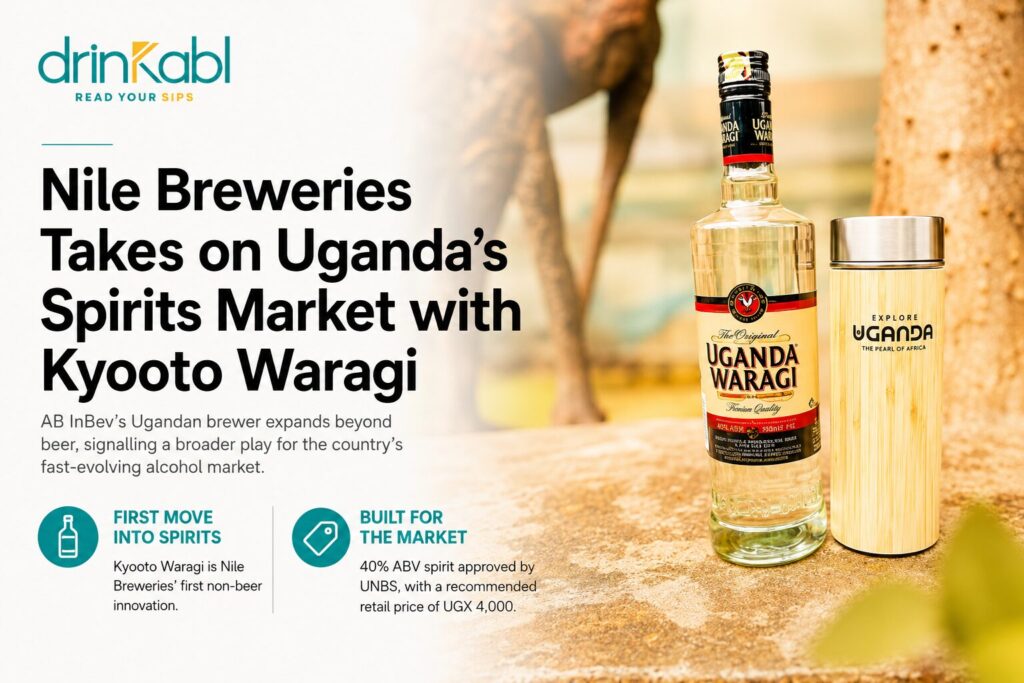
AB InBev’s Ugandan brewer expands beyond beer, signalling a broader play for the country’s fast-evolving alcohol market.
For decades, Nile Breweries has been synonymous with beer. But with the launch of Kyooto Waragi, the AB InBev-owned brewer has crossed a strategic line that could redefine its position in Uganda’s alcohol industry.
The introduction of Kyooto Waragi marks Nile Breweries’ first venture into the spirits category, expanding its portfolio beyond lagers and positioning the company to compete in one of Uganda’s most deeply rooted and commercially significant alcohol segments.
While the company describes Kyooto as a smooth 40% ABV spirit developed for evolving consumer tastes, industry observers are likely to view the launch as something much bigger: a calculated move to diversify revenue streams at a time when African beverage companies are increasingly looking beyond traditional beer to capture growth.
Speaking during the launch at Kampala’s Ndere Cultural Centre, National Sales Director Ifeoluwapo Subair said the new brand reflects the company’s longstanding commitment to quality and innovation.
“Kyooto builds on our legacy by offering a quality spirit that reflects our commitment to excellence, innovation, and meeting the evolving needs of our consumers.”
Country Head of Marketing Wangechi Gitahi described the launch as a milestone for the brewer. “Kyooto Waragi is our first non-beer innovation and a testament to our commitment to understanding Uganda’s evolving consumers. We’ve created a spirit that delivers on a simple but powerful promise: a strong start at 40% ABV and a smooth, flavourful finish with no harsh aftertaste.”
The company says the product has been approved by the Uganda National Bureau of Standards (UNBS), incorporates an advanced quality seal designed to protect product integrity and will retail at a recommended price of UGX 4,000 through its nationwide distribution network.
More Than a New Bottle
The significance of Kyooto extends beyond another shelf addition.
Across Africa, brewers are increasingly confronting slower beer volume growth, shifting consumer preferences and rising competition from spirits, ready-to-drink beverages and flavoured alcoholic products. As a result, leading beverage companies are broadening their portfolios rather than relying solely on beer.
For Nile Breweries, entering the waragi category allows the company to participate in drinking occasions where beer has traditionally played a secondary role. It also enables the brewer to leverage an extensive distribution infrastructure already servicing thousands of bars, wholesalers and retail outlets across Uganda.
That network could become one of Kyooto’s greatest competitive advantages, allowing Nile Breweries to scale more quickly than newer entrants without building an entirely separate route-to-market system.
Why Waragi?
Waragi occupies a unique position in Uganda’s drinking culture.
Unlike premium imported spirits, the category enjoys widespread consumption across urban and rural markets and remains accessible to a broad range of consumers. The recommended retail price of UGX 4,000 places Kyooto firmly within the mainstream segment, suggesting the company is prioritising scale and market penetration over premium positioning.
The launch also reflects growing confidence in Uganda’s formal spirits market, where consumers are becoming increasingly conscious of product authenticity, quality assurance and regulatory compliance amid longstanding concerns over illicit alcohol.
By emphasising UNBS approval and product integrity features, Nile Breweries appears intent on differentiating Kyooto from unregulated alternatives while reinforcing consumer trust.
A New Competitive Chapter
The move inevitably raises competitive questions.
Uganda’s spirits market is already populated by established local and international brands, making Kyooto’s success dependent on more than brand awareness. Winning market share will require convincing consumers to switch from familiar labels in one of the country’s most competitive beverage categories.
The launch also signals an important evolution in Nile Breweries’ identity. Historically recognised as one of Uganda’s leading beer producers, the company is now positioning itself as a broader beverage alcohol business, a strategy increasingly adopted by global beverage groups seeking resilience through portfolio diversification.
Whether Kyooto becomes a standalone success or the foundation of a wider spirits portfolio remains to be seen. But its arrival suggests Nile Breweries is no longer content to compete solely in beer.
What Comes Next?
The real test begins after the launch celebrations.
Industry watchers will be looking for early indicators of consumer acceptance, distribution reach and retail uptake over the coming months. Just as importantly, attention will turn to whether Kyooto represents a one-off product introduction or the first step in a broader spirits strategy that could include new variants, flavour extensions or expansion into neighbouring East African markets.
If the brand gains traction, Nile Breweries’ move could encourage further portfolio diversification across Uganda’s beverage sector, intensifying competition not only in spirits but across the country’s broader alcohol market.
For now, Kyooto Waragi is more than a new product. It is a strategic statement that one of Uganda’s biggest brewers intends to compete wherever consumers choose to drink.