

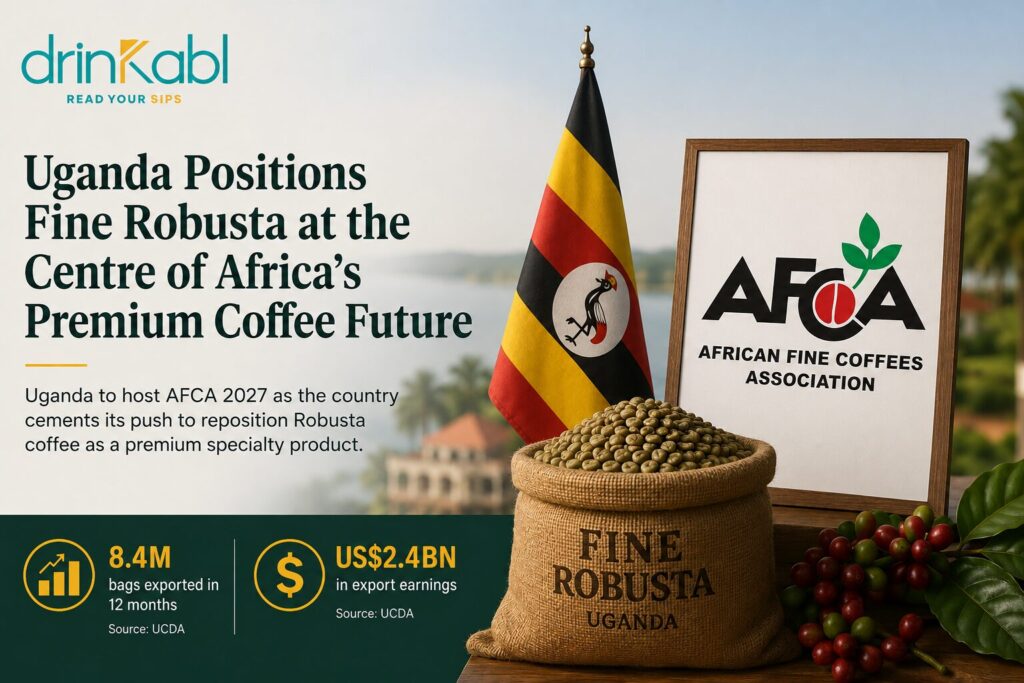
Uganda will host the 23rd African Fine Coffees Conference and Exhibition (AFCA 2027) at the Speke Resort and Conference Centre, Munyonyo, in a move expected to draw more than 1,000 coffee professionals, traders, roasters, producers, exporters and investors to Kampala. The event, organised by the African Fine Coffees Association, cements Uganda’s growing influence in the global coffee trade. It also signals the country’s ambition to reposition Robusta coffee as a premium specialty product rather than a bulk commodity.
The conference lands at a high point for Uganda’s coffee sector. According to UCDA, the country exported approximately 8.4 million 60-kilogram bags of coffee over a recent twelve-month period, generating around US$2.4 billion in export earnings, one of the strongest years in the country’s coffee history. Uganda is now Africa’s largest coffee exporter by volume, having overtaken Ethiopia, although Ethiopia still earns higher export revenues due to its larger share of premium Arabica. Coffee remains Uganda’s leading agricultural export, supporting millions of smallholder farmers and underpinning foreign exchange earnings.
Uganda’s ambitions extend well beyond volume. The country’s specialty segment has gained international recognition through a series of record-breaking auctions, starting with the AFCA-run Fine Robusta Auction, where premium lots sold for as much as US$52.25 per kilogram, evidence of strong international demand for high-quality Robusta. That result followed Uganda’s landmark specialty sale known as Paradigm Shift, which achieved a record price of roughly US$350 per kilogram and underscored specialty buyers’ willingness to pay substantial premiums for exceptional coffees. Together, the results reflect a shift in how the specialty industry views carefully produced Robusta, long overshadowed by Arabica.
Reclaiming Robusta’s Identity
Uganda is widely recognised as the birthplace of Coffea canephora, commonly known as Robusta, and more than 80 percent of the country’s coffee exports consist of the variety. Historically, much of this coffee has entered international supply chains anonymously, blended into commercial products and sold as commodity stock with no recognition of origin or quality. Ugandan policymakers and industry leaders are now working to change that narrative. The strategy centres on developing Fine Robusta as a premium category, building stronger origin branding, improving processing standards, expanding traceability and connecting directly with specialty buyers.
Speaking on Uganda’s direction, Kyakulaga, the Minister of State for Agriculture, has previously stressed the importance of increasing value addition and lifting Uganda’s coffee higher within global markets. Industry stakeholders have echoed the point, arguing that Uganda must capture more value from a coffee heritage that is already internationally recognised.
AFCA 2027: Looking Beyond Production
The upcoming conference will feature business networking, exhibitions, cupping competitions, policy discussions, investment forums and technical sessions on the future of African coffee. Participants are expected from producing countries across Africa as well as importing markets in Europe, North America, Asia and the Middle East. For Uganda, hosting the event is an opportunity to present an evolving identity, from reliable supplier of commodity coffee to recognised origin of premium specialty Robusta. Industry leaders hope it will strengthen trade relationships, attract investment into processing and value addition, and expand market access for Ugandan producers.
A Turning Point for African Coffee
Climate change, sustainability demands and shifting consumer preferences are reshaping the global coffee industry, pushing African producers to differentiate through quality, traceability and origin branding. Uganda’s strategy reflects that broader transformation. Rather than competing solely on volume, the country is aiming to prove that Robusta can command premium prices when produced to specialty standards.
The success of recent specialty auctions and the decision to host AFCA 2027 point to Uganda positioning itself at the forefront of a new chapter for African coffee, one in which Fine Robusta earns recognition as a distinctive, high-value product in its own right. Whether that repositioning translates into sustained pricing power will depend on how far processing, traceability and direct buyer relationships scale beyond the auction lots that have captured headlines so far, a test that will play out across the millions of smallholder farms that still supply the bulk of Uganda’s crop.
Read More