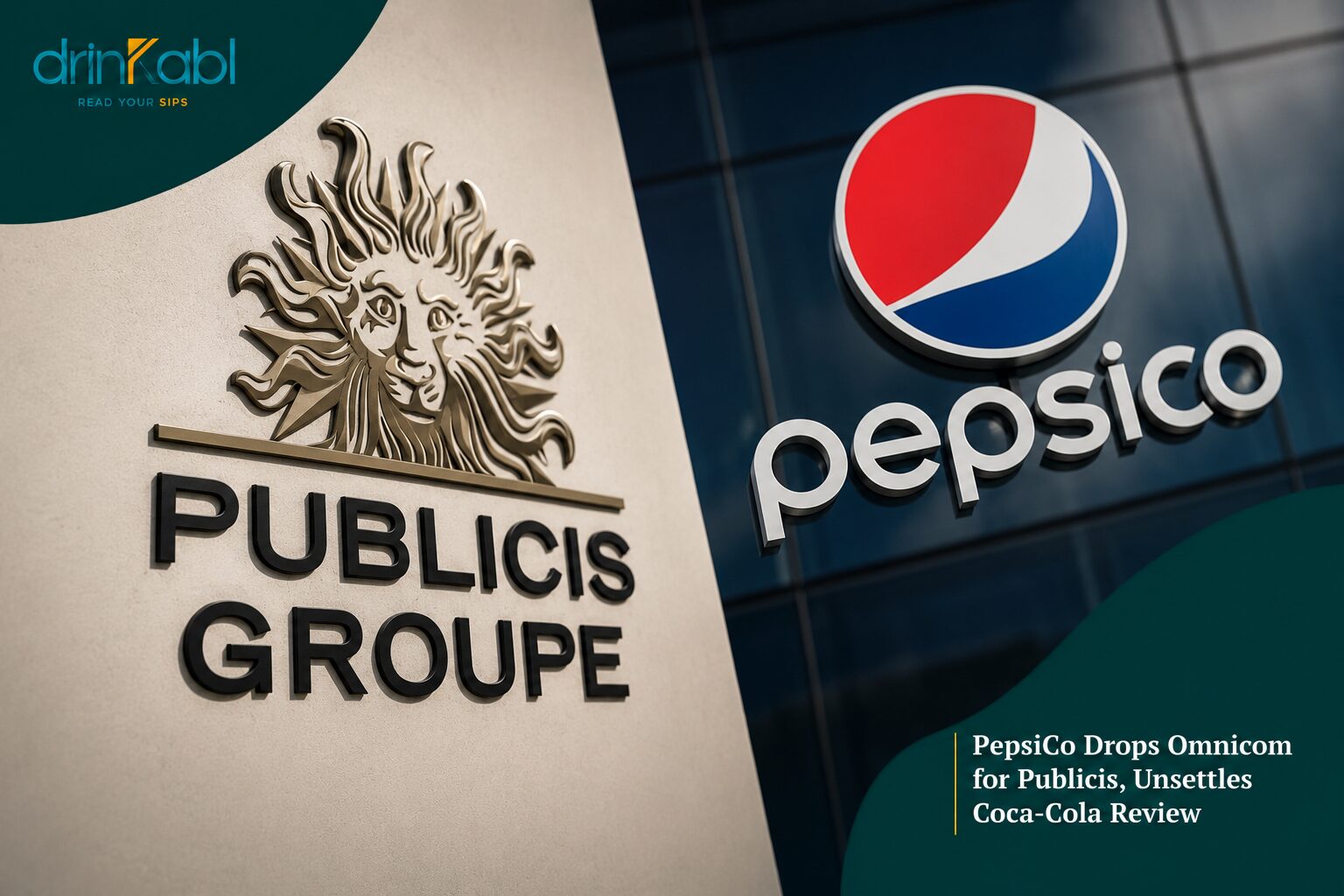

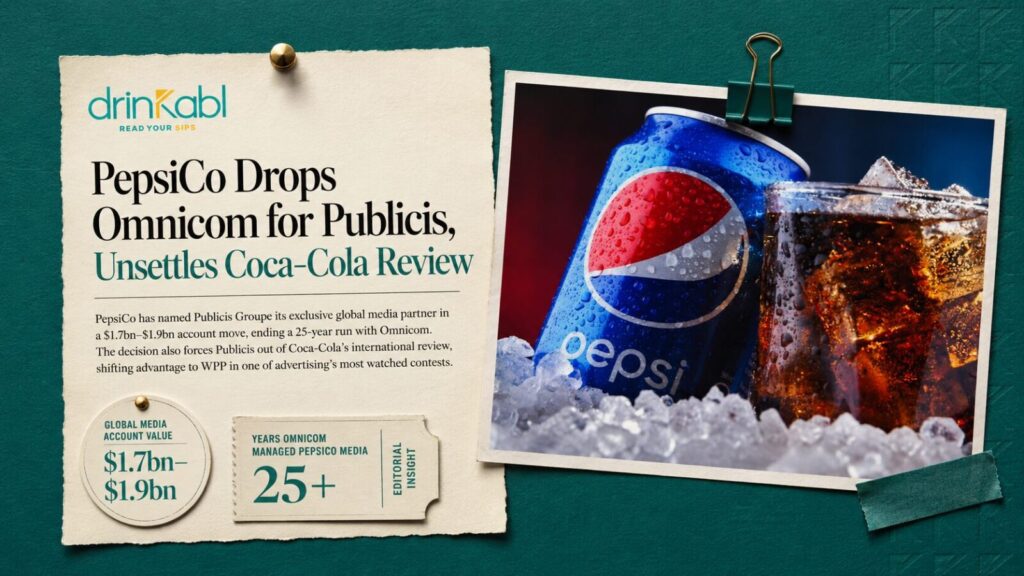
PepsiCo has named Publicis Groupe its exclusive global media partner, moving an account worth an estimated $1.7 billion to $1.9 billion a year away from Omnicom after more than 25 years together. The switch also has a second effect: Publicis is now withdrawing from Coca-Cola’s international media review, handing an advantage to WPP in one of advertising’s most closely watched contests.
PepsiCo did not run a conventional pitch to make the decision. Instead, it conducted a capabilities review and picked Publicis to build a global model spanning media strategy, planning, activation, data, connected identity and technology across more than 200 markets. The account covers PepsiCo’s full portfolio, including Pepsi, Gatorade and Lay’s.
Estimates of the account’s size vary by source. COMvergence figures cited by MediaPost put PepsiCo’s annual media investment at about $1.9 billion, including roughly $780 million in North America. Other trade reports put the global figure closer to $1.7 billion. Neither number should be confused with PepsiCo’s total marketing spend, which reached $5.4 billion in 2025, including $3.4 billion on advertising. The Publicis assignment covers the media component of that budget, not PepsiCo’s entire marketing operation.
A 25-year Omnicom relationship ends
Omnicom has run PepsiCo’s media buying since the late 1990s, with OMD leading the account in major markets including the United States and the United Kingdom. Some reports put the relationship closer to three decades. A partnership that long carries institutional memory: how the client buys media, how its brands are managed, how budgets move and how results get measured.
Omnicom will not disappear from PepsiCo altogether. A PepsiCo spokesperson told Adweek that Omnicom remains a “critical strategic partner” in creative, sports and public relations. Omnicom, for its part, pointed to the length and success of the relationship and to recent wins at other accounts, including Adidas, Dyson, IBM, Subway, Uber, Delta, Novo Nordisk, On and CVS, following its merger with Interpublic Group.
Investors reacted quickly. Omnicom shares fell after the news broke, while Publicis and WPP both gained ground as the market weighed the new balance of power.
Why Publicis won without a pitch
Publicis was not a stranger to PepsiCo. It won PepsiCo’s China media business in 2022 through a competitive pitch, building a dedicated unit called PLUS+ by Publicis to run media, creativity and technology for Pepsi, Gatorade, Lay’s, Quaker and other brands in the market. It later extended that relationship into other regions.
That history helps explain how PepsiCo could hand Publicis a global mandate through a review rather than a multi-agency contest. The agency already understood the client’s brands and operating requirements. It also fits how Publicis has positioned itself in recent years, combining media, data and technology under what it calls a “Power of One” model, rather than operating as a traditional collection of separate agency brands.
The appointment signals a broader shift in how large advertisers pick partners. The question is moving away from who can produce the sharpest campaign, toward who can build the infrastructure needed to interpret data, deploy artificial intelligence and measure results at global scale. PepsiCo’s own transformation strategy, built around a “One PepsiCo” model, leans heavily on technology and AI to simplify decision-making. That said, the media appointment is one piece of that transformation, not the whole of it; PepsiCo has separately explored broader AI marketing work with firms including Omnicom, Accenture, Deloitte and Publicis Sapient.
The Coca-Cola fallout
The timing has turned this into two stories at once. Coca-Cola has been running its own international review covering media, data science and technology, with WPP and Publicis competing for the business. That review followed Coca-Cola’s move toward what it calls a digital-first marketing operating system, including a shift toward agentic tools and away from traditional media planning.
Publicis already runs Coca-Cola’s North American media business, won from WPP in 2025 in a deal reportedly worth about $800 million. That put Publicis in an odd position: an existing Coca-Cola partner in one region while challenging WPP for the rest of the company’s international account, an account COMvergence estimates at roughly $1.715 billion. Becoming PepsiCo’s global media partner makes that conflict unworkable, and Publicis is stepping back from the Coca-Cola contest as a result.
WPP, Coca-Cola’s incumbent global network partner through its Open X structure, now looks better placed to keep the international business. Coca-Cola’s North America account, Japan and South Korea remain outside the scope of that review, as do its global creative and PR relationships with WPP.
What it means for Africa
The development is not simply a dispute between agency holding companies in London and Paris. Both PepsiCo and Coca-Cola sell into highly fragmented African markets, where consumers move between television, radio, mobile, TikTok, WhatsApp and informal trade in ways a global system cannot always anticipate from headquarters.
A consolidated global media operation can bring purchasing scale, stronger data infrastructure and unified measurement. But understanding why a campaign that works in Lagos falls flat in Nairobi, or why a Ghanaian audience needs a different tone than a South African one, is not something technology alone solves. That gap is where local agencies still have an advantage global systems cannot easily replace, and it is likely to matter as Publicis rolls out PepsiCo’s new model across the continent’s markets.
For African beverage marketers, the larger point is that the contest between global drinks brands increasingly plays out through the data, media and AI systems built behind the advertising, not only through the advertising itself.