

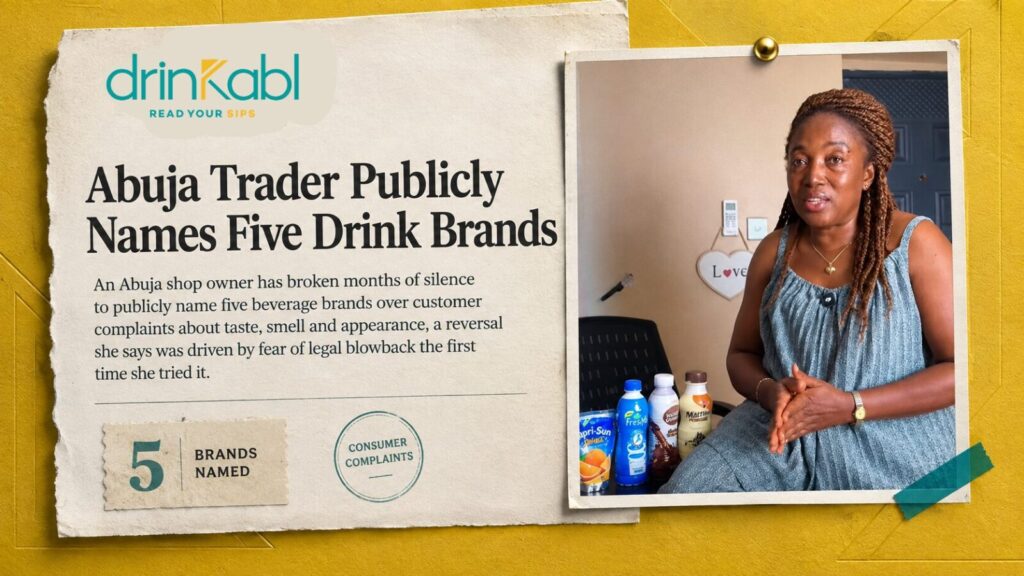
An Abuja shop owner has broken months of silence to publicly name five beverage brands over customer complaints about taste, smell and appearance, a reversal she says was driven by fear of legal blowback the first time she tried it.
In a Facebook video that has spread widely across Nigerian social media, Love Dooshima singled out Viju Baked Yoghurt, CWAY NutriChoco, FreshYo, Capri-Sun and Maltina. She told viewers she had previously avoided showing logos or naming brands because she feared the consequences, and because she wanted to “see her grandchildren.”
That fear has a documented basis. In April 2026, Dooshima spent several hours in police custody after a separate viral video, in which she claimed a loaf of bread had stayed fresh on her shelf for nearly two months, drew a cyberstalking complaint from the bakery involved. She was released after midnight following interventions by rights lawyers, and the case reportedly continues in court. In her new video, she referenced that episode directly, saying she now refuses to hide brand names or logos “because I wasn’t even speculating.”
None of the products she displayed has been independently confirmed as adulterated, counterfeit or unsafe. The claims are allegations that would need batch-level investigation and laboratory testing before any conclusion can be drawn.
Viju Baked Yoghurt: a complaint before expiry
A regular customer returned a bottle of Viju Baked Yoghurt, insisting it had expired. Dooshima said she checked the label and found a manufacture date of 25 July 2026 and an expiry date of 24 January 2027, meaning the bottle had not yet reached its printed shelf life. She stopped selling the product anyway, saying her staff told the distributor about the video and were told other customers had raised similar complaints. That claim has not been independently verified. Dooshima said she will not restock the yoghurt “until something is done about it.”
CWAY NutriChoco and a lumpy return
A second customer returned a bottle of CWAY NutriChoco, saying it smelled off and tasted different from what she remembered, and that the contents looked lumpy once poured out. Dooshima again said the product had not expired. An expiry date does not guarantee every unit holds up under every storage condition, and establishing what went wrong would require examining the actual bottle and its batch records. CWAY’s water business has drawn its own regulatory scrutiny this year: NAFDAC disclosed in September that operators had been refilling 19-litre CWAY-branded bottles with water from unapproved sources and supplying them to hotels and supermarkets.
FreshYo and the counterfeit question
Dooshima’s shop sits near a school, where parents buy drinks for their children on the way in, and FreshYo, including its smaller packs, is among her best sellers. She said counterfeit versions of the product are circulating, though she was careful to note that the packs shown in her video were genuine. Her real question to the brand was what manufacturers can do to protect legitimate stock once counterfeits reach the market. In a later video, Dooshima said a FreshYo representative told her the brand has no fake product in circulation and that both its yellow-labelled and unlabelled packs are authentic, but that the representative did not address her wider concerns. That response has not been independently verified, and FreshYo has issued no public statement of its own.
Capri-Sun: ‘the major culprit’
Dooshima called Capri-Sun the “major culprit” among the five, pointing to videos she said she had seen online of opened pouches containing dark material. Her evidence here rests partly on footage she encountered elsewhere rather than products she examined herself, which makes it the weakest of her five claims. She appealed directly to the brand to explain what she had seen.
Maltina and an unidentified object
The video’s most graphic moment involves a bottle of Maltina, where Dooshima says she found an object she compared to a used condom. That description is her own characterisation, not a confirmed identification. Whether the object is genuinely foreign matter, and how it would have entered a sealed bottle, is exactly the kind of question that needs packaging checks, batch tracing and lab work rather than a visual inspection on camera. In the video, Dooshima urged viewers to “tear it open in our presence” and to “sue the brands” if they find anything incriminating.
What regulators say
The video lands in the middle of a bruising month for Nigeria’s food and drug regulator. NAFDAC Director-General Mojisola Adeyeye told reporters in Lagos that the agency had removed more than 7,000 products from circulation after visiting over 6,000 facilities between May and July, and had secured 64 convictions for counterfeiting since 2025. Days after a national newspaper’s report on suspected fake yoghurt, palm oil and other foods went viral, Adeyeye cautioned that social media allegations alone cannot establish that a product is adulterated or unsafe, and that credible complaints need scientific verification first. “Counterfeiters are not ghosts; they exist within our communities,” she said, urging Nigerians to use NAFDAC’s official complaint channels rather than relying on video evidence alone.
Two different problems
Dooshima’s own framing complicates a simple counterfeit story. She insists the products in her video are genuine, while also saying fakes exist alongside them for at least one brand. That leaves two separate questions for regulators and manufacturers to answer: whether counterfeit products are circulating under real brand names, and whether genuine products are reaching shelves below expected quality. The first needs authentication and supply chain tracing. The second needs batch investigation, storage records and lab testing. Treating every unusual bottle as proof of counterfeiting, or every complaint as proof of a manufacturing fault, risks obscuring which problem is actually at play.
What happens next
Dooshima has urged consumers to record themselves opening suspicious products and to escalate anything unusual to brands and regulators rather than posting and moving on. The most useful evidence in any of these cases would combine the batch number, manufacturing and expiry dates, packaging condition, storage history and an unopened sample from the same batch, handed to NAFDAC for testing. Until the named manufacturers respond directly and any formal complaints are investigated, the claims against Viju Baked Yoghurt, CWAY NutriChoco, FreshYo, Capri-Sun and Maltina remain unverified allegations, not established findings.