
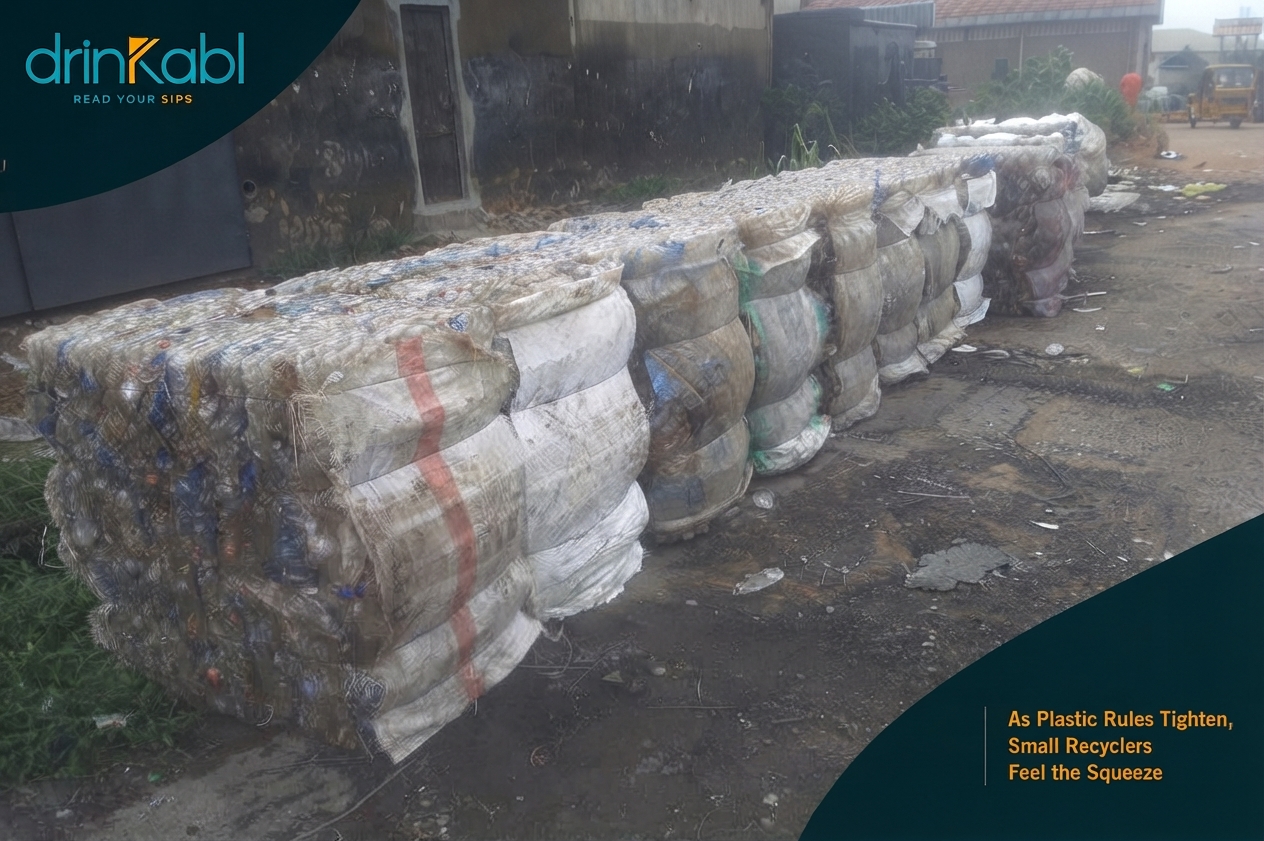

Nigeria’s new plastic regulations put the burden on producers. At the bottom of the chain, a Lagos PET aggregator says price swings and scarce capital decide whether the bottles get collected.
Nigeria’s new plastic rules make producers answerable for the waste their packaging creates. The people who collect that waste say one question is still open: who pays for the work of gathering and preparing it?
The National Environmental (Plastic Waste Control) Regulations, 2026, were unveiled in Abuja on September 3. They tighten producer responsibility, recycling and recovery requirements across the plastics value chain. The National Environmental Standards and Regulations Enforcement Agency (NESREA) says the rules will cut plastic pollution, strengthen producer accountability and stimulate recycling.
The policy direction is clear. The effect on the small businesses that gather, compress and move discarded plastic is less certain. Drinkabl Media visited one of them, APEX Recycling Limited in Lagos.
Price, not supply, is the problem
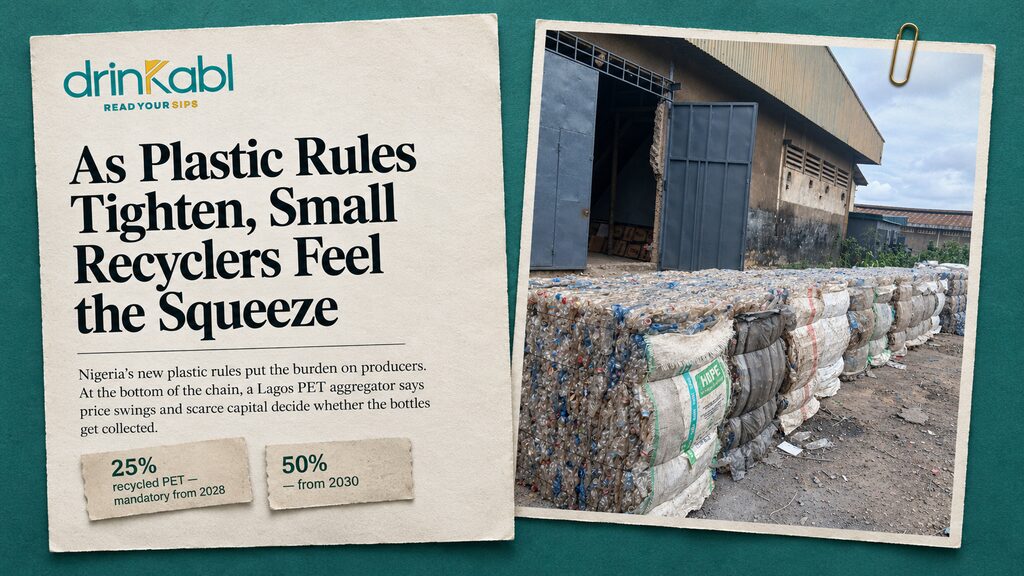
Shitu Kafayiat, APEX’s acting manager, said the company handles several types of waste, and PET has become one of its strongest. APEX does not do the final recycling. It buys collected PET bottles, compresses them into bales and takes them to a refiner further up the chain.
The operation handles about a tonne of PET a day at most, Kafayiat said. She described the business as still young at that scale.
Asked what limits it, she did not point to a shortage of bottles. “It’s price,” she said. Collection has become more competitive as more people enter the trade, she said. Collectors and aggregators switch buyers for a better offer, and a gap of about ₦10 per kilogram is enough to redirect supply. Volumes coming into APEX have risen since January. More buyers chasing the same bottles does not automatically mean better margins.
The squeeze also comes from the other side. Kafayiat said refiners sometimes cut what they will pay after APEX has already bought stock in bulk, leaving the expected profit thin.
A market built by small collectors
Bottles are being picked up because they now carry a cash value. Kafayiat pointed to women who gather PET in small quantities and bring it to recyclers. “They don’t count it as waste anymore,” she said. Drinkabl Media’s team has noticed fewer discarded bottles on the street.
Each woman’s haul is small. Together they form the first link in the supply chain. Kafayiat said many people avoid the trade because the work is dirty, and she wants government to encourage more of them to enter it.
What the rules ask of producers
Nigeria has spent years building its Extended Producer Responsibility (EPR) framework. The principle is simple: companies that put plastic packaging on the market should help deal with it after use. NESREA says the new regulations follow the polluter-pays principle. Its national EPR guideline for plastic packaging assigns roles to producers, producer responsibility organisations, retailers and waste management actors. NESREA also registers collectors and recyclers under the programme.
The new rules add dates. NESREA Director-General Innocent Barikor said mandatory recycled PET content starts at 25 per cent on January 1, 2028, and rises to 50 per cent by January 1, 2030. That creates demand for recycled resin, and resin needs bales.
The rules are contested. The Manufacturers Association of Nigeria has raised objections, and NESREA has rejected calls to suspend the regulations, saying they are not anti-industry.
For large manufacturers, the regulations bring compliance and investment obligations. For small recyclers, the test is whether those obligations become a stronger market for what they collect.
Kafayiat said APEX pays taxes and charges to several bodies. She called that normal for any company and did not name the agencies. Her concern is size. “I don’t believe it should be huge,” she said.
She also said upfront costs put off some would-be entrants, because people start with very different amounts of capital. A government can demand more recycling. If the businesses doing the collecting cannot stay afloat, the system will struggle to hit the recovery rates the rules require.
Big money is moving in
Large beverage companies are already funding collection and processing. The Coca-Cola System in Nigeria commissioned a packaging collection hub in Apapa, Lagos, on January 31, 2025. It can process up to 13,000 metric tonnes of plastic bottles a year. The hub collects PET, produces clean bales and supports rPET production through third-party partners. Coca-Cola’s global goal is to help ensure collection of the equivalent of 70 to 75 per cent of the bottles and cans it puts on the market by 2035.
The Coca-Cola Foundation and USAID funded the Nigeria Plastic Solutions Activity equally, a $4 million programme launched in May 2024 and run by TechnoServe. It aimed to recover about 49,000 tonnes of plastic waste and build the capacity of 24 aggregators and 9,500 collectors. TechnoServe lists it as a 2023 to 2025 programme.
In March 2026, Indorama Ventures, Nigerian Breweries and Genesis Energy announced a Lagos plant to produce up to 45,000 tonnes of food-grade rPET resin a year. Start-up is targeted for the first half of 2027, subject to regulatory approvals and technical validation. Indorama supplies recycling technology, Nigerian Breweries local market ties and Genesis Energy infrastructure expertise.
The bale comes before the resin
That is a very different scale from a tonne a day. The two still depend on each other.
A 45,000-tonne plant cannot run on announcements. On Drinkabl Media’s arithmetic, that capacity is roughly 123 tonnes of resin a day, or about 123 APEX-sized operations before any process losses. The plant needs a steady flow of bottles that have been collected, sorted and prepared to specification.
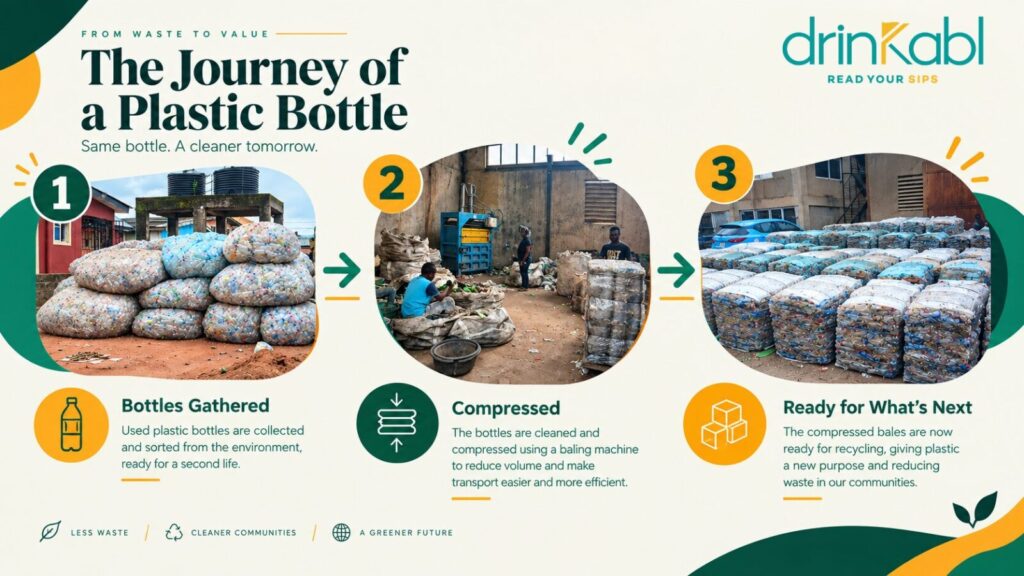
Indorama’s plants elsewhere show the sequence: bottles are sorted, washed and shredded into flakes before conversion into resin. Before any of that, someone has to collect and bale them.
Policy conversations tend to focus on producers and large processors. The collection layer gets less attention. If collection prices turn unattractive, collectors leave. If small aggregators cannot finance purchases, volumes fall and the plants downstream have less to process. Compliance costs that rise without matching revenue can push small operators out of the formal system.
What would help
Kafayiat’s answer was capital. Buying in bulk takes money, she said, and small firms do not have much of it. She wants government to provide loans to small recyclers, or at least help with the interest on bank loans. She agreed that government could come in as an investor, and said officials should ask small companies what they need.
The policy architecture is already deep. The National Policy on Plastic Waste Management dates from 2021, and its implementation guideline was presented in Abuja in November 2025. NESREA says the 2026 regulations are meant to attract investment and create jobs. For that to happen, recycling has to work as a business as well as a compliance exercise.
The gap to close
Nigeria no longer needs to convince people that PET has value. Bottles are being collected because they sell. The harder task is keeping every link in one working chain: the woman with a sack of bottles, the aggregator baling a tonne a day, the beverage company funding a hub and the plant making food-grade rPET. The regulations set the responsibility. The economics at the bottom of the chain will decide whether enough bottles reach the plants to meet it.