

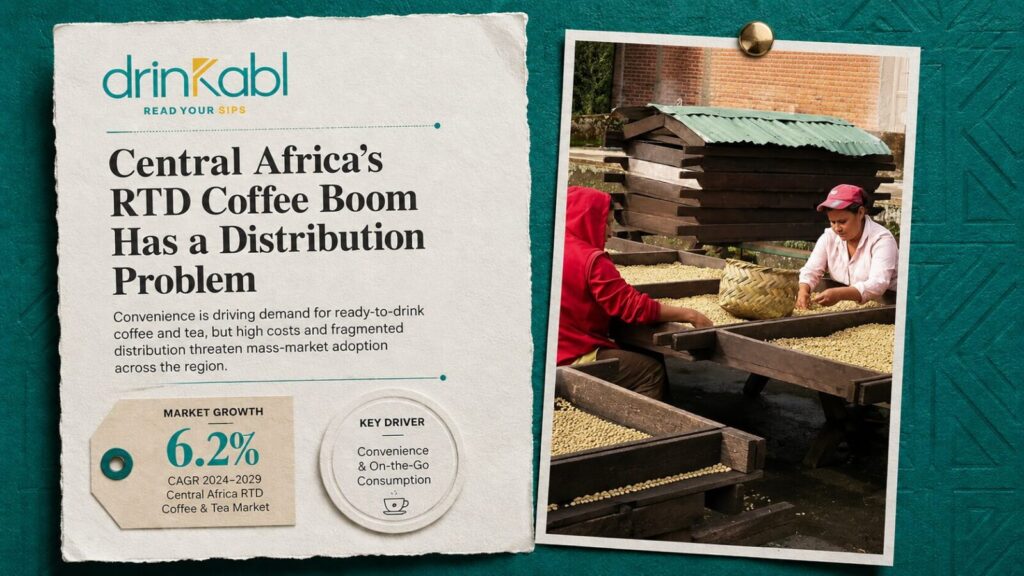
Central Africa’s ready-to-drink coffee and tea market is developing around a simple consumer proposition: less preparation, more portability. The harder commercial question is whether beverage companies can make that proposition affordable and widely available enough to move beyond urban convenience occasions.
The latest Statista Market Insights data points to continued growth in Central Africa’s RTD coffee and tea category, with convenience and on-the-go consumption identified as important demand drivers. The market covers packaged liquid coffee and tea sold through both retail and hospitality channels, rather than dry coffee or tea products.
That distinction matters. RTD is not simply another way of selling coffee or tea. It changes the consumption occasion. A consumer who would normally prepare a drink at home can instead buy a chilled product while commuting, working or shopping. For manufacturers, that creates an opportunity to compete not only with other packaged beverages but with the preparation habit itself.
The opportunity is particularly relevant as African beverage consumption becomes more fragmented. Research on Africa’s RTD tea market points to urbanisation, portability and changing lifestyles as important category drivers, while grocery and convenience channels remain central to distribution.
But convenience has a cost. A ready-to-drink product carries packaging, processing and distribution expenses that loose tea or instant coffee does not. In markets where consumers remain highly price-sensitive, that can limit the category’s ability to move from affluent urban consumers into mass consumption. The commercial challenge is therefore not simply to create a better RTD drink. It is to create one that survives the economics of local retail.
Distribution makes that problem sharper. African RTD tea sales remain heavily weighted toward off-trade channels, with traditional retail playing a significant role in several markets. That means packaging has to work across informal shops and convenience outlets, not just supermarkets and cafés.
The product itself is also changing. Statista identifies growing interest in healthier and more natural RTD coffee and tea, while its Central Africa analysis points to demand for low-sugar, preservative-free and natural formulations. That creates space for herbal, fruit-infused and unsweetened variants rather than another heavily sweetened soft drink wearing a tea or coffee label.
The coffee side has a different opportunity. Statista identifies urbanisation, changing lifestyles and demand for convenient caffeine as drivers of RTD coffee in Central Africa. Global packaging and beverage suppliers are already treating RTD tea as a category with room for substantial expansion, suggesting that manufacturers see convenience formats as more than a temporary trend.
Africa’s beverage companies are already learning that convenience can create new occasions. Drinkabl.media has tracked the expansion of RTD formats in alcohol, while recent reporting on Nigeria’s beverage market shows manufacturers increasingly competing across categories rather than defending a single traditional drink.
For Central Africa, the opportunity is therefore less about copying the global RTD playbook and more about adapting it to local economics. The brands that win will need products consumers can afford, packaging that can travel through fragmented distribution and flavours that feel locally relevant.
The category may be growing. The real test is whether RTD coffee and tea can become everyday beverages rather than premium urban conveniences.