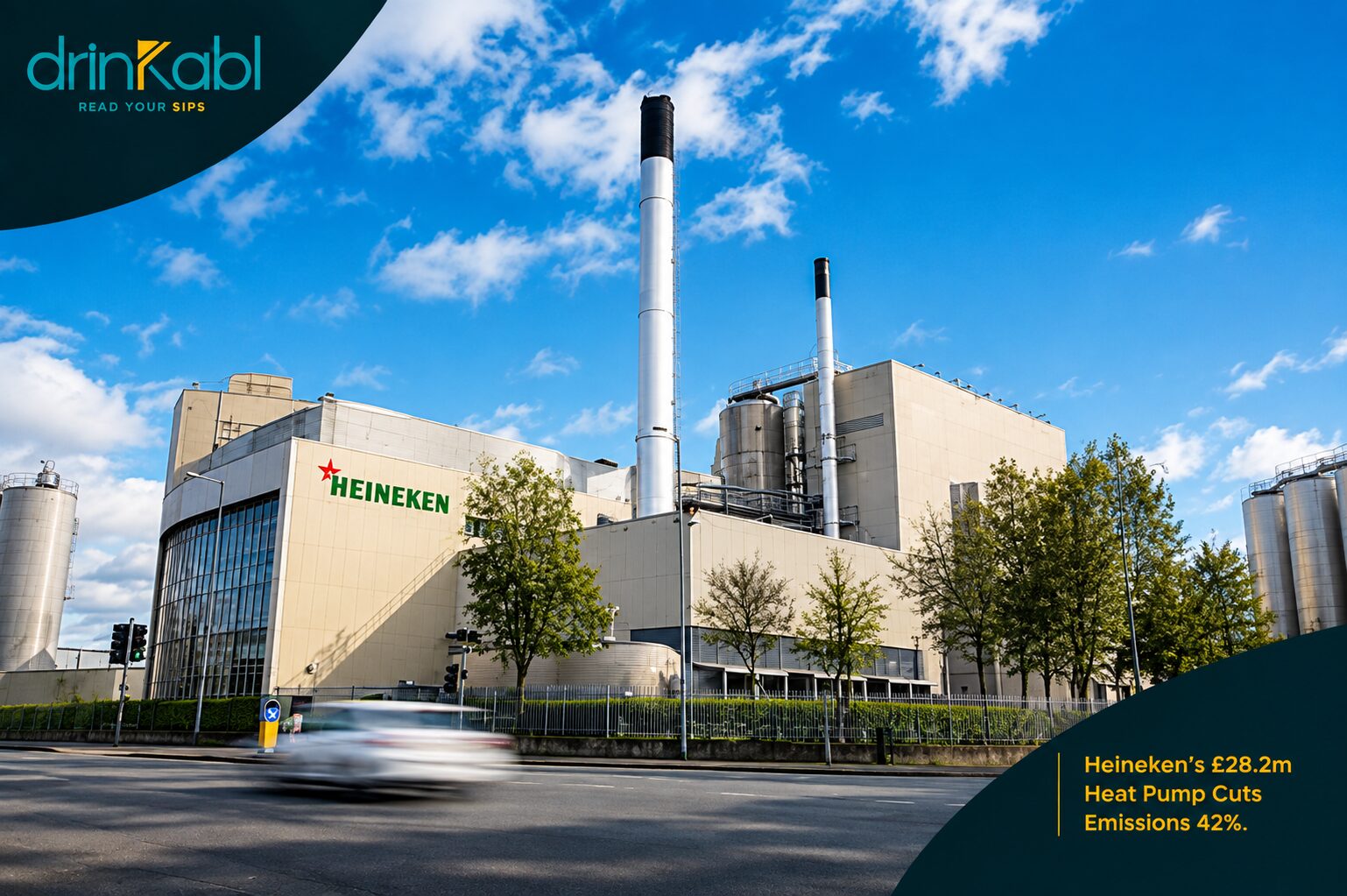

Heineken UK has cut carbon emissions intensity at its Manchester brewery by 42% after a £28.2 million investment in large-scale heat pump technology, giving the brewer a working example of how an established plant can cut fossil-fuel use without stepping back from industrial-scale production.
The brewery has also reduced on-site natural gas use by a third since the heat pump network was commissioned in June 2025. The figures compare July to December 2025 with the same period in 2024, before the system came online.
That comparison matters because Manchester isn’t a small pilot site. It’s Heineken UK’s largest brewery, employing more than 240 people and producing around 2.5 million pints a day of Heineken, Foster’s, Cruzcampo, Birra Moretti, Amstel and Red Stripe.
Turning waste heat into power
The system recovers heat generated during brewing, upgrades it through industrial heat pumps, and distributes it around the site through an interconnected network powered by renewable electricity. In practice, Heineken is changing how the brewery generates and moves heat rather than simply using less of it.
Installation began in 2023, when Heineken first announced a £25 million investment. The final cost rose to £28.2 million, helped by a £3.7 million grant from the UK’s Industrial Energy Transformation Fund. Heineken calls it the first retrofit of this scale anywhere in its global operations. The brewery has now entered a 12 to 18 month optimisation phase, meaning the current numbers may not be the ceiling. The company says the system is already delivering 80% of its estimated gas reduction.

Why Manchester matters beyond Manchester
Breweries need large amounts of heat for brewing, cleaning and packaging, which makes replacing gas-fired heat at a running plant far harder than switching electricity suppliers or fitting solar panels. Manchester is Heineken’s test case for tackling that harder problem: process heat. The company is using the results to inform a wider strategy targeting net-zero emissions across scopes 1 and 2 by 2030.
Cutting gas use also reduces exposure to fossil-fuel prices, which makes a major manufacturing site less vulnerable to energy-market swings. Heineken points to that resilience as a business case for heat pumps that stands on its own, separate from the sustainability argument.
The people behind the numbers
The project also has a workforce story. Heineken says it required close collaboration between engineers, project managers and brewery staff, who adapted daily operations while the new system went in.
That history runs deep at the site. Manchester marked 150 years of brewing in 2025, and technical operator Danny Donohue has worked there for 39 years, long enough to have watched the brewery shift from largely hands-on operations to today’s technology-heavy production.
For Heineken, the question is no longer whether an old, high-volume brewery can run on less gas. Manchester is answering that. The bigger question is whether the model can be replicated elsewhere, and whether the capital and electricity infrastructure needed can make industrial heat pumps commercially attractive at scale. For an industry under pressure to cut emissions without cutting output, that may be the number that matters more than the 42%.
Read more: