

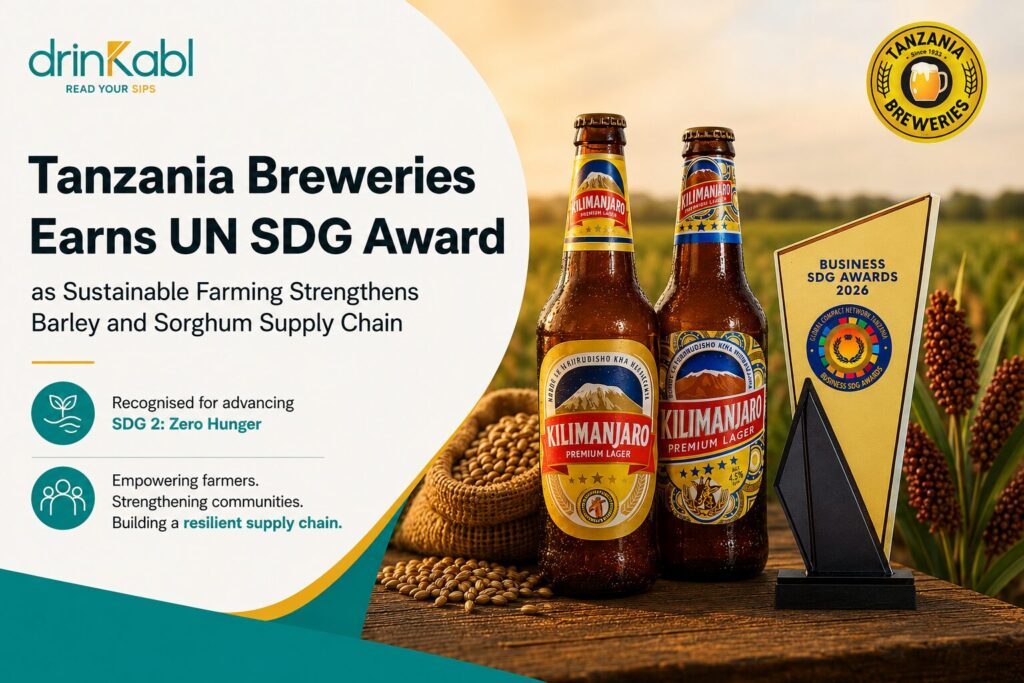
As Sustainable Farming Strengthens Barley and Sorghum Supply Chain
Tanzania Breweries Limited (TBL PLC) has received recognition at the 2026 UN Global Compact Business SDG Awards, earning the People, Corporate Category award for Sustainable Development Goal 2, Zero Hunger. The recognition highlights the brewer’s long-term investment in sustainable agriculture and its efforts to strengthen the supply chain supporting its beer production.
The award, presented by the Global Compact Network Tanzania, acknowledges TBL’s work with smallholder farmers who supply barley and sorghum, two of the company’s most important brewing ingredients. Rather than relying solely on imported raw materials, the brewer has continued investing in local agricultural production to improve supply security while supporting rural livelihoods.
For Africa’s brewing industry, the recognition reflects a broader commercial reality. Climate variability, rising production costs and supply chain disruptions have increased the importance of dependable local sourcing. Brewers that can improve the productivity and resilience of domestic farming communities are better positioned to reduce procurement risks and manage raw material availability over the long term.
TBL said its smart agriculture programmes provide farmers with technical knowledge, improved farming practices and market opportunities designed to increase yields while strengthening household incomes. The company noted that the initiative creates shared value by improving both agricultural resilience and business continuity across its value chain.
The brewer also said it has been recognised consistently since the Business SDG Awards were introduced, reflecting a sustained commitment to sustainable development rather than a single project or campaign.
The award adds to a growing body of evidence that sustainability programmes are becoming operational investments instead of corporate social responsibility initiatives. Across Africa, brewers are increasingly tying environmental and social commitments directly to supply chain performance, particularly in markets where locally grown grains account for a significant share of brewing inputs.
For beverage producers, securing reliable supplies of barley, sorghum and other agricultural commodities has become increasingly important as weather shocks, inflation and global logistics pressures continue to reshape ingredient markets. Investments that improve farmer productivity can also help stabilise sourcing costs while supporting governments’ ambitions to increase local agricultural value addition.
As African brewers continue expanding local sourcing strategies, the industry’s competitive advantage may depend as much on resilient farming networks as it does on brewing capacity. Recognition such as TBL’s signals that sustainable agriculture is becoming an increasingly important business strategy for beverage companies operating across the continent.
Read More: