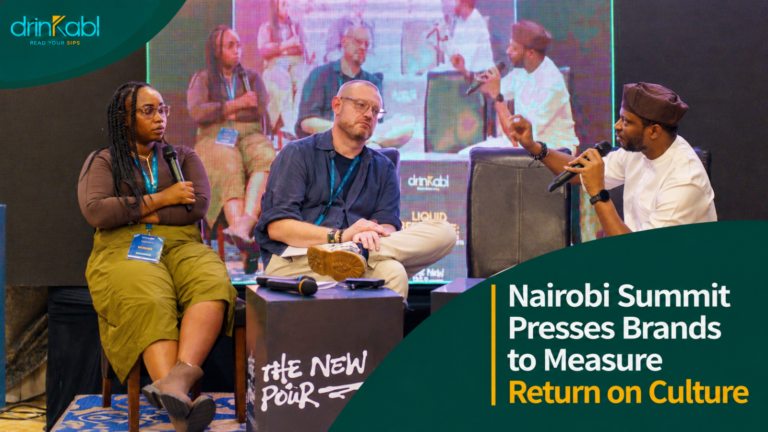


At a recent Bottling Brilliance webinar hosted by Drinkabl Africa, strategist Juwon Olugboye argued that alcohol bans often fail for a simple reason: consumers adapt faster than regulators expect.
Across Africa, governments are tightening control over alcohol through taxes, retail restrictions and, in some cases, outright bans. Policymakers frame these interventions as public health measures. The beverage industry sees them as market disruptions. Consumers often see them differently.
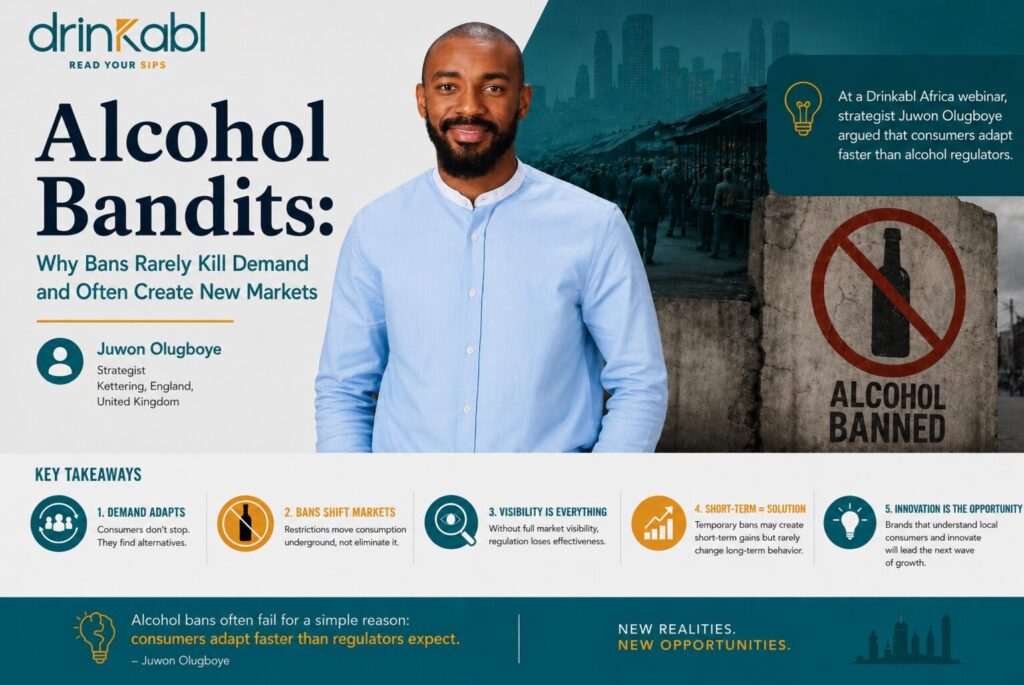
The session explored what happens after a ban is introduced and whether regulators are measuring the right outcomes. For Olugboye, the starting point is straightforward. “The demand is not going to go away. The need is a lot more innate than that.” The discussion covered recent regulatory trends across African markets, from Kenya’s attempts to formalise alcohol distribution channels to South Africa’s temporary pandemic alcohol bans and the growing debate around excise taxes. Olugboye acknowledged that governments are often responding to legitimate concerns. “These problems are real. They are real problems that need to be solved.” The problem, he argued, is that policymakers frequently confuse restricting access with changing behaviour.
When Consumers Go Elsewhere
One of the strongest themes from the session was substitution. Consumers rarely respond to restrictions by abandoning consumption entirely. Instead, they look for alternatives. “The only thing that unifies everybody is that they will look for an alternative. The next question is how?” Olugboye said. That alternative may be an informal distributor, an unlicensed retailer or a homemade substitute. The unintended consequence is that regulation designed to improve public safety can sometimes create greater risk. Olugboye pointed to historical examples where local alcohol products were banned only for governments to later reverse course after illicit alternatives caused greater harm. “They had to unban because the illicit version was even killing more people because it was totally unregulated.”
The webinar repeatedly returned to a central tension in alcohol policy: regulators can control legal supply far more easily than they can control demand.
The Kenya Problem
Kenya’s proposed restrictions on alcohol sales were discussed as a useful case study. On paper, limiting sales to regulated channels appears sensible. In practice, Olugboye argued that success depends on having complete visibility across the market. “For you to effectively achieve that, you almost need to have a perfect system where everything is tracked, where everything is covered, where all your channels are visible to you.” That level of oversight remains difficult in many African markets where informal retail still accounts for a significant share of consumer transactions. Without that visibility, demand often shifts into channels regulators can neither monitor nor tax.
What South Africa Got Right and Wrong
South Africa’s pandemic alcohol ban remains one of the most cited examples of aggressive alcohol regulation. Olugboye acknowledged that the policy achieved certain short-term goals. “The data showed that it really cut down domestic abuse in that period.” The longer-term results were less convincing. “The moment they lifted it, all the things that people did not do in those few months, people came back and did.” His argument was not that the intervention produced no benefits. Rather, temporary restrictions should not be confused with permanent behavioural change. “It doesn’t solve the foundational problem. It doesn’t go away.”
Why Regulators Underestimate Human Behaviour
Moderator Tosin Balogun argued that many policy interventions fail because they overlook a basic aspect of consumer psychology: restrictions can increase the cultural appeal of a product. Referencing historical examples, he noted that banned products often acquire an element of exclusivity and rebellion, particularly among younger consumers. “There’s something about that consumer behaviour that usually results from a ban that has a layer of mischief to it.” The effect is well documented across multiple industries. Scarcity creates curiosity. Restriction can become marketing. That dynamic helps explain why illicit markets frequently survive even under aggressive enforcement.
The Sin Tax Debate
The conversation also examined the global rise of so-called sin taxes. Olugboye took a pragmatic view. Governments face real costs from alcohol abuse, tobacco consumption and related health challenges. “They are actually costs on the government side.” From healthcare systems to public safety, governments often carry the burden of social consequences linked to excessive consumption. But he also acknowledged a more direct motivation. “If I see you declaring billions of dollars in profit, I need to get my share of that pie.” For beverage companies, the challenge is familiar. Higher taxes eventually find their way into retail pricing, and consumers absorb much of the pressure.
The Opportunity Hidden in Innovation
If regulators continue tightening alcohol controls, where should beverage companies look for opportunity? Olugboye believes innovation matters more than resistance. He pointed to ready-to-drink products, flavoured beverages and lower-alcohol formats as potential growth areas. “RTDs can be a magic bullet for a lot of these brands.” He also suggested that African beverage companies should pay closer attention to local consumption habits, from zobo to tiger nut drinks and informal beverage innovations emerging outside corporate R&D departments. His broader point was that consumers are often ahead of companies.
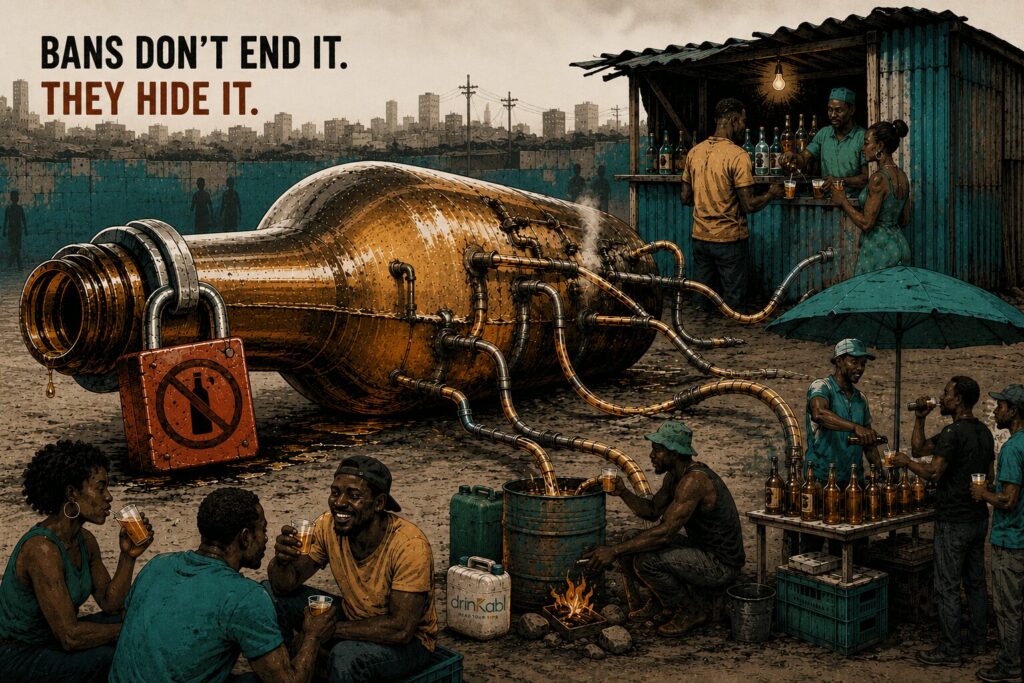
“The consumers are the most innovative. They are the best product developers.”
For regulators, the lesson from the webinar was equally direct. Success should not be measured solely by what disappears after a ban. As Olugboye put it: “You’ll feel it because you will see it all around you that this thing is not working.” The harder question is what emerges in its place. In beverage markets, that answer often determines whether regulation solves a problem or simply moves it somewhere else.
READ MORE