

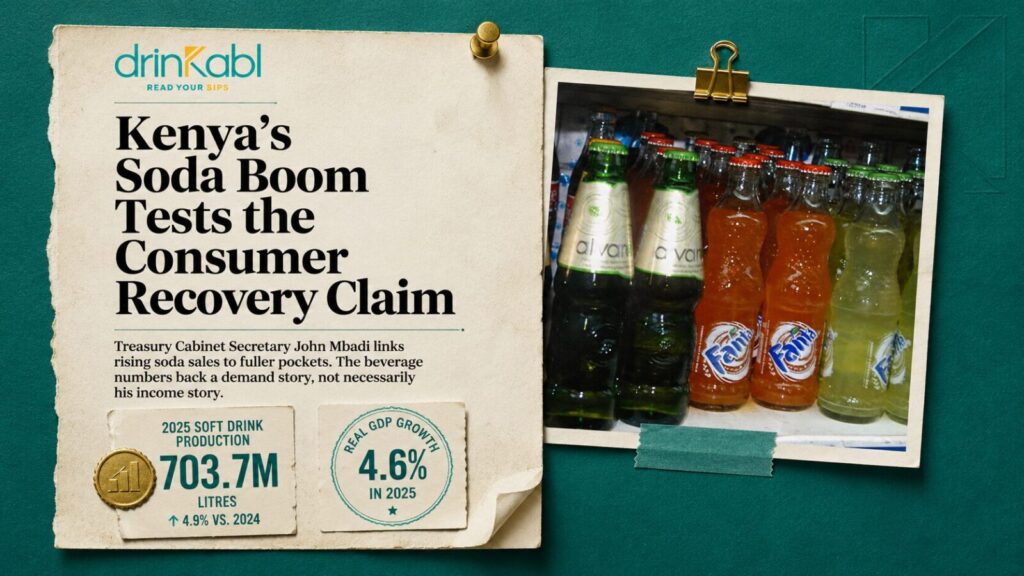
Treasury Cabinet Secretary John Mbadi links rising soda sales to fuller pockets. The beverage numbers back a demand story, not necessarily his income story.
Kenya’s Treasury Cabinet Secretary John Mbadi has pointed to rising soda consumption as proof of economic recovery, arguing that Kenyans buy soft drinks when they have “a little more” in their pockets. The beverage data supports stronger demand. It does not, on its own, prove his conclusion about household income.
The numbers behind the claim
Kenya’s soft-drink production reached 703.7 million litres in 2025, up 4.9% from 671.1 million litres in 2024, according to the Kenya National Bureau of Statistics. That followed a steeper 15.6% jump the year before. Output stayed ahead in 2026: production hit 356.2 million litres in the first half of the year, an 11.4% rise from 319.8 million litres over the same period in 2025.
Where the argument breaks down
The KNBS series measures production, not household spending. Rising output can reflect stronger demand without confirming that consumers have more disposable income, since population growth, distribution reach, pricing and shifting habits all move beverage volumes independently of wages.
A mixed economic picture
Kenya’s real GDP grew 4.6% in 2025 and quickened to 5.3% in the first quarter of 2026, while private consumption rose 4.7% last year. Real average earnings improved 2.0% in 2025, the first gain in six years, but that followed five straight years of decline.
“People take sodas when there is a little more in their pockets.”
John Mbadi, Treasury Cabinet Secretary
Inflation reached 6.5% in July, with food and non-alcoholic beverages up 9.0% and transport costs up 15.6%, per KNBS’s latest price data. Kenya added 822,100 jobs in 2025, yet 87.2% landed in the informal sector, where pay is generally less predictable.
What it means for beverage companies
The more useful reading for manufacturers is that demand is holding up even as household budgets stay pressured. Drinkabl.media has reported that Africa’s beverage shoppers are spending selectively, choosing where each naira or shilling goes even as total volumes climb.
For distributors, the signal worth tracking is not the topline soda figure. It is which pack sizes, price points and buying occasions are driving the extra volume, that breakdown is where Kenya’s soda boom turns into usable market intelligence, more useful than a theory about loose change in people’s pockets.
Read More