

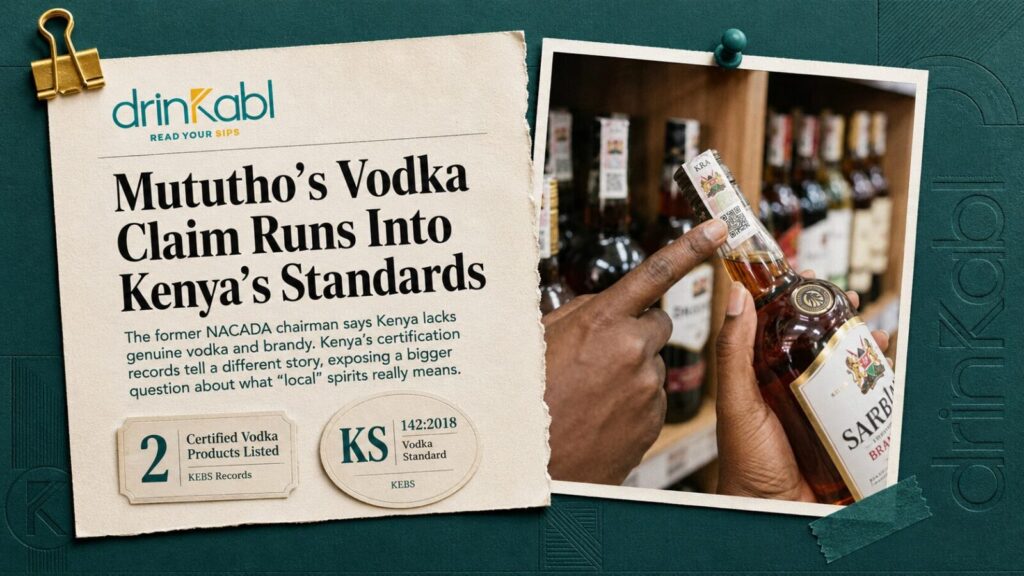
The former NACADA chairman says Kenya lacks genuine vodka and brandy. Kenya’s certification records tell a different story, exposing a bigger question about what “local” spirits really means.
Former NACADA chairman John Mututho’s claim that Kenya does not produce genuine vodka has returned to the spotlight, reviving a question that sits at the intersection of spirits manufacturing, raw-material sourcing and counterfeit alcohol.
Mututho first made the claim in February 2024, shortly after deaths linked to illicit alcohol in Kirinyaga. In remarks reported by Kenyans.co.ke, he said any Kenyan company claiming to make vodka should invite him to inspect its production process.
“For Vodka, there are specific seeds used in its manufacture,” Mututho said, arguing that Kenyan manufacturers did not have access to the necessary inputs. He made a similar argument about brandy, saying production required wine made from white or red grapes. T
The problem with the claim is that Kenya clearly has a regulatory framework for these categories. The Kenya Bureau of Standards maintains KS EAS 142:2018, Vodka Specification, alongside standards for brandy and neutral spirit. More importantly, KEBS records show locally manufactured vodka and brandy products carrying Standardization Marks. Its current database lists Safari Brandy, produced by London Distillers Kenya, as valid under the East African brandy standard. A separate KEBS record lists Juzz Vodka, made by Maspot Distillers, as a certified potable spirit with vodka flavour. KEBS records therefore make a blanket claim that Kenya has no locally manufactured vodka or vodka-category products difficult to sustain.
That does not mean every bottle sold as vodka is genuine. Kenya’s counterfeit-alcohol problem is substantial. Recent enforcement has uncovered branded bottles, counterfeit stamps, empty packaging and large quantities of ethanol being used in illicit operations. NTV Kenya recently reported the recovery of hundreds of cartons of suspected counterfeit spirits packaged in bottles bearing familiar vodka and spirit brands.
The distinction matters. A counterfeit vodka is not evidence that legitimate Kenyan vodka production does not exist. The more useful industry question is where the inputs come from. A spirit can be manufactured locally while relying on imported neutral alcohol or other imported raw materials. Local production, therefore, does not necessarily mean a fully Kenyan supply chain. That is the gap Mututho’s argument points toward, even if his conclusion goes further than the available evidence.
For legitimate distillers, the distinction has commercial consequences. Manufacturers carry certification, taxation, testing and compliance costs while counterfeiters can reuse genuine bottles, copy labels and avoid much of that cost structure. Kenya’s KEBS certification system requires locally manufactured products to meet applicable standards, with factory inspection and product testing forming part of the certification process.
Mututho’s warning therefore deserves scrutiny, but not because Kenya has no vodka. The harder question is how much of Kenya’s spirits industry is genuinely local, how dependent it is on imported inputs, and whether consumers can reliably distinguish compliant products from counterfeit ones.
That is a supply-chain and market-integrity problem. And unlike the question of whether Kenya makes vodka, it cannot be settled by a television interview alone.