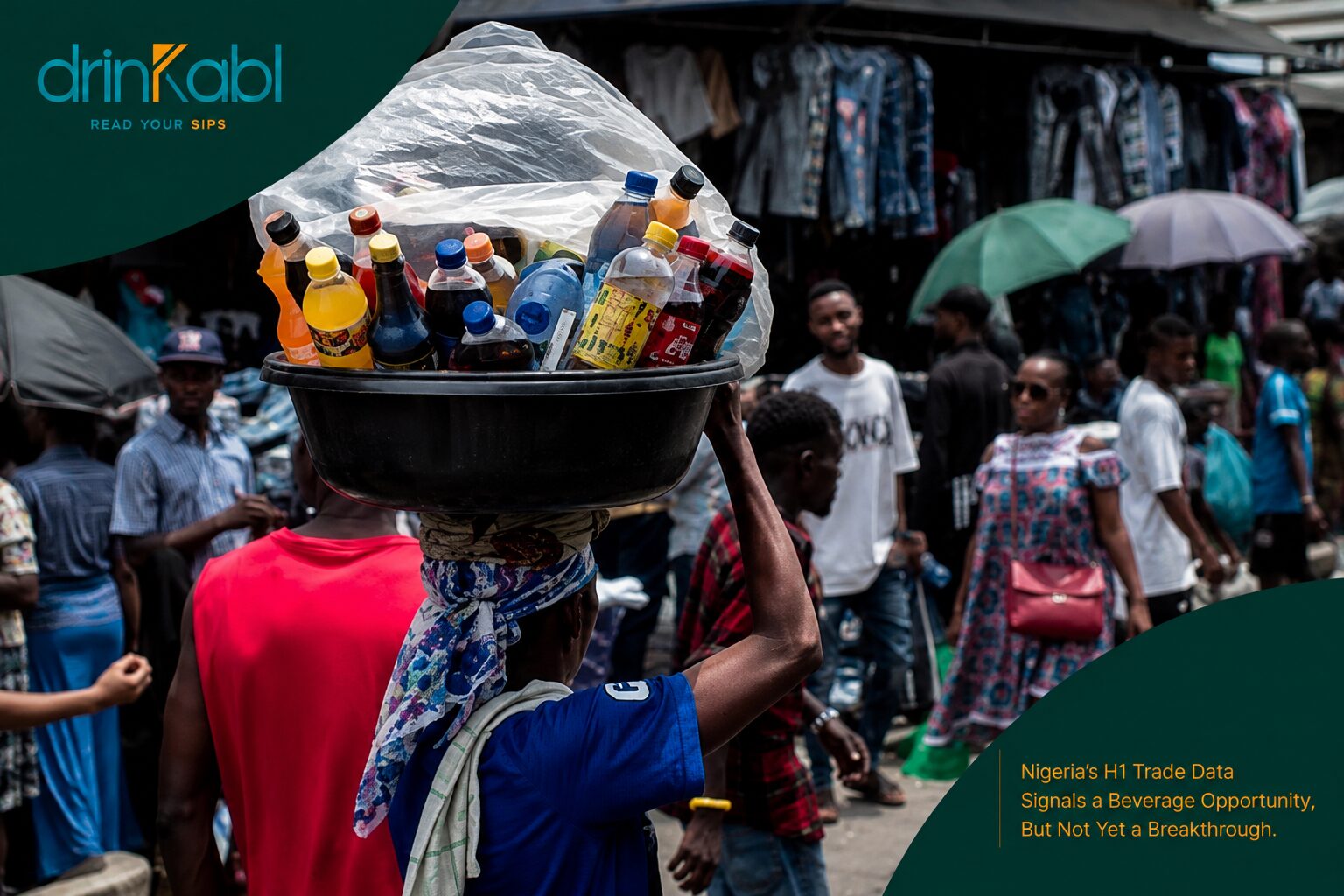

Nigeria closed the first half of 2026 with stronger trade numbers across the board: rising customs revenue, a booming free trade zone, and a sharp jump in exports to China. For the beverage industry, the headline figures look encouraging. But a closer read shows the country is still manufacturing on the back of imports, and rising beverage revenue does not yet prove Nigerians are drinking more.
The Trade Numbers
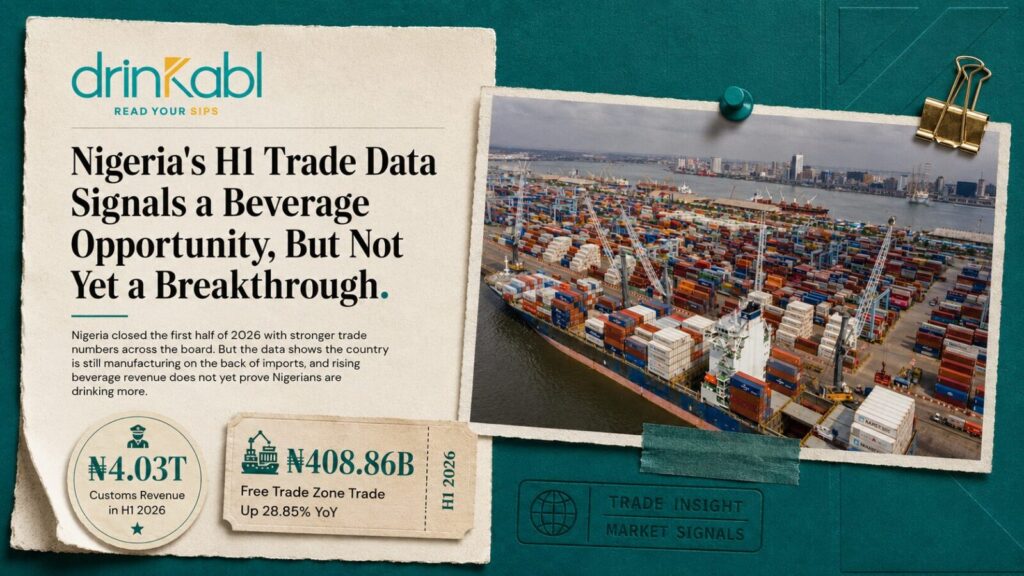
Nigeria entered the second half of 2026 with a stronger trade infrastructure story than the headline figures alone suggest. Customs revenue reached ₦4.03 trillion in the first six months of the year, driven by automation and intelligence-led enforcement. Trade through the Lagos Free Trade Zone and Lekki Deep Seaport generated ₦408.86 billion, up 28.85 percent year-on-year. At the same time, Chinese imports from Nigeria rose 81 percent to about $2.25 billion, following Beijing’s zero-tariff policy for African exporters.
For the beverage industry, those numbers matter. But they need to be read carefully. The clearest takeaway is that Nigeria is getting better at moving goods through formal channels and collecting revenue from that trade. That creates a better operating environment for beverage manufacturers, who depend on predictable clearance times, port charges, and container availability to move raw materials, packaging, and finished products. A brewer or soft-drink maker doesn’t experience trade policy as an abstract statistic. It experiences it through how fast goods clear the port and what that costs.
What the Import Bill Still Shows
The second finding is less comfortable: Nigeria is still importing heavily to manufacture. The latest available NBS foreign trade report, covering Q1 2026, recorded ₦13.62 trillion in imports, with manufactured goods accounting for ₦8.48 trillion, or 62.3 percent of the total. China alone supplied roughly ₦5.1 trillion of Nigerian imports during the quarter.
That distinction matters for anyone assuming that Nigeria’s improving trade balance automatically signals stronger domestic industrial capacity. It doesn’t. A beverage manufacturer can produce locally while remaining deeply exposed to imported machinery, packaging components, chemicals, and ingredients. Local production and import independence are not the same thing.
The China Opening
The export side offers a more genuine opportunity, but one that still needs proof. China’s imports from Nigeria rose sharply after Beijing introduced zero-tariff treatment for eligible African countries on May 1, with monthly growth above 40 percent in both May and June. Bilateral trade reached roughly $17.4 billion over the six-month period.
That is a meaningful opening for Nigerian manufacturers. But it does not yet prove export diversification. Nigeria can sell more to China without exporting significantly more finished beverages. If the increase is concentrated in commodities and other primary products, the country has gained market access without changing the structure of its export economy.
That is where the beverage industry should pay attention. Nigeria already has beverage companies with the brands, production assets, and distribution systems capable of serving markets beyond its borders. The harder question is whether those businesses can turn local manufacturing into repeatable export businesses, rather than simply producing for a large domestic market.
The Domestic Picture
The local numbers add an interesting counterpoint. The three largest listed brewers generated about ₦1.41 trillion in H1 2026 revenue: Nigerian Breweries at ₦803.68 billion, Guinness Nigeria at ₦265.04 billion, and International Breweries at ₦342.07 billion.
That looks like a recovery story until it’s examined more closely. The companies have not released enough volume data to establish that Nigerians actually bought more beer. Revenue can rise because prices rise, and that distinction matters after the brewers raised prices and absorbed higher taxes and operating costs. Drinkabl’s recent reporting found the three major brewers recorded ₦112.87 billion in combined H1 tax expenses, up about 58 percent year-on-year.
The Real Test
So the H1 picture is more complicated than a straightforward recovery. Nigeria is collecting more efficiently at the border. Trade infrastructure is gaining capacity. Export access to China is improving. Domestic beverage revenues are rising. Yet the underlying economy still depends on imported manufactured goods, and beverage revenue growth cannot automatically be read as volume growth.
For beverage companies, the opportunity is to move one step further down the value chain. Nigeria doesn’t need to prove it can export more commodities. It needs to prove it can consistently export finished, branded, competitively priced products. That would change what the trade numbers actually mean.
The next set of data worth watching, then, isn’t simply the size of Nigeria’s trade surplus. It’s the composition of exports, the volume of manufactured goods leaving Nigerian ports, the share of locally sourced production inputs, and whether beverage companies can build export markets without losing their domestic margins.
Nigeria’s trade story is improving. The beverage industry’s test is whether it can help change what Nigeria trades.
Read More