
A clip of Don Vultaggio has been circulating for a few days now, and the comment section tells you everything about why it landed. “Dang may he always keep winning,” one viewer wrote, pulling over a thousand likes. Another compared a $1.50 large can at their local 7-Eleven and still called it reasonable. A third summed up the appeal in six words: “He’s got heart and isn’t consumed by greed.”
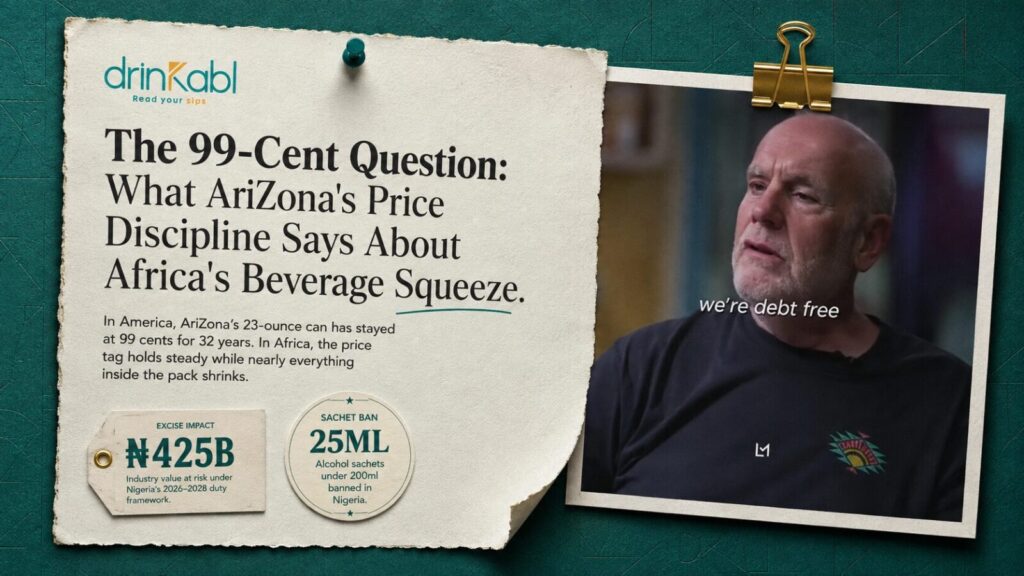
The chairman of AriZona Beverages has kept his 23-ounce iced tea can at 99 cents since he founded the company in 1992, a fact he restates in almost every interview he gives, this one included. “We’re successful. We’re debt free. We own everything,” he says, before delivering the line that made the clip travel. “Why have people who are having a hard time paying their rent have to pay more for our drink? Maybe it’s my little way to give back.”
It is a good story, and it happens to be true. It is also, for anyone who covers this industry on the African side of the ledger, a useful provocation. Because the two beverage economies Drinkabl.media tracks most closely, Nigeria’s and Kenya’s, are currently running something close to the opposite experiment. Where Vultaggio has spent three decades refusing to touch a sticker price, African manufacturers have spent the last three years touching almost everything except the sticker price: the can, the sachet, the bottle, the gram count, the ABV, the shelf position. The number on the label barely moves. Nearly everything wrapped around it quietly shrinks.
The mechanics behind a frozen price
Vultaggio’s answer to “how do you do that” is worth taking seriously as a business model rather than a slogan. In the clip and in earlier interviews with TODAY, he lists the same three levers every time: faster production, tighter shipping, thinner cans. AriZona is privately held, carries no debt, and owns its own plants and distribution, which means there is no lender, private equity sponsor, or public shareholder demanding a quarterly margin defence. When aluminium tariffs added roughly 40 percent to his can costs this year, Vultaggio told TODAY he was absorbing a $40 million hit directly rather than passing it through, betting instead that volume growth would claw the money back over time.
That is a genuinely unusual position for a beverage company of any size, and it is worth naming the condition that makes it possible: stable input costs in dollar terms, a currency that does not devalue against itself, and three decades of compounding scale in the world’s largest consumer market. None of that describes Lagos, Nairobi, or Accra.
Africa’s version of the same instinct, running in reverse
Nigerian and Kenyan manufacturers are chasing the identical goal Vultaggio names, keeping a product inside a price point a low-income consumer can still reach, but they are doing it by shrinking the product instead of protecting the can. Businessday reported that Nigerians are increasingly buying smaller pack sizes and lower-priced value brands as a direct response to two years of naira devaluation, and that this shift now shapes how manufacturers design entire product lines rather than just react to cost spikes. PZ Cussons runs tiered soap brands alongside its premium Imperial Leather line for exactly this reason, and household categories that never used to come in sachets, cleaning liquids, disinfectant, now do.
Kenya’s version of the same pressure produced a regulatory response rather than a shrug. The Competition Authority of Kenya ruled this year that it would permit shrinkflation but mandate disclosure, forcing brands to flag when pack sizes fall while shelf prices hold, after food inflation touched its highest rate since 2023. Nigeria has already had its own reckoning on this front: a viral video in January showed a green sticker claiming 96 diapers in a pack pasted directly over a factory print of 88, a small scandal that became a proxy war over exactly how much manufacturers can quietly take from a pack before it counts as deception.
Vultaggio’s version of this dilemma is a thinner aluminium can nobody notices. Nigeria’s version was a sticker over a sticker, on camera.
Sachets were the actual 99-cent economy, and regulators are dismantling it
If there is one product format on this continent that plays the same structural role AriZona’s can plays in an American gas station, it is the alcohol sachet, and its story right now is the sharpest possible contrast to Vultaggio’s. A 25ml pouch of gin or bitters, sold for the price of almost nothing, was for years the actual floor of affordability in Nigeria’s drinks market. Euromonitor data shows that as consumer purchasing power fell in 2024, volume growth in the alcohol category was driven almost entirely by economy brands and sachets, while mainstream lager contracted.
NAFDAC began enforcing a ban on sachets and bottles under 200ml in January, citing reports of schoolchildren concealing sachets containing up to 90 percent ABV. The policy has lived through suspension, resumption, protests outside NAFDAC’s headquarters, and a court challenge, and it is still not settled. Whatever the public health merits, and they are real, the economic effect is that the segment Nigerians actually used the way Americans use a 99-cent can, as a guaranteed, unshrinking price floor, is the one being removed from the market rather than protected. Companies most exposed to that segment are now retooling factories for larger formats, betting that consumers move up the price ladder with them rather than toward the unregulated market NAFDAC still cannot fully police.
Vultaggio’s pitch is that keeping the cheap option intact is a form of loyalty to the customer. Nigeria’s regulatory logic, not unreasonably given the health data, is that the cheap option was itself the harm. Both arguments can be true, which is exactly why this is worth an opinion column and not a press release.
The other reason nobody can just copy the 99-cent playbook
The excise numbers make the gap between the two markets concrete. Nigeria’s beer sector is heading into a 2026 to 2028 duty framework that the Beer Sectoral Group, representing Nigerian Breweries, Guinness Nigeria, and International Breweries, has warned could put roughly ₦425 billion of industry value at risk. That is not a hypothetical: combined tax expense across the three major brewers rose 58 percent year-on-year in the first half of 2026, to nearly ₦113 billion, even as profit before tax grew. Guinness Nigeria’s effective tax rate alone climbed from 30.7 to 34 percent in a single year. A private, debt-free American company absorbing a tariff shock is one thing. A listed brewer absorbing a statutory excise increase on top of naira-driven input inflation, while still owing shareholders a return, is a different problem entirely, and “we’ll just eat the cost” is not a sentence any CFO in that boardroom can credibly say twice.
This is the honest caveat to anyone tempted to hold AriZona up as a model African brewers should simply adopt. Vultaggio operates in a market with a stable currency, no comparable excise escalation, and total ownership of his balance sheet. Nigerian and Kenyan manufacturers operate inside government fiscal targets, foreign exchange volatility, and, in most cases, shareholder structures that answer to Lagos, London, or Amsterdam. The romantic version of this story, a founder simply choosing kindness over margin, undersells how much of that choice was purchased by decades of dollar stability.
What actually travels
What does travel, and what Drinkabl.media has flagged before in our reporting from the sector, is the underlying idea that a price point can function as a piece of brand architecture rather than a number that floats with input costs. AriZona has kept 99 cents legible for 32 years because it decided, deliberately, that the number itself was the product. African manufacturers currently treat price stability as an emergency tactic, something you protect only until the next devaluation forces a rethink, rather than a design constraint you build sourcing, packaging, and logistics around from day one.
The industry conversation happening in Abuja right now, over whether the coming excise framework gets softened enough for brewers to plan multi-year investment again, is really a conversation about whether anyone in this market gets to make Vultaggio’s kind of promise at all. Our coverage of the 2026 outlook has tracked how much of the sector’s near-term strategy now hinges on that single fiscal negotiation. Until it resolves, the honest answer to “why not just hold the price like AriZona does” is that almost nobody operating here has been handed the stable ground Vultaggio has stood on since 1992. The interesting question for 2027 is which African beverage company, if any, decides to build that ground for itself rather than wait for the government to hand it over.