
Momentum had been building within Africa’s fast-moving consumer goods sector for some time, as multinationals faced mounting pressure from investors, regulators, and consumers to demonstrate measurable climate commitments. For Coca-Cola Beverages Africa, signals emerging from its sustainability roadmap began to converge around one critical lever, which was its energy mix, and behind the scenes, a strategic recalibration across its African manufacturing footprint was already underway.
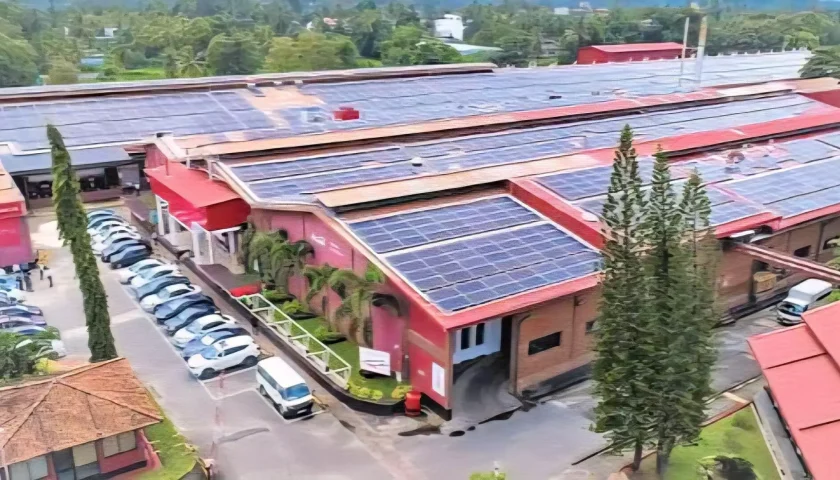
That recalibration has now taken a concrete form. CCBA, operating as part of The Coca-Cola Company, has commissioned a 4-megawatt solar installation across several of its Kenyan bottling facilities, marking one of the most significant clean energy moves by a multinational beverage manufacturer on the continent this year.
The decision was not made in a vacuum. Kenya’s energy market has long been plagued by grid volatility and fossil-fuel-linked price fluctuations that erode operational margins at scale. By deploying rooftop and ground-mounted panels across multiple production sites, CCBA is effectively insulating its Kenyan operations from those pressures while simultaneously locking in a predictable cost curve over the long term. The calculus is industrial as much as it is environmental.
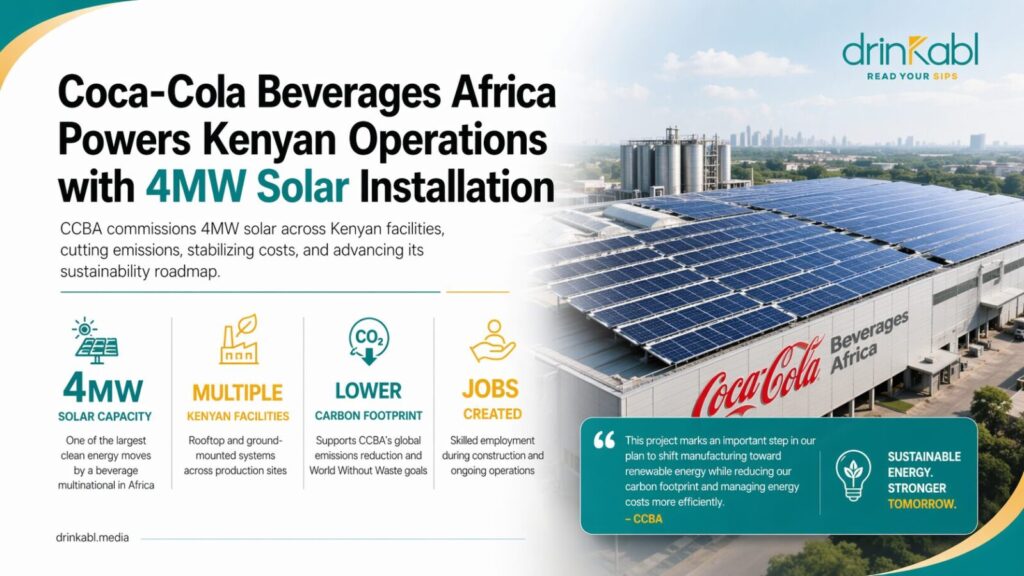
The project anchors directly into CCBA’s global sustainability architecture, including its wider commitment to cutting greenhouse gas emissions and advancing its World Without Waste framework. Kenya’s geography accelerates the return on that investment, as the country’s equatorial solar irradiance provides near-year-round generation capacity that many other markets simply cannot match.
“This project marks an important step in our plan to shift manufacturing toward renewable energy while reducing our carbon footprint and managing energy costs more efficiently,” CCBA stated in announcing the commissioning.
The timing is also politically astute. Kenya’s government has actively pursued private sector participation in its national renewable energy transition, and a 4 MW industrial deployment by a company of CCBA’s scale carries weight beyond its own balance sheet. It signals to smaller regional manufacturers that the economics of solar are no longer aspirational, they are operational.
The installation also produced a tangible social dividend during its construction phase, generating skilled employment, with ongoing operations requiring dedicated maintenance and monitoring personnel at each facility.
More broadly, CCBA’s move reflects a structural shift unfolding across Sub-Saharan Africa, where industrial energy procurement is rapidly decoupling from centralized fossil-heavy grids. As battery storage costs fall and power purchase agreement structures mature in markets like Kenya, the conditions for replication across CCBA’s broader African portfolio are increasingly in place.
For competitors watching from the sidelines, the question is no longer whether to follow, it is how quickly they can close the gap.
Read More