
The Coca-Cola system plans to invest $10 billion in United States infrastructure between 2026 and 2030, backing new and expanded production, distribution and office facilities across the country.
The figure looks bigger than it is at first glance. It covers the whole Coca-Cola system, not Coca-Cola Company’s own capital budget. President and CFO John Murphy told Fortune that the “lion’s share” of the $10 billion belongs to the company’s independent bottling partners, who fund most of the local manufacturing and distribution work.
That distinction sits at the heart of how Coca-Cola runs its business. The company makes concentrates, beverage bases and syrups. Bottlers buy ingredients and packaging, manufacture the finished drinks and get them to retailers. Together, Coca-Cola and its bottlers make up what the company calls the Coca-Cola system. In the US, that system now includes Coca-Cola’s own operations and 61 independent bottling partners.
Projects already announced under the plan span Rancho Cucamonga in California, Colorado Springs, Indianapolis, Birmingham, Coopersville in Michigan, St. Cloud in Minnesota, Orlando and Webster in New York. More are expected before 2030. The Webster project centres on fairlife, Coca-Cola’s dairy brand, where capacity expansions tend to create jobs while equipment upgrades often do not.
Coca-Cola’s own 2026 capital spending is guided at around $2.2 billion, against an expected $14.6 billion in operating cash flow and $12.4 billion in free cash flow. That gap shows why comparing the $10 billion system figure to Coca-Cola’s corporate capex would be misleading.
The investment plan lands alongside a fresh economic-impact study. Coca-Cola commissioned consultancy Steward Redqueen to measure the system’s 2025 footprint in the US, and the results are striking: $85 billion added to US GDP, close to a million jobs supported, $37 billion spent with American suppliers and $177 million put into community programmes. Coca-Cola says 98 cents of every dollar spent on its drinks stays inside the US economy.
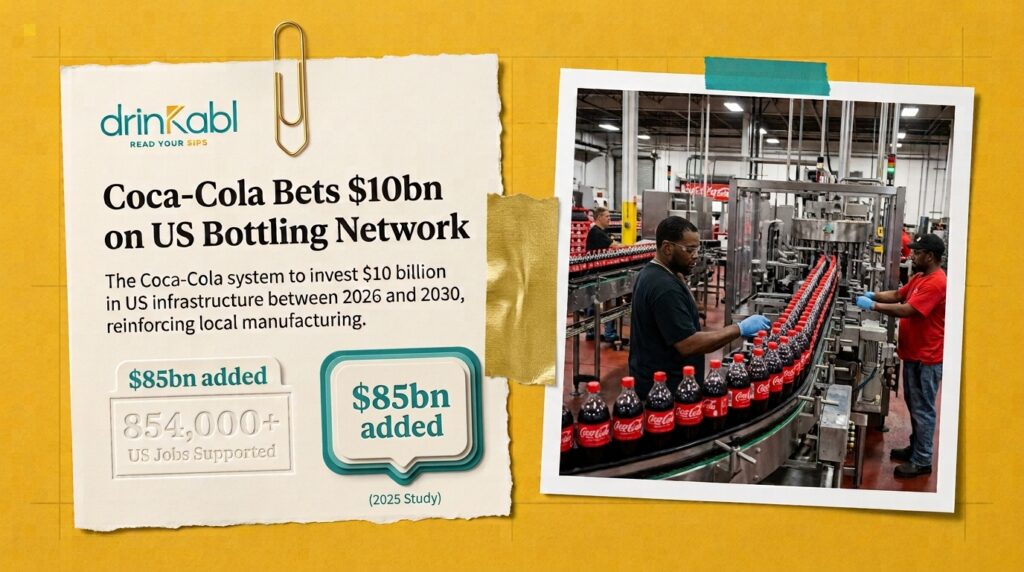
Those numbers come from a study the company paid for, so they should be read as Coca-Cola’s own account of its impact rather than an independent verdict. The first version of this study, covering 2022, put the figure at $57.8 billion and more than 854,000 jobs. The bottler count has also shifted, from 64 then to 61 now, so the jump between the two studies reflects more than growth alone.
The US remains an important market for Coca-Cola, but it is not where most of the company’s volume comes from. US unit cases made up 16 percent of Coca-Cola’s global volume in 2025, with the rest sold abroad. Even so, the company reported a strong second quarter in 2026, with global volume up 5 percent and net revenue up 7 percent to $13.4 billion, prompting Coca-Cola to raise its full-year revenue growth outlook to about 5 percent.
The $10 billion programme is less about Coca-Cola opening new factories of its own and more about strengthening the bottling network that turns its brands into drinks on shelves across America. That network, financed largely by local partners, is what lets Coca-Cola combine a global brand with production and distribution built close to the customer.