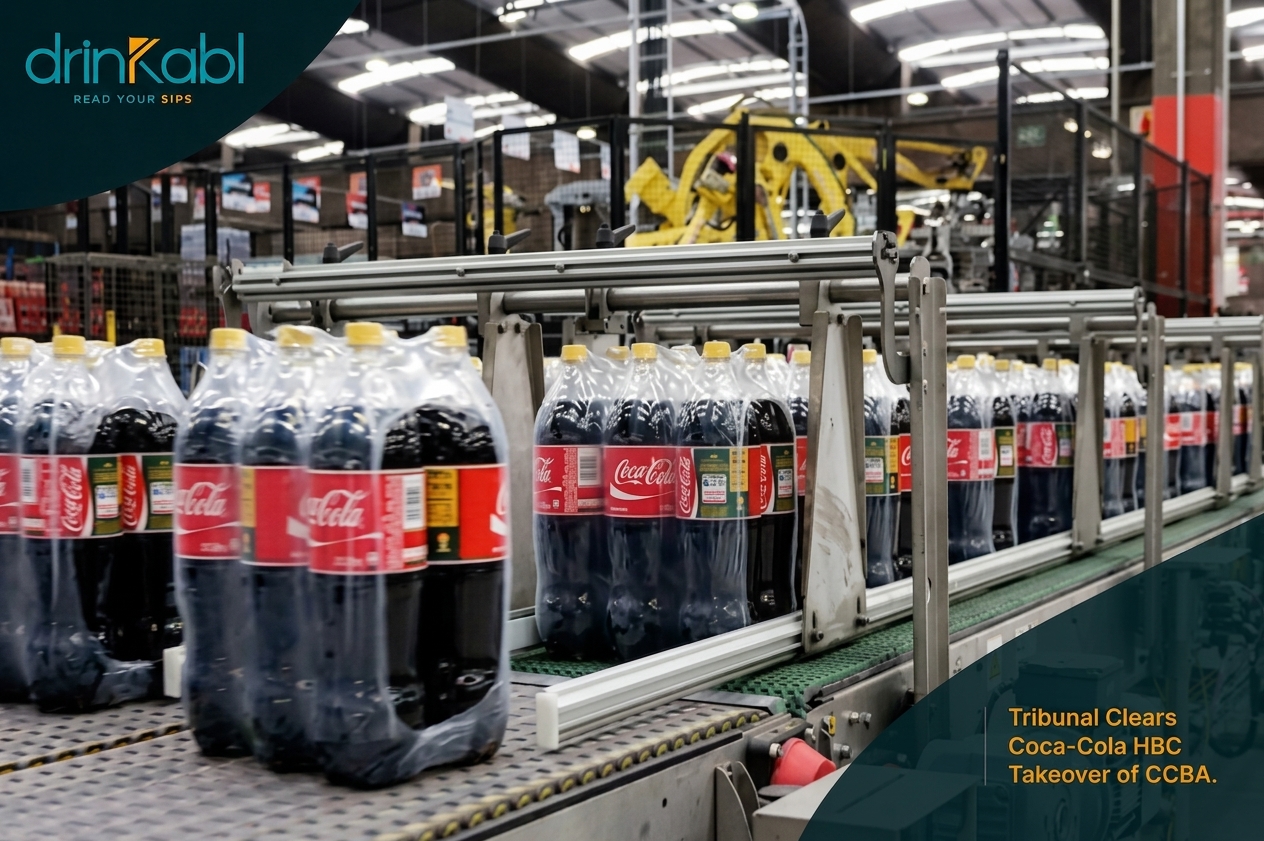

South Africa’s Competition Tribunal has approved Coca-Cola HBC’s purchase of a controlling stake in Coca-Cola Beverages Africa, subject to conditions aimed at public-interest concerns.
The decision, announced on September 11, clears the most important regulatory obstacle in a US$2.6 billion deal for 75% of CCBA, first announced in October 2025. It places one of Africa’s largest beverage distribution networks under a single bottler.
The Tribunal said only that it had approved the transaction subject to conditions addressing “various public interest considerations.” The detailed conditions have not yet been published. That qualification matters, and the hearing showed why.
Alongside the Competition Commission and the merging parties, the Tribunal heard from the National Union of Food, Beverage, Wine, Spirit and Allied Workers, which represents CCBA employees, and from several former Amalgamated Beverage Industries employees who later became owner-drivers under the company’s owner-driver scheme.
So this was never only a question of competition between large beverage companies. Jobs and the treatment of former employees were part of the regulatory test.
What the conditions are likely to cover
The Tribunal has not published its conditions, but the Competition Commission set out much of their shape when it recommended approval in July. The Commission said the deal was unlikely to substantially lessen competition in any market. It added that the parties had agreed to public-interest commitments, including a moratorium on retrenchments in South Africa after the two businesses combine. The Commission declined to say how long that moratorium would run.
The parties also committed to keeping CCBA incorporated and headquartered in South Africa, and Coca-Cola HBC agreed to pursue a secondary inward listing on the Johannesburg Stock Exchange.
A bottling giant changes hands
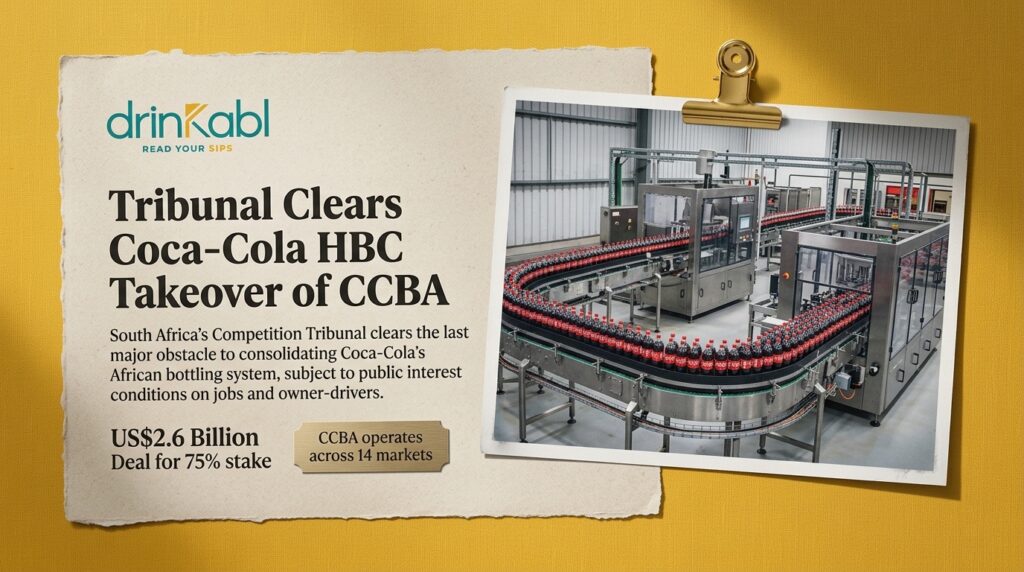
Under the October agreement, Coca-Cola HBC is buying 41.52% of CCBA from The Coca-Cola Company and 33.48% from Gutsche Family Investments, giving it 75%.
The transaction values 100% of CCBA at about US$3.4 billion. Coca-Cola keeps the remaining 25%, with an option arrangement that allows Coca-Cola HBC to buy that stake within six years of closing.
CCBA is Africa’s largest Coca-Cola bottler. It operates across 14 markets, including South Africa, Kenya, Ethiopia, Uganda, Mozambique, Namibia, Tanzania, Botswana, Zambia, Eswatini, Lesotho, Malawi, Comoros and Mayotte. The company says it serves more than 840,000 customers, employs more than 13,000 people and accounts for over 40% of Coca-Cola ready-to-drink volumes sold in Africa.
Coca-Cola HBC is headquartered in Switzerland and listed in London and Athens. It already operates in Nigeria and Egypt. Once the CCBA deal closes, it expects to account for roughly two-thirds of Coca-Cola system volumes in Africa and to reach more than half the continent’s population. That is not simply a change of owner. It is a consolidation of Coca-Cola’s African bottling system.
Why the owner-driver question keeps returning
CCBA was itself built through consolidation. The 2014 merger that brought SABMiller, Coca-Cola and Gutsche bottling assets together came with conditions covering employment, local procurement, small businesses, refrigeration access and owner-driver arrangements.
Former owner-drivers turned up again at this hearing, which suggests the model remains unsettled in the South African business. The issue sits between employment and entrepreneurship. Workers who leave the payroll to run their own distribution routes take on financing, vehicle and operating costs while still depending commercially on the company whose products they carry. When the route economics shift, the risk sits with the driver. Their participation put those questions directly before the Tribunal as part of its public-interest assessment.
The court case behind the caution
Employment conditions in Coca-Cola’s South African bottling business have already been tested at the highest level. In April 2024, the Constitutional Court ruled in a dispute over whether CCBA had breached employment conditions attached to the 2016 bottling merger approval. Those conditions included holding aggregate employee numbers for three years and barring merger-specific retrenchments of bargaining-unit staff.
The Court found the retrenchments were driven by operational requirements rather than the merger, setting aside an earlier Competition Appeal Court decision against the company.
CCBA won, but the case took eight years of regulatory and legal scrutiny to resolve. That history explains why unions and former contractors treat a new set of merger conditions as something worth arguing over now rather than later.
Africa’s bottling map is consolidating
The CCBA decision lands in the same week as another change of ownership in African drinks.
In Kenya, the Competition Authority approved Asahi Group Holdings’ acquisition of Diageo’s 65% stake in East African Breweries, a deal worth about US$2.3 billion. The regulator attached conditions requiring the merged company to reserve at least 20% of the refrigeration space it supplies to retail outlets for beer and cider brands owned by neither EABL nor Asahi, and to set aside funds for outstanding liabilities.
The two transactions are different in shape. Together they point to multinational groups concentrating control around large regional platforms while regulators bargain for access, jobs and shelf space in return.
For The Coca-Cola Company, the sale continues a long retreat from owning bottling assets. Bottling investments fell from 52% of consolidated net revenue in 2015 to 13% in 2024, and the company expects that figure to drop to around 5% after this deal closes.
For Coca-Cola HBC, the logic runs the other way. It is buying scale that would have taken years to assemble market by market, and control of the physical system through which Coca-Cola products are made, moved and sold. The company points to population growth and low per-capita consumption as the long-term case, along with the chance to apply its commercial playbook across a much larger African operation.
What happens next
South African approval is the biggest hurdle, not the last one. Coca-Cola HBC’s original transaction documents listed approvals in South Africa, Botswana, COMESA, Mozambique, Namibia and Tanzania as closing conditions. The company has said it remains on track to complete by the end of 2026 and to proceed with the JSE listing.
The open question is no longer whether the deal happens. It is what the published conditions actually require, and for how long. Until the Tribunal releases them, neither CCBA’s 13,000 employees nor the owner-drivers who argued their case know what they have been given.