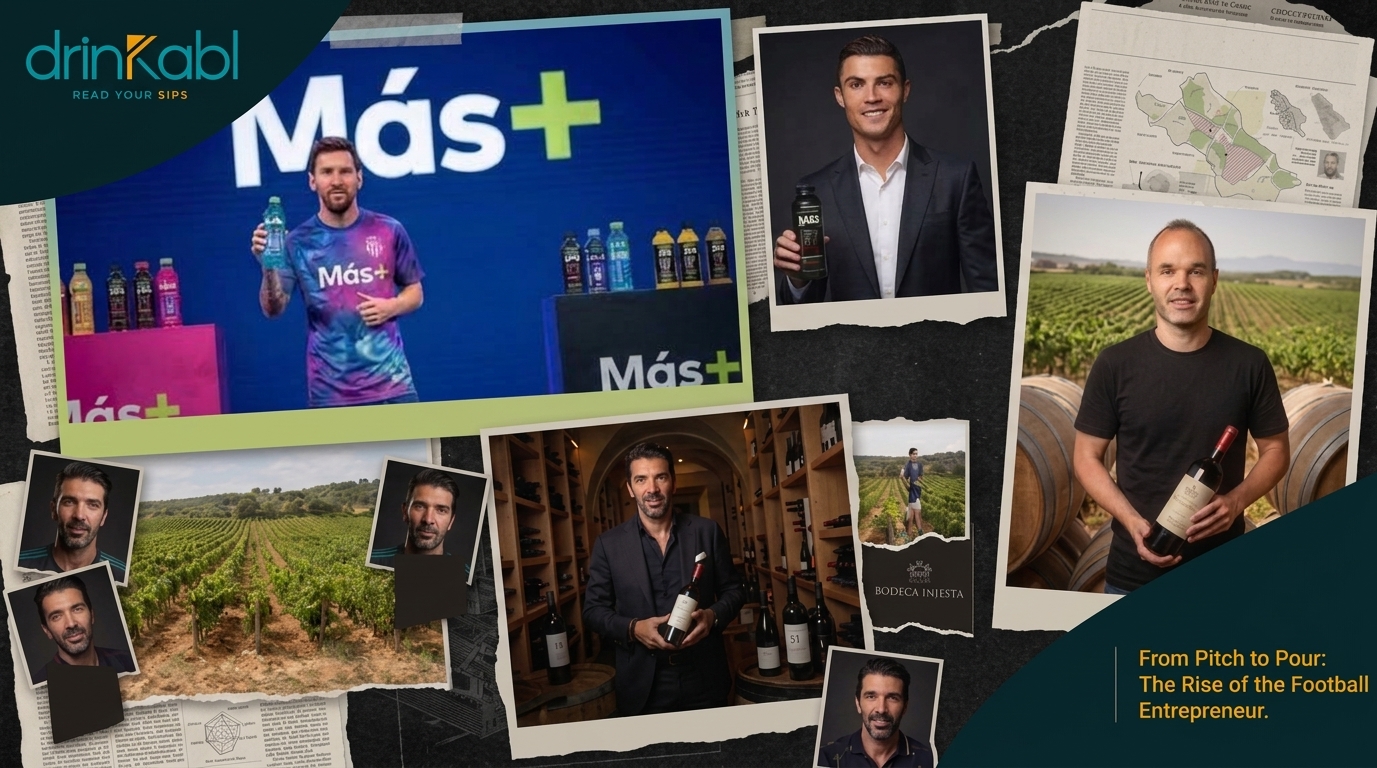

LIONEL MESSI, CRISTIANO RONALDO, ANDRES INIESTA & GIANLUIGI BUFFON
Football’s biggest names are building second careers off the pitch, and for a growing number of them, the next game is being played in the beverage aisle.
For decades, footballers were simply faces on a bottle. Pay a star to hold the product, and sales followed. That model is changing. A widening group of players are no longer content to endorse drinks. They are founding brands, buying vineyards, and taking equity stakes in the businesses behind what people drink.
Not every name on this list owns a beverage company outright. Some are founders, some are investors, and others have partnered with established producers to put their name on an existing label. That distinction, between borrowing fame and building equity, is what makes the story worth telling, and it is the same question shaping how African celebrities and athletes now approach beverage deals: is this an endorsement, or is it ownership?
Lionel Messi: a cautionary tale as much as a case study
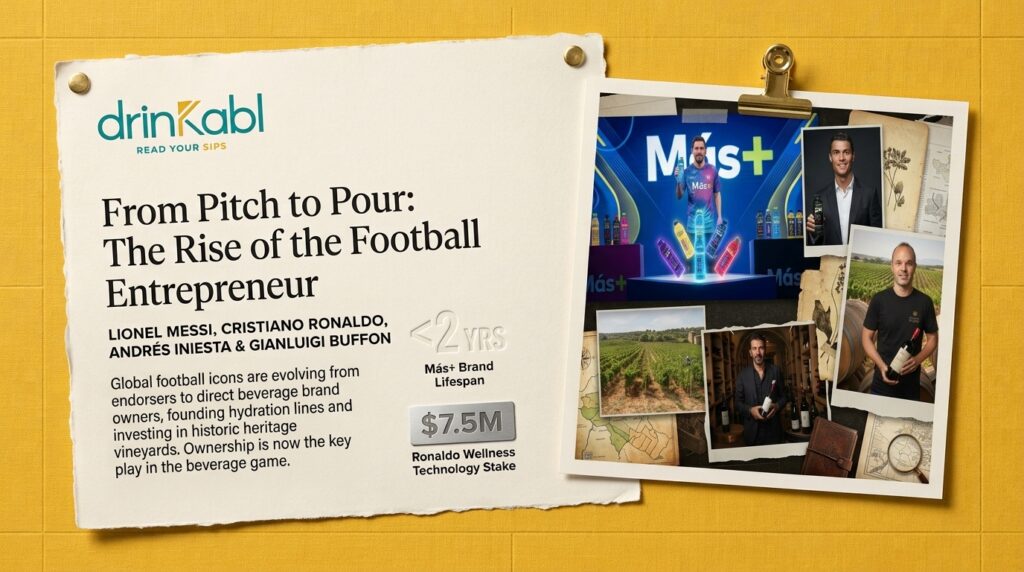
Lionel Messi’s Más+ was meant to be the clearest example of a footballer turning personal brand power into a beverage business. Launched in June 2024 with Mark Anthony Brands, the company behind White Claw, the non-alcoholic hydration drink positioned Messi as a founder, not just a face.
The story has since taken a sharp turn. In January 2026, Mark Anthony Brands confirmed it had quietly phased out Más+, saying the brand “did not achieve all of our objectives” less than two years after its debut. The withdrawal followed a bruising trademark dispute with rival Prime Hydration, and it came despite Messi’s enormous global following, proof that fame alone cannot carry a beverage brand to repeat purchases. For African entrepreneurs weighing celebrity partnerships, Más+’s collapse is arguably the more instructive half of this story than its launch ever was.
Business position: former founder, discontinued brand.
Cristiano Ronaldo: from co-developed drink to tech investor
Cristiano Ronaldo’s route has been different from the start. His decade-long partnership with Herbalife, in place since 2013, produced Herbalife24 CR7 Drive, a hydration product developed for elite competition rather than a company he owns.
In February 2026, that relationship moved into investment territory. Ronaldo put $7.5 million into HBL Pro2col Software, a Herbalife subsidiary building a personalised health and wellness platform, for a 10 percent stake. It is not a beverage acquisition, but it shows his relationship with the nutrition sector stretching well past a licensing deal.
Business position: beverage co-development, plus a strategic stake in related wellness technology.
The wine club: heritage, land, and long-term ownership
Away from sports hydration, a separate group of footballers built their second careers in wine, often years before “celebrity beverage” became a marketing category of its own.
Ronaldo Nazário was an early mover, investing in Bodegas Cepa 21, a winery in Spain’s Ribera del Duero region, a stake that fits naturally with the life he built in Spain after football.
Andrés Iniesta grew up around wine rather than discovering it in retirement. His father planted the family’s first vines in Fuentealbilla in the 1990s, and Iniesta later reinvested his football earnings to expand the estate into one of the largest producers in the Manchuela region, spanning red, white, rosé, and sparkling wines.
Andrea Pirlo bought Pratum Coller in 2007, a winery near his hometown of Flero, outside Brescia, where his father takes an active role in production.
David Silva took a similarly hands-on approach, acquiring Bodegas Tamerán on his native Gran Canaria in 2019. The six-hectare vineyard uses indigenous Canary Islands grape varieties, and Silva has been described as involved through harvest, winemaking, and bottling rather than just lending his name.
David Ginola got there first among this group. Long before celebrity wine was fashionable, the former France winger invested in a Provence vineyard and produced Coste Brulade rosé, which won a silver award at the 2009 International Wine Challenge.
Business position (all five): winery owner or investor, built on land and family rather than a licensing deal.
The collaborative route: lending a name to an established label
A lower-barrier path into the category runs through partnerships with existing wine producers. Eden Hazard entered the business after retirement through Italian producer Fabio Cordella’s “Wine of the Champions” project, with his wine produced in Italy’s Salento region.
Ronaldinho and Gianluigi Buffon are part of the same project, alongside other legends including Cafu. In 2026, Ronaldinho joked that rivals were following his lead, telling Flashscore: “I see that after me, now, everyone wants to make wine. Everyone copies me.” It is a lower-barrier route into beverage entrepreneurship than buying land, but it still turns football fame into a physical product on a shelf. Business position: football-legend wine collaboration.
Why footballers keep choosing drinks
The logic is straightforward. A footballer plays once or twice a week; a fan can buy his drink every day. A playing career lasts a decade or two at most; a beverage business can run for generations. And the entry points have multiplied, spanning hydration, wine, and the wider wellness and functional-drinks space that increasingly overlaps with an athlete’s own lifestyle.
The bigger shift is in who holds the equity. For years, brands paid footballers to borrow their fame. Now some are using that fame to buy into, or build, the businesses themselves. Messi’s model tried to build a beverage around an athlete’s identity and folded within two years. Iniesta and Pirlo represent the opposite model, built on land and family patience rather than a single celebrity launch. Ronaldo shows the relationship extending from product endorsement into equity ownership of the technology around it.
The next time a footballer is pictured holding a drink, the more useful question for anyone watching Africa’s own beverage market may not be what he is drinking. It is how much of the business, if any, he actually owns, and whether that model would survive contact with African retail, distribution, and consumer trust the way Más+ did not.