
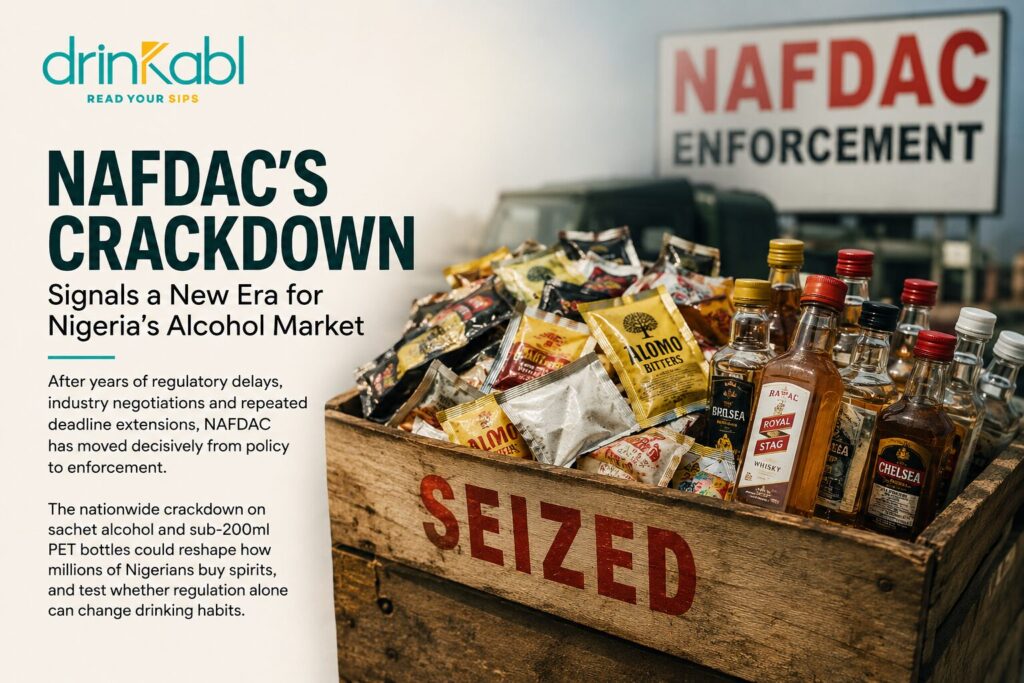
After years of regulatory delays, industry negotiations and repeated deadline extensions, NAFDAC has moved decisively from policy to enforcement. The nationwide crackdown on sachet alcohol and sub-200ml PET bottles could reshape how millions of Nigerians buy spirits, and test whether regulation alone can change drinking habits.
The nationwide seizure of sachet alcohol and sub-200ml PET-bottled spirits is not the beginning of Nigeria’s alcohol packaging reform; it is its moment of truth.
From Transition to Enforcement
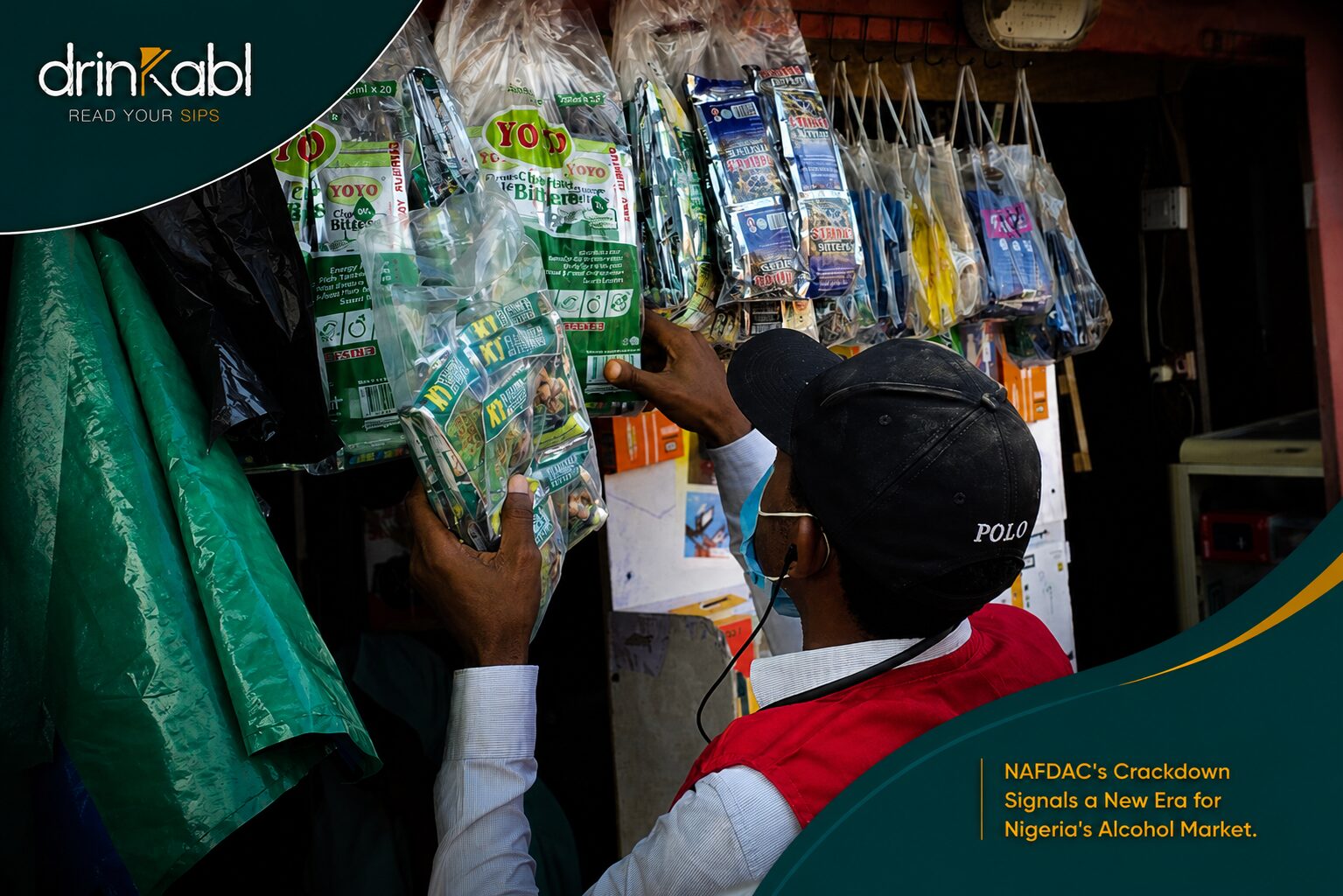
NAFDAC on Wednesday announced the commencement of a nationwide enforcement exercise targeting alcoholic beverages packaged in sachets and polyethene terephthalate (PET) bottles below 200ml, reinforcing the Federal Government’s prohibition on the production, importation, distribution and sale of the affected products.
According to the agency, enforcement teams have been deployed across Nigeria’s six geopolitical zones to remove the products from markets, retail outlets, bars, motor parks and other distribution channels following the closure of manufacturing facilities found to be violating the regulation.
Manufacturers, importers, distributors, wholesalers, retailers, transporters and hawkers have been directed to surrender any remaining inventory voluntarily or face product seizure, regulatory sanctions and possible prosecution.
NAFDAC maintains that the operation forms part of a sustained campaign to reduce underage drinking, harmful alcohol consumption and substance abuse while encouraging responsible drinking among adults.
Importantly, the agency says compliant manufacturers operating within approved packaging thresholds are not the target of the exercise.
Years after regulators, manufacturers and industry groups agreed to phase out the products, the National Agency for Food and Drug Administration and Control (NAFDAC) has shifted decisively from policy to enforcement, setting the stage for what could become Nigeria’s most consequential alcohol market intervention in decades.
For Drinkabl readers, this story has a long trail. We have tracked its evolution from the earliest policy conversations through implementation timelines, industry responses, deadline extensions and regulatory clarifications. This week’s nationwide mop-up answers one lingering question: the ban is no longer theoretical.
It also raises a more consequential one: what comes next for Nigeria’s alcohol market? The answer will determine whether the policy becomes a public health milestone or merely a packaging reform with unintended market consequences.
A Policy Years in the Making
The significance of this week’s enforcement cannot be understood without appreciating the policy’s unusually long gestation. The restriction on sachet alcohol was never designed as an overnight prohibition. It emerged through years of consultations involving NAFDAC, the Federal Ministry of Health and industry stakeholders, who were granted a transition period to phase out affected stock and redesign product portfolios.
Over time, the implementation timeline became one of the most debated regulatory issues in Nigeria’s beverage industry, with deadline extensions, calls for reconsideration and repeated clarifications creating uncertainty over when enforcement would finally begin in earnest.
That uncertainty has now largely disappeared. NAFDAC’s latest operation signals that the agency believes the transition period has effectively ended and that compliance will now be measured through market enforcement rather than voluntary commitments.
The Ban Is No Longer the Story
The policy itself is no longer the most important development. What matters now is how the market responds. For decades, sachet spirits and miniature PET bottles occupied a unique place within Nigeria’s beverage economy. Their popularity was driven less by packaging preference than by affordability, allowing consumers with limited disposable income to purchase alcohol in single-serve quantities. Removing that format fundamentally alters the economics of value spirits.
Consumers who previously bought sachets or miniature bottles now face fewer legal low-cost options. Some are likely to migrate to larger compliant bottles. Others may reduce consumption altogether. The industry’s greatest concern, however, lies elsewhere. If legitimate products disappear from one end of the market without affordable alternatives filling the gap, illicit operators may attempt to satisfy that demand through counterfeit or unregulated alcohol.
Nigeria has spent years combating fake beverages and illicit spirits. The success of the current enforcement campaign will therefore depend not only on removing banned products from circulation but also on preventing illegal substitutes from taking their place.
Winners, Losers and Unanswered Questions
Much of the manufacturing sector has had years to prepare for this transition. Several producers have adjusted packaging strategies, discontinued affected product lines or shifted focus towards compliant formats in anticipation of full enforcement.
Retailers face a more immediate challenge. Neighbourhood kiosks, roadside bars and informal outlets that relied on high-volume sales of low-cost spirits may need to rethink inventory, pricing and product mix as consumer purchasing patterns evolve.
At the same time, compliant manufacturers capable of offering affordable alternatives within approved packaging limits could find themselves competing for a newly reshaped segment of the market.
Whether those alternatives are sufficiently accessible will play a major role in determining consumer behaviour.
Enforcement Is Only Half the Job
NAFDAC has framed the crackdown as a public health intervention designed to protect children and adolescents while promoting responsible alcohol consumption. Those objectives are difficult to dispute.
The more difficult question is whether enforcement alone can deliver them. Packaging restrictions may reduce accessibility and visibility, but lasting behavioural change depends on a broader ecosystem that includes consumer education, responsible retail practices, effective policing of illicit alcohol and sustained regulatory oversight.
Without those complementary measures, enforcement risks becoming a recurring exercise rather than a permanent solution.
The Story Moves Beyond the Ban
This week’s operation closes one chapter in Nigeria’s alcohol regulation journey. It opens another. The industry will now be watching a different set of indicators: consumer migration, retailer adaptation, compliance levels, illicit market activity and the ability of regulators to sustain enforcement across one of Africa’s largest and most fragmented beverage markets.
For years, the conversation centred on whether Nigeria would enforce the sachet alcohol ban. That debate is over. The more important conversation has begun. It is no longer about removing small-format alcohol from the shelves. It is about whether the country’s beverage industry can navigate the transition without creating new risks for consumers, legitimate businesses and the market itself.
Because in the end, the success of this crackdown will not be measured by the number of sachets seized; it will be measured by the kind of alcohol market that emerges after they are gone.