
India’s energy drink category has been expanding at a pace few markets can match. A growing base of young urban consumers, rising disposable incomes in tier-one cities, and a cultural shift toward lifestyle-driven consumption have drawn premium international brands into a market long dominated by domestic and regional players. That pressure has been building for several years, and the window for early-mover advantage is narrowing fast.
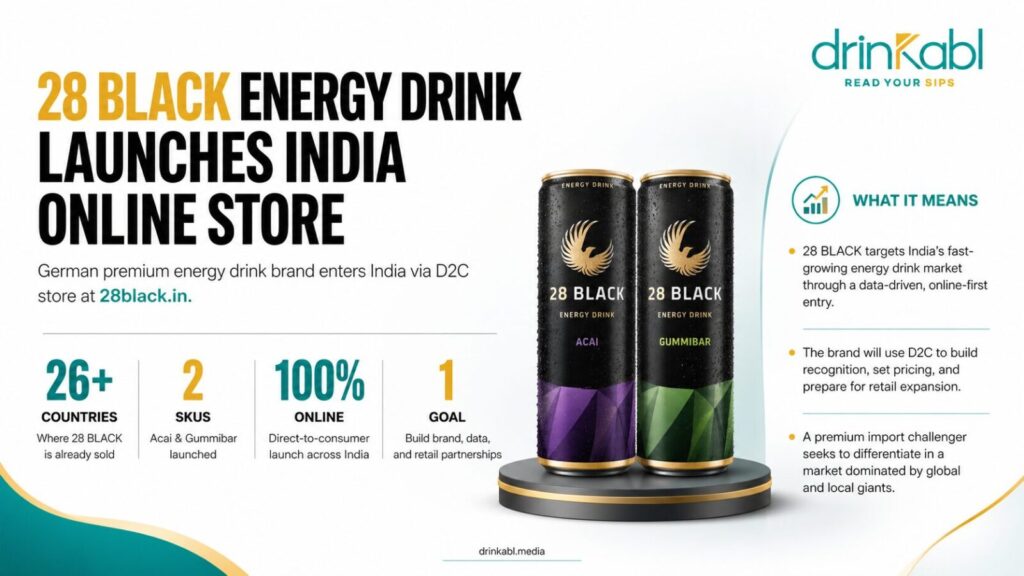
For 28 BLACK, a German premium energy drink brand already sold across 26 countries, the timing of a structured India entry reflects exactly that calculus. The brand has been tracking the market and working to establish a compliant import and retail framework before committing to consumer-facing activity.
On April 28, 28 BLACK officially launched its Indian e-commerce store at 28black.in, making its products available for direct-to-consumer purchase across the country. The launch is operated through Indicart Retail Services Private Limited, with Yinbev Beverages India Pvt. Ltd. serving as the exclusive importer. The two-SKU opening lineup features the brand’s Acai variant, described as a lighter, fruit-forward energy drink, and its Gummibar flavour, a reference to the German gummy bear tradition. Both arrive in the brand’s signature black-and-gold packaging, which has earned the Red Dot Design Award for brand and communication design on multiple occasions.
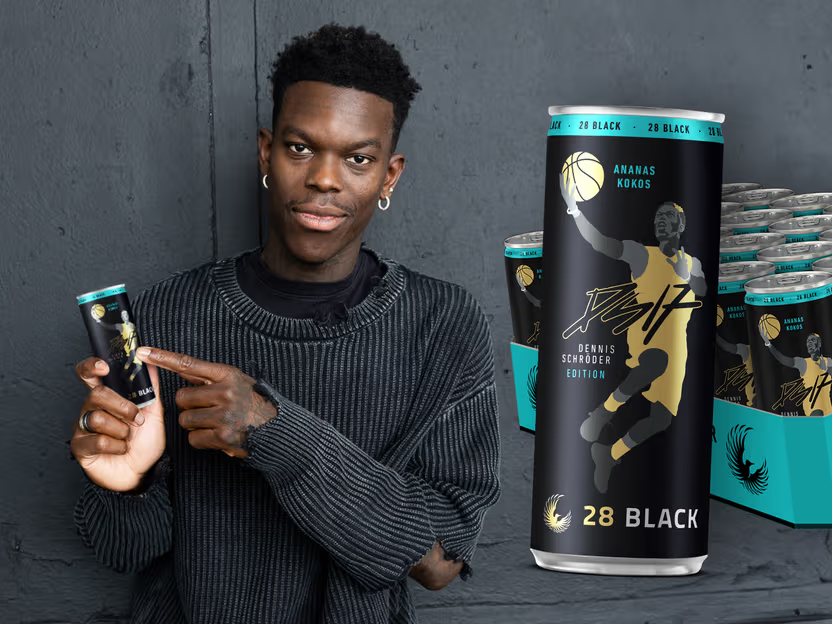
“With an ambitious and young demographic, India is a market full of energy, a perfect match for an energy drink like 28 BLACK,” said Daniel Geuther, CEO of Yinbev Beverages India. “We couldn’t be more excited to finally bring 28 BLACK to the Indian consumers.”
The online-first entry is a deliberate portfolio strategy. Rather than committing immediately to the complex and costly Indian modern trade network, 28 BLACK is using direct-to-consumer e-commerce to build brand recognition, gather consumer data, and establish a pricing baseline before expanding into physical retail. The brand has confirmed it is actively seeking partnerships with supermarkets, convenience stores, cafes, and clubs. The category it is entering is competitive. Red Bull, Monster, and Sting dominate Indian shelf space, and several domestic brands have expanded aggressively in tier-two cities. A premium import brand entering via online retail will need to build significant lifestyle and taste differentiation to earn trial at that price point.
The broader energy drink category across Asia has been one of the fastest-growing beverage segments over the past five years. India’s young population, at a median age below 30, represents a consumer profile that globally correlates with high energy drink affinity. Brands that establish early loyalty in that demographic tend to hold it, which makes the current moment more strategic than it may appear from the outside. As Drinkabl.media has tracked across non-alcoholic beverage coverage, the intersection of lifestyle identity and product premiumisation is reshaping which brands consumers adopt and retain. The hydration funding boom and the entry of celebrity-backed energy brands have raised the baseline for what a premium launch now requires in terms of storytelling and consumer education.
For 28 BLACK, the next phase will be physical distribution. The brand’s ability to convert online early adopters into a broader retail footprint will determine whether its India presence becomes a genuine market position or remains a niche import play. If the offline expansion follows quickly and the brand invests in experiential marketing, its European design identity and distinct flavour profile could carve real space in a market where differentiation remains commercially viable. The research on how youthful demographics are reshaping beverage consumption across emerging markets reinforces that the window for premium positioning in these economies is open, but it will not stay that way indefinitely.
Read More
Starbucks integrates AI to reshape how customers discover drinks.
Nestlé and the ILO partner to address labour conditions in coffee supply chains.
Japan’s vending machine drink sector contracts as inflation reshapes consumer behaviour.
Alcohol-free beer is no longer the odd one out in premium retail.