
Energy drink consumption among teenagers in Quebec has been climbing steadily, and the adults responsible for their wellbeing have run out of patience. School administrations sounded the alarm first, but by Tuesday, the call for a legislative ban had spread across the province’s sporting infrastructure, drawing in federations, physical education bodies, and public health associations whose combined membership exceeds one million young people.
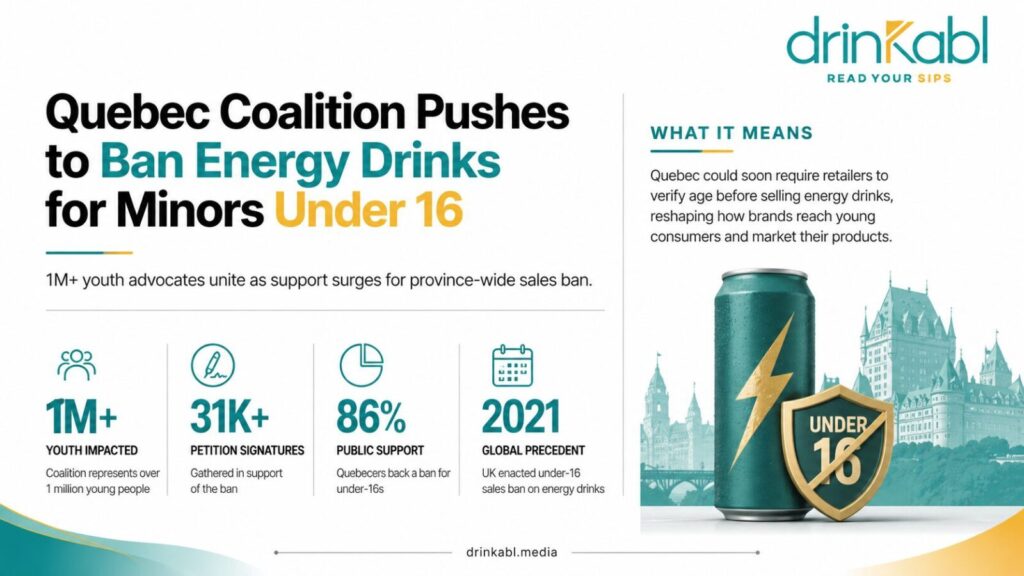
Sports Québec, the umbrella body for 67 provincial sports federations, joined the Zachary Miron Movement on April 29 alongside the Réseau du sport étudiant du Québec and the Quebec Maritimes Junior Hockey League. The M18 AAA Hockey Development League, the Quebec Federation of Physical Education Teachers, the Filleactive organization, the Alliance Sport-Études, and the Aléo Foundation all signed on as well. The Quebec Federation of Kinesiologists, the Collectif Vital, and the Quebec Public Health Association rounded out a coalition that now stretches well beyond education into sport, healthcare, and civic advocacy.
The movement takes its name from Zachary Miron, who died at 15 during a school ski trip after consuming a Red Bull that, combined with his ADHD medication, triggered a cardiac arrhythmia. His parents have been pressing the Quebec National Assembly for age restrictions on energy drink sales ever since, and their petition has gathered more than 31,000 signatures.
The energy drink category has operated with relatively light restrictions globally despite its well-documented risks to younger consumers. In Canada, the Canadian Beverage Association has maintained that its members’ products comply with Health Canada’s caffeine limits, which currently cap the amount permitted in energy drinks sold domestically. The category has been sold commercially worldwide for more than three decades and generates significant retail volume, making legislative intervention commercially contentious.
Yet the political arithmetic in Quebec is shifting. Quebec Solidaire MNA Guillaume Cliche-Rivard cited survey data showing 86 per cent of Quebecers support a sales ban for those under 16. He pressed Health Minister Sonia Bélanger to move from listening to legislating. “Quebec Solidaire is ready to collaborate to quickly pass a law regulating the sale and distribution of energy drinks to those under 16,” he said on Tuesday.
The implications for the energy drink market extend beyond one province. Quebec’s action mirrors regulatory moves seen in the United Kingdom, where a ban on energy drink sales to under-16s came into force in 2021, and echoes ongoing debates in several other jurisdictions. Producers who rely on youth-adjacent marketing, particularly those linking their brands to sport and athletic performance, face a specific challenge here. Sports Québec executive director Isabelle Ducharme put the product’s appeal among teenagers plainly: young athletes believe energy drinks will help them run longer, stay on the ice longer, and perform more sharply, when the evidence consistently points to sleep, nutrition, and disciplined training as the actual performance variables.
The global energy drink market, valued at roughly $87 billion, has been expanding into premium and functional positioning even as regulatory headwinds build. Brands targeting active consumers are already pivoting away from high-caffeine formulas toward alternative stimulants and cleaner-label profiles. Coverage of how health and youth consumption trends are reshaping product strategy has become a defining theme across beverage markets in 2026, and Quebec’s coalition is adding institutional force to that conversation.
Collège de Montréal executive director Patricia Steben captured the shift in her Tuesday statement. “We are no longer just a few school administrations,” she said. “Until regulations are officially amended to protect our youth, our movement will continue to grow.”
Quebec’s health minister has acknowledged the campaign. If legislation follows, retailers would be required to verify age at point of sale before stocking energy drinks, a compliance burden that would reshape shelf placement, checkout display, and convenience retail strategy across the province. Producers without a credible non-stimulant alternative range would find their teen-facing product lines restricted overnight. The petition at the National Assembly continues to collect signatures as the coalition builds pressure for a formal legislative response before the end of the current parliamentary session.
Read More
Starbucks integrates artificial intelligence into how customers discover drinks, a sign of how beverage brands are rethinking consumer engagement.
Uganda’s tea sector continues pressing its government for a promised bailout as price recovery stalls.
Nigeria’s first craft brewery charts its course through a mass-market landscape to build a global name.