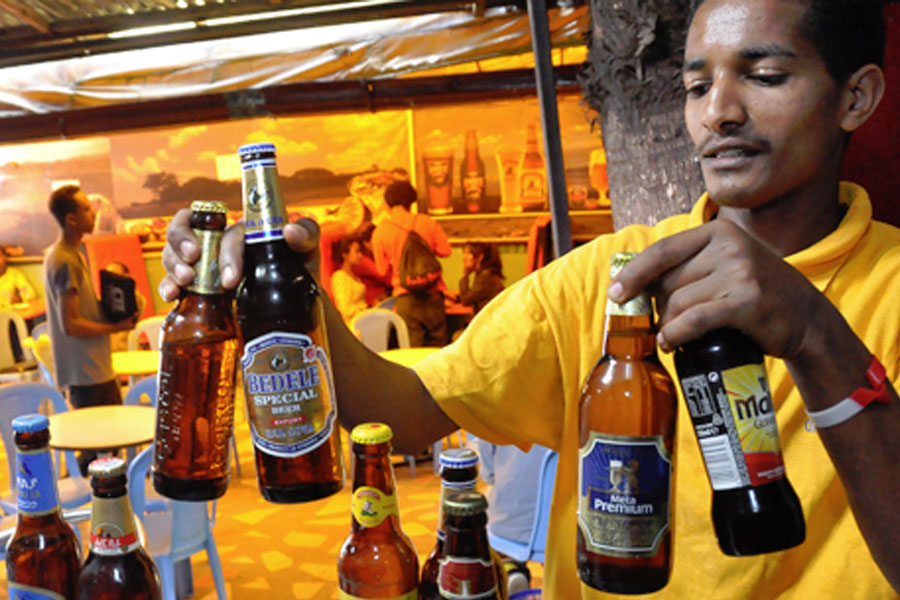

Ethiopia’s beer market is valued at USD 3.8 billion in 2025 and projected to reach USD 5.1 billion by 2030, a 6.02% CAGR that looks credible on paper and increasingly strained in practice. Six brewers now operate 14 plants with 18 million hectolitres of installed capacity. Actual output sits at roughly 11 million hectolitres.
That gap between capacity and production is not a logistics problem. It is a demand signal. Consumers across urban and rural markets are cutting frequency, trading down within existing portfolios, or exiting beer entirely for locally produced spirits and traditional beverages that offer lower price points and higher alcohol content per birr spent.
The cost shocks arrived in sequence. Ethiopia suspended fuel subsidies as of June 2025, aligning domestic pump prices with global market rates and pushing distribution costs sharply higher. Habesha Breweries reported distribution costs of ETB 838 million in 2024, equivalent to 10.8% of revenue, with fuel subsidy removal identified as a primary driver. For smaller brewers and independent distributors working thinner margins, the exposure is proportionally worse.
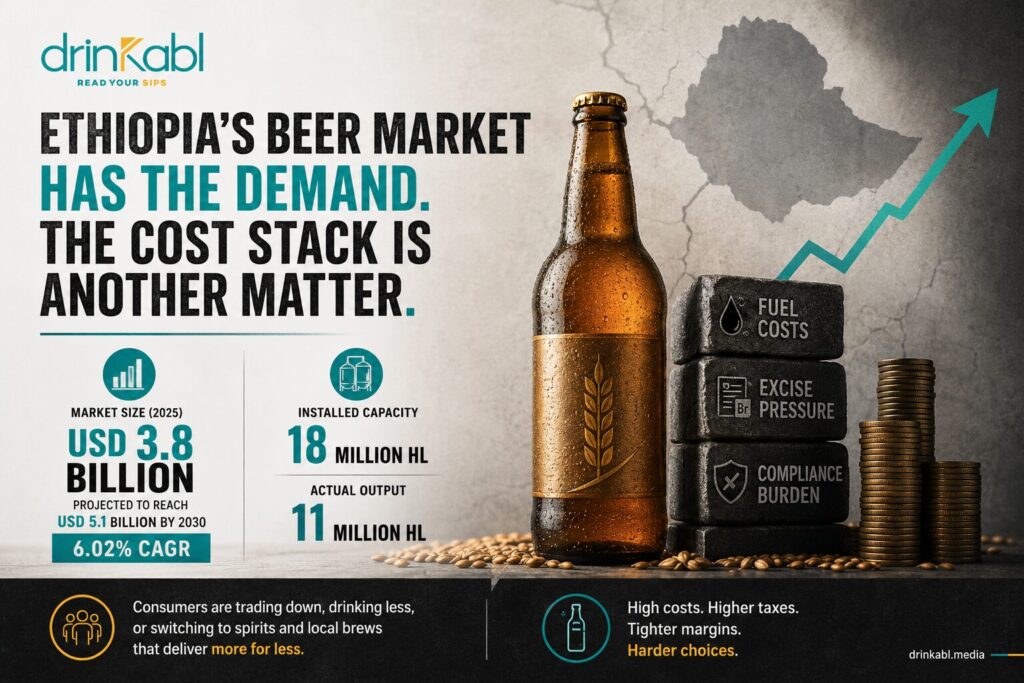
Excise pressure is the second layer. As of March 2025, malt beer carries an excise burden of 40% or ETB 28 per litre, whichever is higher, up from ETB 11 per litre under the previous rate. In a market where retail prices generally stay below USD 1 per bottle, that rate already compresses margins to the point where volume is the only viable defence. The IMF confirmed in its January 2026 country report that Ethiopia plans further excise rate increases on alcohol in line with accumulated inflation, alongside the full rollout of a digital excise stamp system that was targeted for completion by March 2026. Brewers are now carrying the cost of compliance on top of higher rates.
The competitive picture has shifted alongside the regulatory one. Diageo, which paid USD 225 million for the Meta Abo brewery in 2012, exited Ethiopia entirely in 2022, selling the asset to BGI/Castel for a reportedly symbolic price after failing to meet its commercial targets. That left Heineken and Castel/BGI as the dominant duopoly, with Dashen, Habesha, and United Beverages competing for the remaining share. Into that structure stepped Kegna Beverages, backed by the Oromia state government and the Development Bank of Ethiopia, which launched its flagship Kegna Premium Lager on 14 June 2025 with a USD 250 million investment and a 3 million hectolitre brewery in Ginchi. Kegna plans to double capacity to 6 million hectolitres within four years.
The addition of 3 million hl in capacity to a sector already running at roughly 60% utilisation raises questions the launch did not answer. Kegna brews with domestic barley, which qualifies for a lower excise rate of 35% or ETB 23 per litre. That structural advantage matters at current price points. Whether it is sufficient to build distribution reach against two incumbents with decades of channel depth across Addis Ababa and the regions is a different calculation.
Drinkabl.media’s reporting on Tanzania’s brewing sector found a similar pattern at work across East Africa: headline volume growth masking a generational shift in consumption behaviour, with younger consumers compressing frequency and concentrating spending on formats incumbents are slow to stock. Ethiopia’s urban consumer base is following a comparable trajectory, with flavoured variants, low-alcohol lines, and non-alcoholic malt products all attracting pipeline investment from established brewers looking to defend share without destroying margins.
The IMF projects Ethiopia’s GDP growth at 6.6% for 2025/26, more conservative than the government’s own 8.9% forecast. Household purchasing power has been eroded by inflation that peaked above 30% between 2022 and 2023, and although the headline rate had eased to 13.9% by June 2025, real incomes in urban areas remain under pressure. Brewers entering or expanding in this market are betting on long-term demographic weight, a population above 120 million with a notably young age structure, against a medium-term affordability constraint that shows no clear resolution.
The next pressure point is the excise stamp rollout. If enforcement is applied uniformly and rates rise further as the IMF and Ministry of Finance have indicated, the cost structure for every brewer in Ethiopia gets harder. Brands competing on volume at sub-dollar retail prices have limited room to absorb both.
READ MORE