

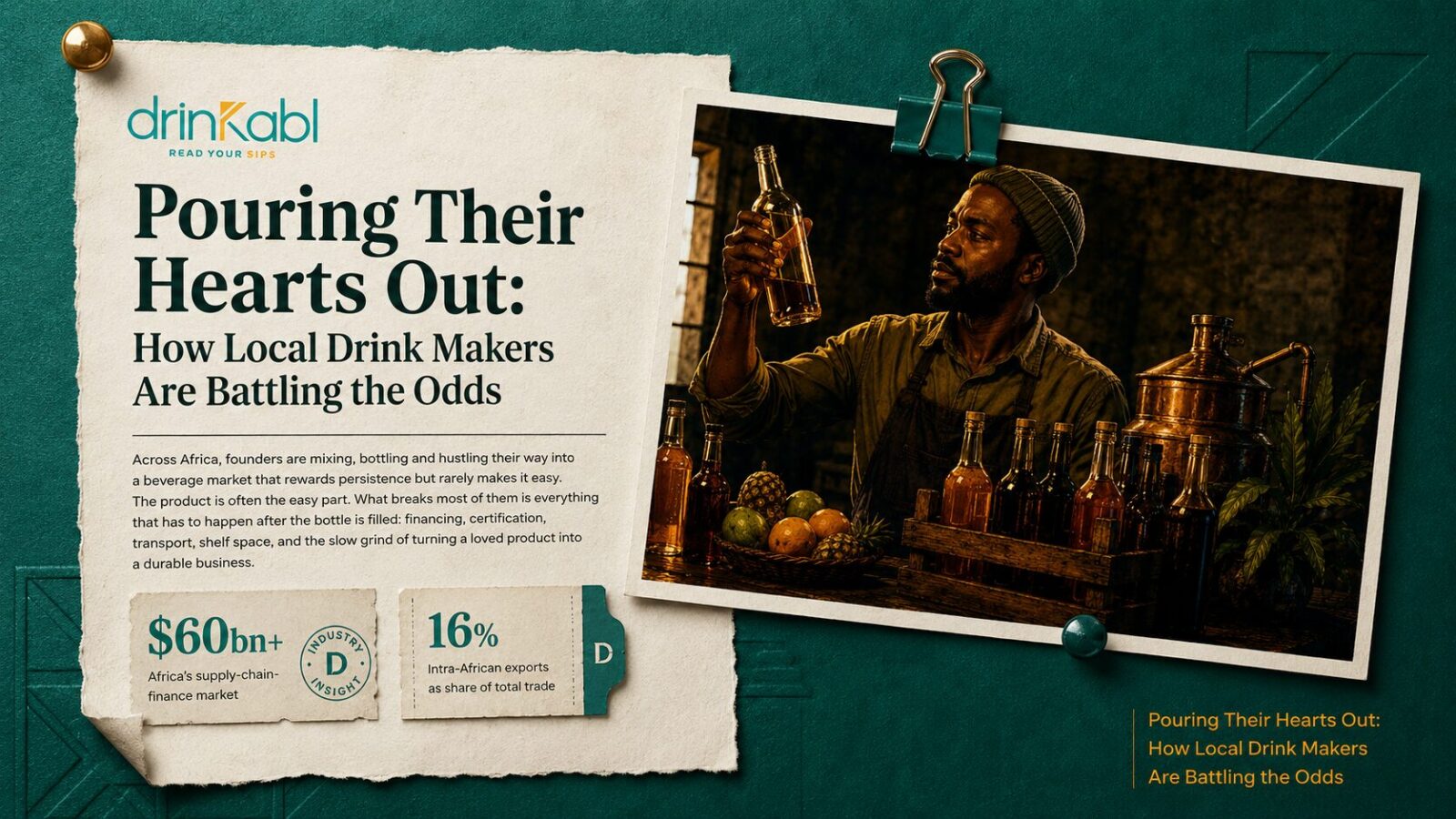
Across Africa, founders are mixing, bottling and hustling their way into a beverage market that rewards persistence but rarely makes it easy. The product is often the easy part. What breaks most of them is everything that has to happen after the bottle is filled: financing, certification, transport, shelf space, and the slow grind of turning a loved product into a durable business.
Industry leaders at Drinkabl Africa’s New Pour Summit in July named financing, regulation and skills development as the barriers holding back the continent’s beverage sector, alongside the need to adapt to changing consumers and speed up innovation. The struggle is rarely about the drink itself. It is about the system a small founder must build alone to keep it alive.
Money runs out before the market pays back
A beverage business can burn through cash long before it earns any back, covering ingredients, packaging, testing, warehousing and transport before a single retailer settles up. Africa’s supply-chain-finance market exceeds $60 billion, yet only 7% to 25% of demand is currently met, according to UN Trade and Development research spanning 31 countries. For a small producer, even good news can sting: a supermarket order bigger than anything made before still has to be paid for in materials and production before the cheque arrives, meaning growth itself can trigger a cash crunch.
Making a good batch is not the same as scaling one
The founder who nails a small batch often discovers that commercial volume asks harder questions: shelf life, quality control, food safety, equipment reliability. Big manufacturers spread those tasks across specialist teams. For most local drink makers, they all sit on one desk, handled by one exhausted person doing five jobs before lunch.
Regulation and bad roads add their own tax
Regulation exists for good reason, but what actually wears founders down is unpredictability, not the rules themselves. Add unreliable power, costly transport and patchy cold-chain access, and every naira, cedi or shilling of that cost lands on the business long before a consumer ever tastes the drink. A multinational spreads that shock across enormous volume. A small producer has nowhere to hide it.
This is the trap known as the missing middle: too big to stay informal, too small to command the financing or shelf terms of an established brand. Even a great product fails quietly if it cannot reach enough outlets, often enough, at a price that still leaves something behind. The regional picture makes it harder still, with intra-African exports making up just 16% of the continent’s total trade, so “Africa is a huge market” means little without a route, a regulator and a cost structure attached to it.
What would actually help
No single fund fixes this. Lenders can design financing around working-capital cycles instead of demanding conventional collateral. Governments can make compliance simpler to navigate. Bigger beverage companies and industry bodies can hand down the manufacturing and distribution know-how that smaller founders are often left to learn the hard way.
The continent is not short on people willing to pour their hearts into a drink. What is often missing is the ecosystem strong enough to catch them when the scaling gets hard.
READ MORE